
Revolutionizing Advanced Ceramics: Synteris’s Shrink-Free SLRS 3D Printing for High-Performance Applications in Energy and Defense
3D printing, also known as additive manufacturing, continues to transform numerous industries with its unparalleled ability to create intricate, customized geometries from a diverse range of materials. Among these groundbreaking advancements, ceramics have emerged as an exceptionally attractive option. These materials boast a unique combination of properties, including remarkably high wear resistance, superior thermal stability, and excellent corrosion resistance, making them ideal for the most demanding environments. Within the vast field of ceramics, carbide and nitride compounds are particularly distinguished for their outstanding performance, pushing the boundaries of what is possible in extreme applications.
The integration of these advanced ceramics into the realm of 3D printing represents a significant leap forward. This fusion not only broadens the horizons of industrial manufacturing capabilities but also unlocks a world of possibilities for cutting-edge sectors such as energy, aerospace, and defense. These industries critically rely on materials that can withstand severe conditions, from extreme temperatures and pressures to corrosive agents and mechanical stresses. Recognizing this crucial need, Synteris, an innovative startup, has developed its proprietary additive manufacturing technology specifically designed to optimize the creation of parts using these high-performance carbide and nitride materials. To delve deeper into this exciting development, we had the opportunity to speak with one of its visionary co-founders, Ken Malone.
The Visionaries Behind Synteris: Ken Malone’s Journey in 3D Printing
During our conversation, Ken Malone, who serves as the Board Chair of Materic and a co-founder of Synteris, shared insights into his extensive background and deep connection with the evolving landscape of 3D printing. Trained as a polymer scientist, Malone dedicated the early stages of his professional career to global polymer and specialty chemical companies. His responsibilities during this period were broad and impactful, encompassing manufacturing operations, technical support, strategic marketing, business management, and vital merger and acquisition activities. This comprehensive experience provided him with a robust foundation in material science and industrial processes.
Transitioning to academic leadership in the mid-point of his career, Malone took on responsibilities in technology transfer, a role that further honed his ability to bridge the gap between scientific discovery and commercial application. This unique blend of expertise in polymers and university innovation proved to be a powerful catalyst. It inspired him to co-found a series of companies dedicated to the custom manufacture of advanced materials, primarily based on intellectual property licensed from leading universities. This entrepreneurial journey has seen him involved in diverse ventures within additive manufacturing, including companies specializing in 3D bioprinting, 3D printing of oxide ceramics, operating a commodity 3D print shop, and, of course, Synteris. His varied experience underscores a profound commitment to leveraging cutting-edge material science for industrial advancement.
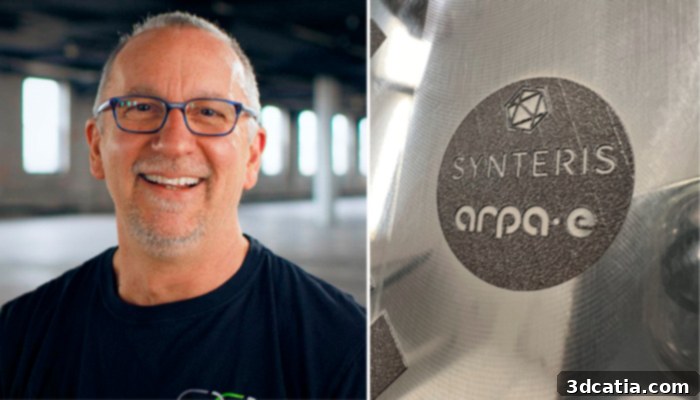
Ken Malone, co-founder of Synteris
Synteris: A Materic Subsidiary Driving Innovation in Advanced Materials
Synteris operates as a forward-thinking subsidiary of Materic, a company renowned for its custom manufacturing of advanced materials across several high-tech domains. Materic’s expertise spans 3D printing, nanomaterials, functional inks, technical textiles, and control release technologies, making it a pivotal player in the advanced materials landscape. The genesis of Synteris was rooted in a strategic decision to license and commercialize a groundbreaking invention by Adam Peters et al. from Johns Hopkins University. The management team at Materic astutely recognized that Peters’ invention held substantial synergy with their existing 3D printing developments, presenting a unique opportunity to expand their capabilities and market reach in advanced ceramics. This strategic alignment positioned Synteris to become a leader in the additive manufacturing of high-performance materials.
Unveiling Selective Laser Reaction Sintering (SLRS) Technology
A Game-Changing Process: No Shrinkage, No Post-Processing
One of the most remarkable aspects of Synteris’s Selective Laser Reaction Sintering (SLRS) technology is its ability to produce ceramic parts that require no post-processing and exhibit absolutely no change in the volume of the printed part. This zero-shrinkage characteristic is a monumental achievement in ceramic additive manufacturing, as traditional ceramic processes are notorious for significant material shrinkage during sintering, often necessitating complex post-processing steps and careful design compensation. SLRS technology bypasses these challenges, delivering precise, net-shape parts directly from the printer. The process is capable of manufacturing components from an impressive array of high-performance ceramic materials, including Silicon Carbide (SiC), Silicon Nitride (Si3N4), Aluminum Nitride (AlN), Hafnium Carbide (HfC), Zirconium Carbide (ZrC), Titanium Carbide (TiC), Hafnium Nitride (HfN), Zirconium Nitride (ZrN), Titanium Nitride (TiN), Tantalum Carbide (TaC), and Tantalum Nitride (TaN). These materials are critical for applications demanding extreme hardness, heat resistance, and chemical inertness.
The underlying principle of SLRS is conceptually elegant yet technically sophisticated. The process involves introducing a reactive gas, such as methane, into the printing chamber. Simultaneously, a laser selectively fuses a metal or metalloid powder, like silicon. The critical innovation lies in the *in-situ* reaction: as the laser melts the metal/metalloid, it reacts with the surrounding gas to form the desired metal carbide or nitride. For instance, silicon reacting with methane results in Silicon Carbide (SiC). By carefully formulating the initial powder mixture and precisely controlling the gas composition within the chamber, Synteris can achieve net-shape printing of complex metal carbide and metal matrix composites with full density. This direct reaction mechanism is key to eliminating shrinkage, as the material is formed in its final state rather than densifying and shrinking from a porous green body.
To illustrate this profound advantage from a less technical standpoint, consider a common experience: a pottery class where you might have crafted a large coffee mug. After being placed in a high-temperature kiln for firing, that mug would emerge noticeably smaller, often reduced by as much as a third of its original size. This reduction in volume, known as shrinkage, is an inherent characteristic of virtually all traditional ceramic manufacturing processes. It’s a challenge that engineers and designers constantly grapple with, requiring them to oversize initial designs to account for the expected contraction. Synteris’s SLRS technology completely circumvents this issue. We are currently the only method available that can produce complex ceramic parts at full density without any accompanying shrinkage. This unique capability saves time, reduces material waste, and opens up new design freedoms previously unattainable in ceramic additive manufacturing.
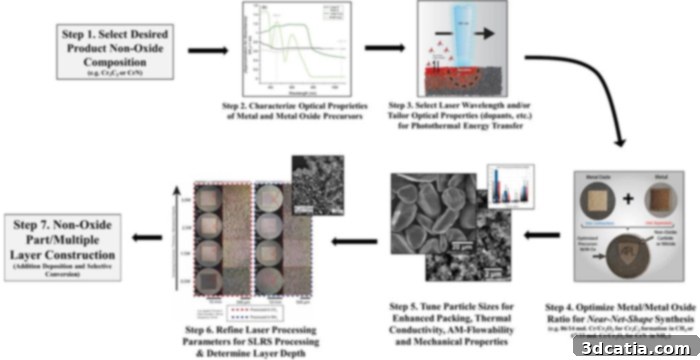
Explaining the SRLS process
Pioneering Applications: Energy, Defense, and Beyond
The advanced ceramic parts produced by Synteris’s SLRS technology are specifically designed to meet the rigorous demands of critical industries. Energy, defense, and industrial sectors represent the primary target markets where Synteris has already demonstrated its capabilities by printing essential components. These applications are incredibly diverse, ranging from structural elements within high-performance rockets and critical parts for modular nuclear reactors to specialized components for advanced power electronics. While these market applications appear disparate on the surface, they share a fundamental commonality: an urgent need for high-temperature resistant materials capable of being formed into complex geometries with exceptional precision and durability. The unique properties of carbides and nitrides, coupled with the precision and design freedom of SLRS 3D printing, make them indispensable for these cutting-edge uses.
In the energy sector, for instance, components for advanced nuclear reactors require materials that can endure extreme radiation and temperatures for extended periods, where traditional metals might fail. Similarly, rocket propulsion systems demand lightweight, incredibly strong, and heat-resistant parts for nozzles, combustion chambers, and other critical areas to maximize efficiency and safety. In defense, Synteris’s technology can create bespoke components for aerospace applications, advanced armaments, and protective systems where material integrity under duress is paramount. For industrial applications, the superior wear and corrosion resistance of these ceramics translate into longer-lasting parts for machinery, tools, and processing equipment operating in harsh chemical or abrasive environments, leading to reduced downtime and maintenance costs. The ability to produce these parts without shrinkage further enhances their reliability and performance, ensuring that components fit and function exactly as designed from the outset.
The Future Landscape of 3D Printing and Synteris’s Role
Ken Malone also shared his forward-looking perspective on the future trajectory of 3D printing over the next decade. He observes that the industry has largely transitioned from its nascent “new tech” phase, characterized by a proliferation of new companies chasing novel ideas annually, into a more mature consolidation phase. The current focus is increasingly shifting towards enhancing manufacturing efficiency, achieving economies of scale, and integrating additive manufacturing more seamlessly into established production workflows. However, Malone emphasizes that this consolidation doesn’t signify an end to innovation. There remain exciting and vital areas within 3D printing that will continue to foster new technological developments and new market entrants, especially in specialized niches. Among these, the field of advanced ceramics stands out as a prime example, where companies like Synteris are poised to launch and introduce fresh, disruptive ideas to the market, challenging existing paradigms and pushing material science boundaries.
Looking specifically at Synteris, Malone anticipates that their SLRS technology will be well-established within the next ten years. However, he prudently notes that markets such as energy and defense typically exhibit a slower adoption curve. This cautious approach is understandable and, indeed, necessary; these sectors rightly demand rigorous testing and validation to establish robust safety performance and reliability of parts before they can be widely commercialized. Given these stringent requirements, Malone suggests that in ten years, Synteris will likely be transitioning into receiving routine manufacturing orders for its unique ceramic components. While the company would naturally prefer a faster pace of adoption, he acknowledges that the primary rate-limiting step will be customer integration and acceptance of new, critical technologies, rather than the readiness or capability of the technology itself. This highlights the importance of continued collaboration, testing, and trust-building within these high-stakes industries.
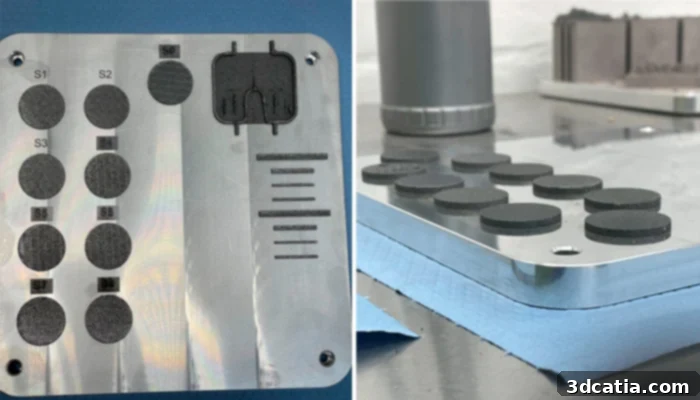
Synteris technology is particularly used in the energy, defense and industrial sectors.
Conclusion: Embracing Complex Projects with Synteris
Synteris stands ready to tackle complex projects involving high-performance metal carbide or metal matrix composites, offering solutions that overcome traditional manufacturing limitations. Their unique SLRS technology promises unparalleled precision, full density, and crucially, zero shrinkage, paving the way for revolutionary applications in sectors where material integrity is paramount. If your organization is grappling with the challenges of demanding environments and requires components with exceptional thermal, wear, or corrosion resistance, Synteris invites you to explore their capabilities. You can reach out to them directly or find more detailed information regarding their innovative technology and services on their official website here.
What are your thoughts on the groundbreaking technology developed by Synteris and its potential impact on advanced manufacturing? Let us know your insights and questions in a comment below or engage with us on our LinkedIn, Facebook, and Twitter pages! Don’t miss out on the latest advancements and news in the 3D printing world; be sure to sign up for our free weekly newsletter here to receive updates straight to your inbox! For a visual experience of additive manufacturing innovations, you can also find all our compelling videos on our YouTube channel.
*All Photo Credits: Synteris