
Revolutionizing Surgical Planning: The Exploding Market for 3D Printed Anatomical Models
The landscape of modern medicine is undergoing a profound transformation, largely driven by advancements in additive manufacturing. A recent comprehensive study published by Brandessence Market Research and Consulting shines a spotlight on the burgeoning market for 3D printed surgical models, revealing an impressive trajectory of growth. This vital report projects that the market is set to soar past the one-billion-dollar mark by 2025, demonstrating a robust annual growth rate of 10.57% since 2018. These compelling figures are not merely statistics; they underscore the pivotal role that 3D printing technologies are increasingly playing within the broader medical sector. Specifically, 3D printing offers unparalleled capabilities for crafting bespoke medical devices and highly realistic anatomical models that are precisely tailored to the unique physiological requirements of each individual patient. This level of customization, previously unattainable with traditional manufacturing methods, brings with it a multitude of benefits for healthcare professionals. Physicians can leverage these sophisticated models for enhanced pre-operative planning, to create concrete and realistic training materials for medical students and residents, and crucially, to significantly mitigate the risk of error during complex and delicate surgical procedures. The implications for patient safety and surgical outcomes are immense, heralding a new era of precision medicine.
The concept of customization holds particular resonance within the additive manufacturing industry, with the medical field frequently cited as a prime example of its transformative power. Today, 3D technologies have evolved into viable, efficient, and increasingly accessible production methods, perfectly poised to address the exacting demands of medical practitioners. These professionals constantly seek innovative solutions for devices and tools that can be perfectly adapted to the intricate and varied anatomy of individual patients. Consequently, the array of 3D printed surgical devices and aids is vast and continuously expanding. This includes everything from highly personalized prostheses and orthoses designed to seamlessly integrate with a patient’s body, to specialized visual tactile aids that assist patients with disabilities or complex conditions, and remarkably precise 3D printed implants that offer superior fit and functionality. The continuous evolution of available 3D printing technologies, coupled with the development of advanced associated materials, pushes the boundaries even further. This enables the manufacturing of solutions that are not only more precise and anatomically accurate but also inherently biocompatible and of superior quality. Given these profound advantages and ongoing innovations, the reported annual growth rate of 10.57% for the 3D printed surgical models market is entirely understandable. The leap from 505.9 million U.S. dollars in 2018 to an anticipated 1.022 billion U.S. dollars by 2025 vividly illustrates the rapid adoption and indispensable nature of these technologies in modern healthcare.

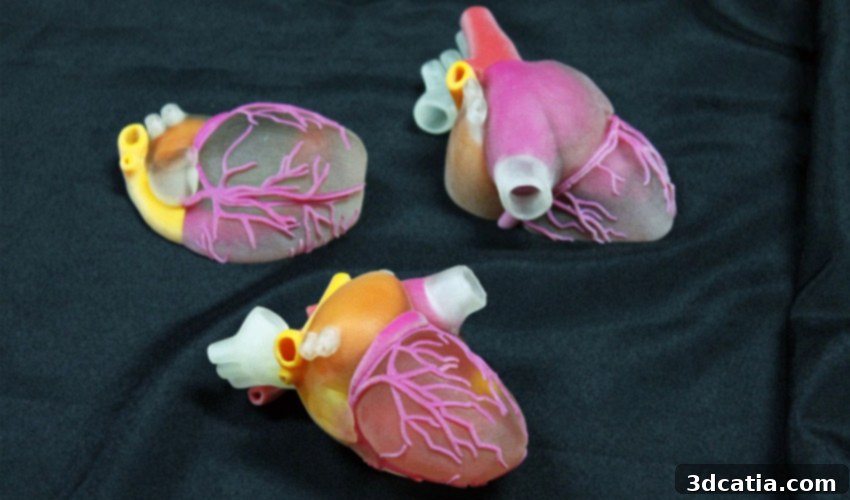
3D printing allows for the design of very realistic surgical models (photo credits: Phoenix Children’s Hospital)
The Indispensable Role of 3D Printed Surgical Models in Modern Healthcare
The integration of 3D printed surgical models into clinical practice marks a significant leap forward in patient care, surgical education, and medical innovation. These models, crafted with exceptional fidelity to individual patient anatomy from medical imaging data (such as CT scans, MRIs, and ultrasounds), offer an unparalleled level of realism and detail. Their utility spans across various critical areas within healthcare, fundamentally altering how surgeons prepare, teach, and execute complex procedures. Beyond the impressive market statistics, understanding the tangible benefits of these models is key to appreciating their growing importance.
Enhanced Pre-Operative Planning and Strategy
One of the most significant advantages of 3D printed surgical models lies in their capacity to revolutionize pre-operative planning. Surgeons can hold an exact replica of a patient’s anatomy in their hands, allowing for a thorough and tactile understanding of complex pathologies, tumors, or anatomical variations that might be difficult to fully appreciate from 2D images alone. For instance, in complex cardiac surgeries, a 3D model of a child’s heart can help surgeons visualize intricate defects, plan incision points, and even practice delicate repairs before entering the operating room. Similarly, in orthopedic surgery, models of fractured bones or complex joint deformities enable surgeons to pre-bend plates, select optimal screw lengths, and anticipate challenges, thereby streamlining the actual surgery and potentially reducing operative time and associated risks. This hands-on preparation not only boosts surgeon confidence but also contributes directly to improved patient outcomes by minimizing unexpected intraoperative complications. The precision afforded by these models leads to more efficient surgeries, reducing anesthetic exposure and recovery times for patients.
Advanced Surgical Training and Education
The value of 3D printed models as educational tools cannot be overstated. They provide an invaluable resource for training medical students, surgical residents, and even seasoned surgeons looking to master new techniques or refresh their skills. Unlike cadaveric training, which can be limited by availability, cost, and ethical considerations, 3D printed models can be produced on demand, are patient-specific, and can replicate a wide range of pathological conditions. This allows trainees to repeatedly practice intricate procedures, develop spatial awareness, and refine their dexterity in a risk-free environment. For rare or extremely complex cases, these models facilitate team training, allowing the entire surgical team to walk through a procedure step-by-step, rehearse their roles, and identify potential challenges collectively. This collaborative approach enhances coordination and communication, which are critical elements for successful surgical outcomes. The ability to simulate various scenarios provides invaluable experience that translates directly to improved performance in the operating room.
Improved Patient Communication and Consent
For patients and their families, undergoing surgery can be a daunting prospect. 3D printed anatomical models serve as powerful visual aids that can significantly improve patient understanding and facilitate the informed consent process. Instead of relying solely on verbal explanations or abstract diagrams, surgeons can use these tangible models to clearly illustrate the patient’s specific condition, explain the proposed surgical intervention, and outline potential risks and benefits. This visual and tactile engagement empowers patients to make more informed decisions about their healthcare, reduces anxiety, and builds trust between the patient and the medical team. It transforms abstract medical concepts into concrete, understandable realities, fostering a more collaborative approach to patient care and ensuring patients feel more involved and confident in their treatment plan.
Reducing Risks and Optimizing Surgical Outcomes
Ultimately, the deployment of 3D printed surgical models is geared towards one overarching goal: enhancing patient safety and optimizing surgical outcomes. By allowing for meticulous pre-surgical planning and practice, these models directly contribute to a reduction in operative time, a decrease in blood loss, and a lower incidence of post-operative complications. For procedures involving critical structures or delicate dissections, the ability to thoroughly explore the anatomy beforehand can prevent unintended damage. This translates to faster patient recovery, shorter hospital stays, and overall improved quality of life for patients. The investment in 3D printing technology for surgical models yields significant dividends in terms of clinical efficacy and patient well-being, proving to be a cost-effective solution in the long run by mitigating expensive complications and re-operations.
Diverse Applications and Technologies Powering Medical 3D Printing
The versatility of 3D printing in the medical sphere extends far beyond simple anatomical replicas. The technology supports a broad spectrum of applications, each tailored to specific clinical needs. For instance, in maxillofacial surgery, 3D printed models are indispensable for reconstructing complex facial fractures or planning orthognathic procedures. In oncology, models of tumors embedded within organs allow surgeons to plan the most effective resection strategy while preserving healthy tissue, sometimes enabling limb-sparing surgery instead of amputation. Vascular models, often printed with transparent and flexible materials, enable surgeons to simulate blood flow dynamics, practice stent placements, or rehearse aneurysm repairs, ensuring a smoother and safer procedure. Pediatric surgeons, in particular, benefit immensely from patient-specific models, which help them navigate the smaller, more delicate anatomies of children with greater precision. Furthermore, the development of surgical guides and templates directly from 3D models ensures unparalleled accuracy during bone cutting or implant placement, reducing manual error.
The underlying technologies and materials are crucial to the success of these applications. Different 3D printing processes are utilized depending on the desired properties of the model:
- FDM (Fused Deposition Modeling): Often used for larger, less intricate models, offering good strength and cost-effectiveness. It’s suitable for basic anatomical shapes or early-stage planning models.
- SLA (Stereolithography) and DLP (Digital Light Processing): Known for producing highly detailed and smooth models with excellent surface finish, ideal for intricate anatomical structures with fine features like nerves or small vessels. These technologies use liquid resins cured by light.
- PolyJet/MultiJet Printing: Capable of printing multiple materials and colors simultaneously, allowing for models that accurately represent different tissue types (e.g., bone, soft tissue, vasculature) within a single print, offering unparalleled realism. This technology is particularly valuable for simulating the varying stiffness and texture of human tissues.
- SLS (Selective Laser Sintering): Used for strong, functional parts from powdered materials, providing excellent mechanical properties. While less common for direct anatomical models, it finds significant application in patient-specific prosthetics, orthotics, and functional components that require durability.
Materials range from rigid, bone-like photopolymers to flexible, tissue-mimicking resins, and increasingly, biocompatible materials for direct implantation. This broad palette of options ensures that medical professionals can select the most appropriate technology and material to create models that precisely meet their clinical and educational objectives, pushing the boundaries of what is possible in personalized medicine.

A model of a 3D printed prostate (photo credits: McAlpine, University of Minnesota Twin Cities)
Global Market Dynamics: North America Leads, Asia-Pacific Surges
The Brandessence Market Research report provides critical insights into the geographical distribution and growth patterns within the 3D printed surgical models market. It explicitly highlights North America as the region projected to command the largest market share, a testament to its well-established healthcare infrastructure, high adoption rate of advanced medical technologies, and significant investment in research and development. The United States, in particular, stands as a powerhouse, boasting over 6,500 medical device companies. While the exact number of these firms that have fully integrated additive manufacturing into their core operations is constantly evolving, their collective impact on the industry is undeniable. Pioneer companies like SmileDirectClub exemplify this integration, leveraging HP Multi Jet Fusion technology to produce thousands of dental aligners daily, showcasing the scalability and efficiency of 3D printing in high-volume medical applications. The region’s robust ecosystem of innovation, supported by substantial R&D funding from both public and private sectors, continues to drive the development of new processes, materials, and software solutions, accelerating the creation of suitable medical tools with greater speed and efficiency. Furthermore, favorable reimbursement policies and a strong intellectual property framework contribute significantly to North America’s dominance.
Simultaneously, the Asia-Pacific region is recognized for recording the strongest growth in the sector. This accelerated expansion can be attributed to several factors, including rapidly developing healthcare infrastructure in populous countries like China and India, increasing healthcare expenditure driven by economic growth, a growing awareness of personalized medicine among both practitioners and patients, and supportive government initiatives promoting technological adoption. As disposable incomes rise and access to advanced medical care expands, the demand for sophisticated surgical planning tools and patient-specific devices is burgeoning. Moreover, a large patient pool, coupled with a rising prevalence of chronic and complex diseases, creates a compelling need for advanced diagnostic and surgical solutions. This dynamic growth positions Asia-Pacific as a crucial region for future market expansion and investment opportunities, with increasing collaborations between local medical institutions and international 3D printing companies.
Beyond regional dynamics, the overall market growth is propelled by several macroeconomic and technological factors. An aging global population, coupled with a rising prevalence of chronic diseases such as cardiovascular conditions, cancer, and orthopedic ailments, necessitates more precise and personalized medical interventions. Furthermore, the continuous evolution of 3D printing technology, including improvements in resolution, speed, and material properties, makes these models more accessible and versatile. Regulatory bodies worldwide are also adapting, creating clearer pathways for medical device approval using additive manufacturing, which further encourages innovation and market entry by reducing uncertainty for manufacturers. This global shift towards patient-centric healthcare models strongly supports the continued expansion of the 3D printed surgical models market.
Key Innovators Shaping the Future of 3D Printed Surgical Models
The competitive landscape of the 3D printing market for anatomical models is shaped by a diverse group of manufacturers, service providers, and specialized medical companies. The Brandessence study specifically cites several industry leaders whose contributions are pivotal to the market’s current and future development. Prominent hardware manufacturers like 3D Systems, EnvisionTEC (now part of Desktop Metal, a leader in digital light processing and bioprinting), Stratasys (known for its multi-material PolyJet technology and specific Digital Anatomy printer), and Concept Laser (part of GE Additive, focusing on metal 3D printing for implants) are at the forefront, developing cutting-edge 3D printers and advanced materials tailored specifically for medical applications. These companies not only provide the hardware but also often offer comprehensive software solutions for converting complex medical imaging data into print-ready models, ensuring seamless integration into clinical workflows.
Beyond hardware manufacturers, specialized 3D printing service bureaus play a critical role, offering on-demand production of highly complex and precise anatomical models. Companies such as Materialise are instrumental in this segment, providing extensive expertise in medical image processing, design for additive manufacturing, and certified production facilities that adhere to stringent medical standards. Their services enable hospitals and clinics without in-house 3D printing capabilities to access these advanced models efficiently. Furthermore, established medical device giants like Zimmer Biomet and Stryker are increasingly integrating 3D printing into their product development and manufacturing workflows, particularly for patient-specific implants, personalized surgical guides, and instrumentation. This showcases the technology’s move from a niche application to a mainstream medical practice, driven by its proven benefits in terms of precision, customization, and efficacy.
It is worth noting that virtually all 3D printing processes, from FDM to advanced multi-material jetting and metal laser sintering, are finding diverse applications within the medical sector. This broad adoption signifies a comprehensive interest across the entire healthcare value chain, from initial diagnostics and surgical planning to post-operative care and rehabilitation. The collaborative efforts between technology developers, medical institutions, and regulatory bodies are continuously refining standards and expanding the possibilities for 3D printed solutions in healthcare, creating a dynamic and rapidly evolving ecosystem.
The Future Outlook for 3D Printed Surgical Models
The future of 3D printed surgical models appears exceptionally bright, poised for continued innovation and deeper integration into routine clinical practice. Several emerging trends are expected to further fuel market growth and enhance the capabilities of these models. The advent of artificial intelligence (AI) and machine learning (ML) will likely streamline the entire process of converting medical imaging data into 3D printable files, making the creation of models faster, more automated, and less prone to manual error. AI could also assist in identifying critical anatomical features and pathologies, optimizing model design for specific surgical scenarios. Furthermore, advancements in material science are expected to yield even more realistic, durable, and biocompatible materials, some perhaps with integrated functionalities like sensing capabilities or even drug delivery systems, although the latter leans more towards advanced bioprinting.
Point-of-care 3D printing, where hospitals establish in-house 3D printing labs directly within their facilities, is another significant trend. This allows for immediate production of models, reducing lead times and enabling quicker surgical planning, especially in urgent or complex cases. As the technology becomes more accessible, affordable, and user-friendly, more healthcare facilities worldwide will likely adopt this decentralized model, fostering greater customization, faster turnaround times, and improved accessibility to these vital tools. The synergy between 3D printing and bioprinting also holds immense promise, with ongoing research exploring the creation of models that incorporate living cells or tissues. While still in early stages for direct surgical models, this paves the way for even more sophisticated and functional biological replicas for advanced research, drug testing, and potentially, future regenerative medicine applications.
The regulatory landscape is also maturing, with clearer guidelines and frameworks being established for 3D printed medical devices and models by authorities such as the FDA. This regulatory clarity provides a solid foundation for companies to innovate and bring new products to market with greater confidence, further accelerating adoption and ensuring patient safety. The sustained investment in R&D, coupled with a growing recognition of the tangible benefits for patient care, ensures that 3D printed surgical models will remain a cornerstone of advanced medical practice for the foreseeable future, continuing to transform surgical planning, training, and personalized medicine, ultimately leading to better health outcomes for patients globally.
In summary, the substantial growth forecast by Brandessence Market Research is a clear indicator of 3D printed surgical models transitioning from a novel technology to an indispensable tool in modern healthcare. Their ability to offer patient-specific solutions, enhance surgical precision, improve training, and facilitate better patient communication is revolutionizing medical practice. As technology continues to evolve and adoption rates climb, these models are set to play an even more critical role in delivering safer, more effective, and truly personalized healthcare experiences globally.
What are your thoughts on the rapidly expanding market for 3D printed surgical models and their impact on healthcare? We’d love to hear your insights in a comment down below or connect with us on our Facebook and Twitter pages! Don’t miss out on the latest 3D printing news and trends; sign up to receive our free weekly Newsletter, delivered straight to your inbox!
*Thumbnail photo credits : 3D Operations