
Generative Design & Hybrid Manufacturing: Revolutionizing Injection Mold Cooling Channels for Peak Efficiency
While additive manufacturing continues to evolve beyond its initial role as a rapid prototyping technology, injection molding remains the gold standard for the high-volume production of plastic parts. Its unparalleled efficiency makes it indispensable for manufacturing intricate plastic components on a large scale. A critical factor in achieving both higher product quality and lower manufacturing costs in injection molding is the development of highly efficient cooling systems for the melted materials. Recognizing this vital need, Panasonic Corporation’s Life Solutions Company, in a groundbreaking collaboration with Autodesk, has embarked on an exploration into automating the design of mold cooling channels, aiming to significantly enhance this crucial process.
The innovative approach taken by Panasonic Corporation’s Life Solutions Company centers on a novel hybrid manufacturing method. This method seamlessly integrates the precision of 3D printing, the versatility of milling, and the intelligence of generative design. By utilizing the LUMEX Avance-25, a state-of-the-art hybrid machine that combines metal 3D printing with high-speed milling, Panasonic was able to produce a sophisticated conformal-cooling system. Unlike conventional cooling channels that are drilled in straight lines, conformal cooling channels are custom-designed to closely follow the complex contours of the product, ensuring uniform and rapid heat dissipation. This advanced system has demonstrated remarkable results, achieving a significant 20% reduction in cooling times compared to traditional methods. Such an improvement not only accelerates production cycles but also enhances the overall quality of the manufactured plastic parts, minimizing issues like warping and uneven shrinkage.

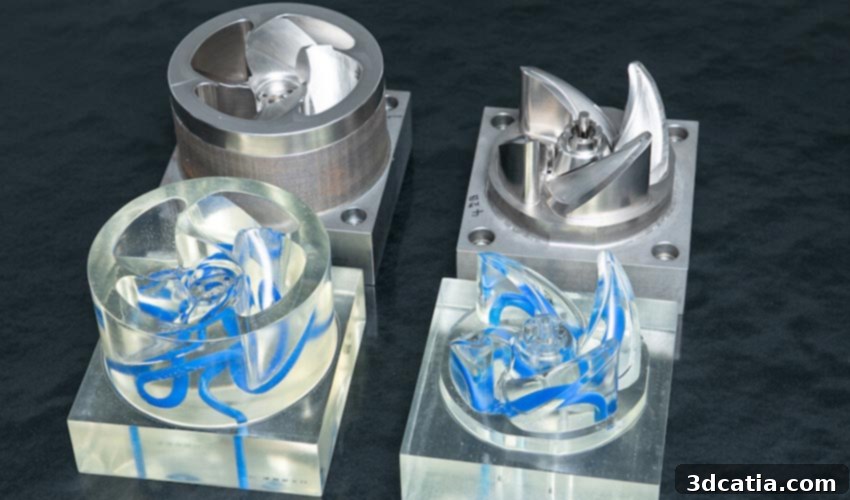
Seiichi Uemoto, an analyst at Panasonic’s Life Solutions Company, initiated using generative design to deliver new designs that otherwise would have been impossible | Image via Autodesk
The Power of Generative Design in Manufacturing Workflows
Generative design represents a paradigm shift in engineering and manufacturing. It is a powerful technique that automatically generates numerous design solutions based on a set of predefined goals and constraints, allowing engineers to explore a vast design space that would be impossible to achieve manually. Seiichi Uemoto, a perceptive analyst at Panasonic’s Life Solutions Company Manufacturing Engineering Center, was instrumental in recognizing the immense potential of generative design. He initiated its application to create novel and optimized designs for mold cooling channels that would have been unattainable through conventional design processes. Uemoto explains his initial insight: “I thought that with the right settings in place, I could use generative design to automatically create mold-cooling channels.” This vision laid the groundwork for a truly innovative approach to mold manufacturing.
Uemoto also elaborated on the distinct advantages of generative design over other optimization techniques like topology optimization. While topology optimization provides “only one solution from the conditions provided to the system” and often results in geometries that are difficult to smooth, generative design inherently produces designs with more organic and “smoother shapes.” This characteristic is crucial for applications like cooling channels, where fluid flow efficiency and manufacturability are paramount. The ability of generative design to explore diverse solutions and prioritize smooth, functional contours makes it exceptionally well-suited for complex thermal management challenges within injection molds. It opens up possibilities for designs that are not only structurally sound but also highly efficient in their intended function, surpassing the limitations of traditional, human-led design iterations.
Collaborative Innovation: Panasonic and Autodesk’s Project
The collaborative effort between Panasonic and Autodesk focused on a specific, challenging application: the mold cooling water channels for a small, complex, mass-produced fan blade. These fan blades are integral components in duct ventilation systems, and their quality directly impacts system performance. The complexity of these parts, coupled with the high production volumes, made them an ideal test case for generative design. The process began with engineers inputting a comprehensive set of constraints and desired conditions into the Autodesk software. These parameters included considerations such as material properties, desired cooling rates, mold space limitations, and manufacturing process capabilities. The software then leveraged its algorithms to propose numerous design iterations, each an optimized solution, until only the most efficient and practical key components remained. Uemoto expressed his astonishment at the outputs, commenting, “I was really impressed by the fully formed models that were being automatically generated,” and was particularly surprised by the unique and often counter-intuitive behavior of the resulting water channel layouts, which often defied conventional human engineering intuition but proved highly effective.
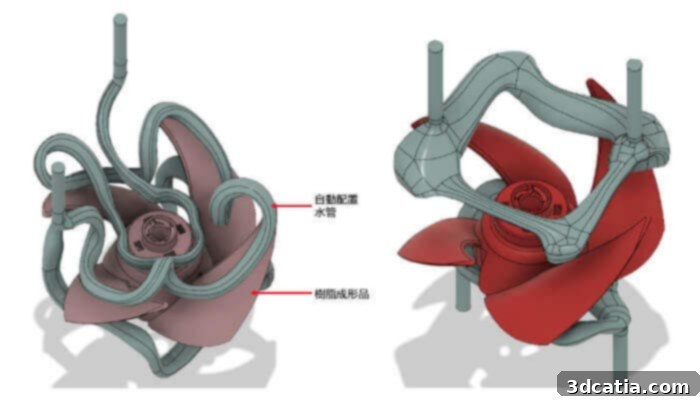
The left was generatively designed with its shape constrained to a designer’s initial shape; The right was generatively designed with its shape constrained only by the initial shape of the outer shell | Credits: Life Solutions Company, Panasonic Corporation.
To thoroughly validate the efficacy of the generatively designed cooling channels, four distinct mold samples were manufactured and rigorously tested. These samples included: 1) the original part, meticulously designed by an experienced engineer using traditional methods; 2) a mold based on a generative design solution with relatively strict shape constraints; 3) another generative design solution, but this time with looser shape restrictions, allowing the algorithm more freedom to innovate; and 4) a design similar to the first traditional mold, but augmented with additional water channels to enhance cooling. Products manufactured from each of these molds were then subjected to precise measurements and performance assessments. The results were highly compelling: the performance of parts produced from the generatively designed cooling channels showed negligible difference compared to those from the engineer’s traditionally designed mold. This parity in performance, achieved through an automated and significantly faster design process, underscores the immense potential of generative design not just for optimization, but for replicating and even surpassing human design expertise efficiently.
The Future Landscape of Mold Design: Automation, Efficiency, and Engineering Freedom
The findings from this pioneering project hold profound implications for the future of injection mold design and manufacturing. Creating advanced cooling systems has historically been a challenging, iterative, and time-consuming endeavor, requiring significant expertise and manual effort. Seiichi Uemoto expresses great optimism that this project will catalyze the development of more automated solutions, fundamentally streamlining the entire design and manufacturing process. He envisions a future where engineers are liberated from the tedious, repetitive tasks of manual design, instead gaining the freedom to focus on higher-level strategic challenges and innovative problem-solving. This shift would not only accelerate the overall workflow but also empower engineers to concentrate more intensely on critical aspects such as precise temperature control and advanced material behaviors, leading to even greater product sophistication and reliability.
Uemoto articulates this future vision, stating, “If this becomes a part of a packaged software in the near future, it could lead to a solution for speeding up tasks and allow us to develop programs focusing more on temperature control. That should benefit a wide range of users and applications.” The potential benefits extend far beyond a single company or application. By integrating generative design capabilities into accessible software packages, industries across the board could realize significant advantages. This automation would translate into faster product development cycles, substantial cost reductions due to minimized design iterations and optimized material usage, and an overall increase in manufacturing throughput. Furthermore, it paves the way for the creation of previously unachievable geometries, opening new avenues for product innovation and performance enhancement in diverse sectors, from automotive and aerospace to consumer electronics and medical devices. The collaborative work by Panasonic and Autodesk is not merely optimizing a process; it’s laying the foundation for a more intelligent, efficient, and innovative manufacturing ecosystem.
What are your thoughts on leveraging generative design to create optimized objects and processes in manufacturing? We invite you to share your insights and comments below, or join the conversation on our Facebook and Twitter pages! Don’t miss out on the latest advancements in 3D printing and manufacturing; sign up for our free weekly Newsletter to receive all the crucial industry news directly in your inbox.