

Revolutionizing Bioprinting: Unveiling the Breakthrough of Sound-Based 3D Printing Technology
Additive manufacturing, commonly known as 3D printing, has emerged as a transformative technology with an ever-expanding array of applications across diverse industries. From aerospace and automotive to consumer goods and healthcare, its ability to create complex geometries layer by layer has opened up unprecedented possibilities. Within the vast landscape of additive manufacturing, bioprinting stands out as a particularly promising frontier, offering revolutionary potential in the medical field. This cutting-edge process involves the precise deposition of biomaterials, such as living cells and growth factors, known as bio-ink, to fabricate intricate cellular structures, functional tissues, and even entire organs. The implications for treating chronic diseases, addressing organ shortages, and advancing regenerative medicine are profound and far-reaching.
Driven by the ambition to push the boundaries of this critical field, a pioneering new project has recently captured the attention of the scientific community. This groundbreaking initiative is spearheaded by a collaborative team of esteemed scientists from two of Germany’s most prestigious research institutions: the Max Planck Institute for Medical Research and the Institute for Molecular Systems Engineering and Advanced Materials at the University of Heidelberg. Together, these visionary researchers have developed and unveiled an innovative technology that leverages the power of sound to assemble three-dimensional matter with unprecedented control and precision. At the heart of this novel concept lies the ingenious application of multiple acoustic holograms, meticulously designed to model and shape objects in three dimensions, promising to unlock new avenues for advanced bioprinting and beyond.
The Urgent Imperative: Addressing the Critical Need for Bioprinting Innovation
The global bioprinting market is poised for exponential growth, reflecting an urgent and growing demand for innovative medical solutions. A comprehensive study conducted by Research and Markets projects that this market will reach an astounding $5.3 trillion by the year 2030. This projected expansion is not merely speculative; it is a direct response to a confluence of factors, primarily the escalating global prevalence of chronic diseases. Conditions such as organ failure, cardiovascular diseases, and various degenerative disorders are placing immense strain on existing healthcare systems, necessitating novel and effective therapeutic strategies that traditional methods often cannot provide.
One of the most pressing challenges in modern medicine is the severe shortage of transplantable organs. In the United States alone, the Health Resources and Services Administration (HRSA) reports a sobering statistic: over 105,800 individuals are currently on the national transplant waiting list. This critical demand continues to grow, with a new person added to the list approximately every 10 minutes. Tragically, the supply of viable organs from donors falls far short of this overwhelming demand, leading to prolonged waiting times, diminished quality of life for patients, and, in many cases, preventable deaths. The development of new applications, particularly in advanced bioprinting, is not just desirable but absolutely essential to bridge this life-threatening gap. The innovative technology emerging from the Max Planck Institute and the University of Heidelberg, which ingeniously combines sound manipulation with 3D printing principles, represents a significant leap forward, offering a potential pathway to dramatically increase the availability of functional tissues and organs, thereby saving countless lives and transforming the landscape of transplant medicine.
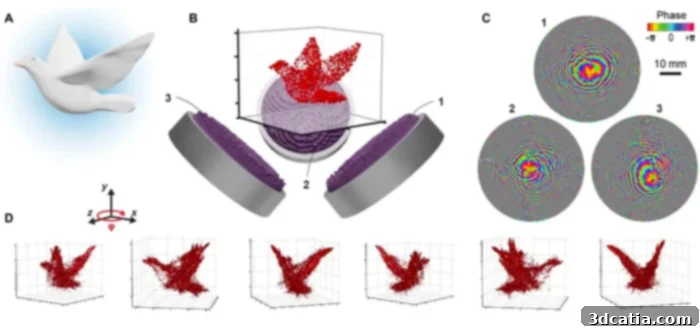
Photo Credits: Max Planck Institute / University of Heidelberg
Unveiling the Mechanisms: How Sound Powers 3D Assembly
The journey to this groundbreaking 3D technology began with fundamental research into the precise manipulation of ultrasound using acoustic holograms. Initially, researchers focused on understanding how controlled sound fields could be employed to create two-dimensional shapes. This foundational work laid the essential groundwork for their subsequent breakthrough. Building upon this knowledge, the interdisciplinary team meticulously developed a sophisticated technology where precisely modulated sound waves exert a quantifiable force on microscopic materials. This directed force enables the delicate and accurate shaping of objects in three dimensions, moving beyond simple planar structures to truly volumetric forms. The method relies on the generation of high-frequency ultrasound, which, by its very nature, operates at frequencies well beyond the range of human hearing, ensuring a silent and unobtrusive process.
A critical aspect of this technology is the remarkably small wavelengths of the generated sound waves, which push below a millimeter. This microscopic precision is what makes the technique exceptionally versatile and ideal for manipulating an extensive variety of materials at a cellular and even sub-cellular level. Unlike conventional mechanical manipulation or some other forms of additive manufacturing that might be too harsh for delicate biological components, this sound-based approach offers unparalleled gentleness. It allows for the precise positioning and assembly of sensitive biological cells, enabling the construction of complex tissue scaffolds without causing damage or compromising cell viability. Beyond biological applications, the technique’s robust control also extends to materials as diverse as glass, demonstrating its broad potential for micro-fabrication across numerous scientific and industrial domains. This capability to delicately yet firmly control materials using acoustic forces represents a significant paradigm shift in how we approach the assembly of complex structures at the micro-scale.
The Science Behind Acoustic Holography
Acoustic holography, at its core, involves the creation of a three-dimensional sound field designed to exert specific forces on matter. Much like optical holography uses light waves to create a 3D image, acoustic holography uses sound waves to generate a complex acoustic pressure field. The researchers achieve this by using an array of tiny sound emitters, each precisely controlled in terms of phase and amplitude. By carefully orchestrating the emissions from these individual transducers, they can create interference patterns that form acoustic “traps” or “force fields” in specific regions of space. These traps are strong enough to hold and manipulate microscopic particles, including living cells, suspended in a liquid medium. The genius of this approach lies in the ability to dynamically reconfigure these acoustic holograms, allowing for the sequential or simultaneous assembly of multiple particles into intricate 3D architectures, all without any physical contact, thereby preserving the integrity of the delicate materials being manipulated.
The use of high-frequency ultrasound is crucial because shorter wavelengths allow for finer resolution and more precise control over smaller particles. Think of it like using a very fine brush versus a broad one – the finer the wavelength, the smaller the detail you can achieve. This sub-millimeter precision is what makes the technology suitable for working with individual cells and tiny biological components, which are often measured in micrometers. Furthermore, the non-invasive nature of sound waves means that the process minimizes the risk of contamination or mechanical stress, issues that can plague other forms of micro-assembly and bioprinting. This gentle yet powerful manipulation ensures that the integrity and viability of biological materials, especially living cells, are maintained throughout the intricate assembly process, a factor of paramount importance for the success of bioprinting and regenerative medicine.
Expert Insights: A Leap Forward for Biomedical Innovation
The potential impact of this sound-based 3D technology on biomedicine is eloquently articulated by the lead author of the study, Kai Melde. He emphasized the groundbreaking nature of their achievement, stating, “We were able to assemble microparticles into a three-dimensional object within a single shot using shaped ultrasound.” This statement highlights a significant advancement in efficiency and control. Traditional methods often require multiple steps or prolonged processes for micro-assembly, but the ability to achieve a 3D structure in a “single shot” demonstrates an unparalleled level of dynamic and instantaneous control over material manipulation. This efficiency is critical for scaling up bioprinting processes and reducing manufacturing times for complex biological constructs.
Further underscoring the specific relevance to bioprinting, Peer Fischer, a distinguished Professor at the University of Heidelberg and a key contributor to the research, added, “This can be very useful for bioprinting. The cells used there are particularly sensitive to the environment during the process.” Professor Fischer’s insight pinpoints one of the most significant challenges in bioprinting: the extreme fragility of living cells. Unlike inert materials, biological cells are highly susceptible to mechanical stress, temperature fluctuations, and chemical changes in their immediate environment. Traditional 3D printing methods, which might involve extrusion, laser heating, or photo-polymerization, can often compromise cell viability and function. The gentle, contact-free manipulation offered by acoustic holograms provides an ideal solution, allowing researchers to precisely arrange cells into desired architectures without inducing cellular damage, thus preserving their biological integrity and functionality.
For the entire research team, this study represents an immensely important contribution to the fields of biomedicine and regenerative engineering. The unique capability of ultrasound to manipulate cells with exceptional care, yet with thorough precision, without causing detrimental effects, is truly a promising advance. This delicate balance of control and gentleness is precisely what is needed to unlock the full potential of bioprinting, paving the way for the creation of more complex, viable, and functional biological structures. The implications stretch from fabricating simple tissue models for drug testing and disease research to, in the long term, engineering fully functional human organs for transplantation. The details of this pioneering study are available for further exploration through the scientific community. You can get more information about the study HERE.
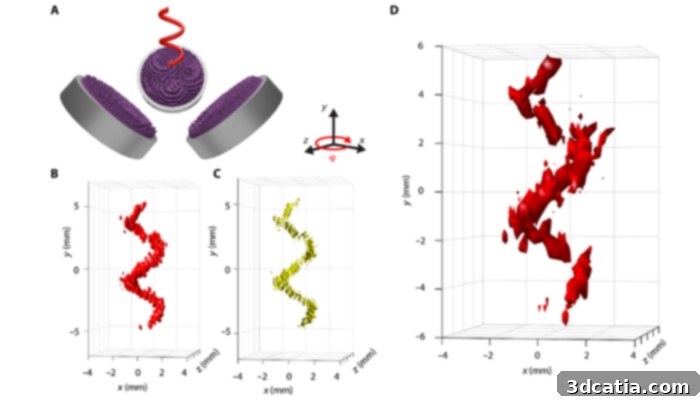
Photo Credits: Max Planck Institute / University of Heidelberg
Beyond Bioprinting: Future Prospects of Acoustic Assembly
While the immediate and most compelling application of this sound-based 3D technology lies in the realm of bioprinting and tissue engineering, its underlying principles suggest a much broader potential across various scientific and industrial disciplines. The ability to precisely manipulate microparticles and delicate materials using non-contact acoustic forces opens doors to entirely new manufacturing paradigms. Imagine the precise assembly of tiny electronic components in micro-robotics or the fabrication of intricate micro-fluidic devices with unprecedented accuracy. The technology could revolutionize fields such as drug delivery, where encapsulating therapeutic agents within precisely structured micro-carriers could lead to more targeted and efficient treatments.
Moreover, the versatility of manipulating a wide range of materials, from biological cells to glass, underscores the fundamental robustness of this acoustic assembly method. This suggests that it could be adapted for creating novel composite materials with tailor-made properties, or for advanced materials research where precise control over micro-structure is paramount. The non-invasive nature also makes it ideal for environments where contamination or mechanical stress must be absolutely minimized, such as in sterile medical device manufacturing or in sensitive laboratory settings. As research progresses, we can anticipate the emergence of even more sophisticated applications, further solidifying sound-based 3D printing as a cornerstone technology for the next generation of additive manufacturing and micro-fabrication.
The Road Ahead: Impact and Adoption of Acoustic 3D Printing
The introduction of sound-based 3D printing technology marks a significant milestone in the ongoing evolution of additive manufacturing. By offering an unprecedented level of control and gentleness in material manipulation, particularly for fragile biological constructs, it promises to accelerate progress in bioprinting and regenerative medicine. This breakthrough brings us closer to a future where complex tissues and organs can be reliably fabricated in laboratories, offering hope to millions suffering from organ failure and chronic diseases. The collaborative efforts of the Max Planck Institute and the University of Heidelberg exemplify the power of interdisciplinary research in pushing the boundaries of what is possible.
What are your thoughts on this revolutionary sound-based 3D technology and its potential to transform medicine and manufacturing? We invite you to share your insights and comments below, or engage with us on our LinkedIn, Facebook, and Twitter pages! Don’t miss out on the latest advancements in additive manufacturing—be sure to sign up for our free weekly Newsletter here, delivering the most current 3D printing news directly to your inbox. You can also explore all our engaging videos and deeper insights on our YouTube channel.