
The State of 3D Printing 2021: Navigating Growth and Resilience in Additive Manufacturing
For the seventh consecutive year, Sculpteo, a prominent printing service provider, has unveiled its highly anticipated annual study, “The State of 3D Printing.” This comprehensive report meticulously examines the landscape of additive manufacturing (AM) users across the globe, providing invaluable insights into industry trends, challenges, and opportunities. This year’s edition holds particular significance, as it uniquely delves into the profound impact of the unprecedented global health crisis on respondents’ 3D printing activities. The findings paint a remarkably positive and optimistic picture for the additive manufacturing sector. A substantial 30% of participants reported a direct increase in their 3D printing operations as a strategic response to the demands and disruptions caused by COVID-19. Furthermore, a significant 23% of companies demonstrated their commitment to the sector by investing over $100,000 in additive manufacturing technologies and services in the past year alone. This sustained confidence in the technology is further underscored by the fact that over 61% of respondents expressed their readiness to increase their investment in 2021. Such robust figures affirm the inherent health and dynamism of the additive manufacturing industry, echoing and strengthening the positive trends and growth trajectory that were observed and reported in the previous year’s study.
The latest, seventh edition of “The State of 3D Printing” report is built upon a robust foundation of data, having meticulously gathered responses from an impressive 1,900 industry professionals spanning 86 diverse countries. Clément Moreau, CEO and co-founder of Sculpteo, proudly highlighted this year’s achievement as the most internationally representative study to date, reflecting the global reach and growing adoption of additive manufacturing. A key takeaway from this year’s analysis is the clear and compelling evidence of the 3D printing sector’s continued maturation. This maturity is visible in several indicators: a greater number of participants are not only adopting the technology but are also integrating it internally and structuring their entire operational activities around its capabilities. Indicative of this trend, 18% of the surveyed companies have established dedicated departments specifically for additive manufacturing, signaling a strategic organizational commitment. Moreover, a substantial 43% of respondents have been leveraging 3D printing technologies for more than five years, demonstrating long-term engagement and experience within the industry. Historically, 3D printing was predominantly associated with rapid prototyping, serving primarily as a tool for accelerated product development and iteration. However, in recent years, this paradigm has definitively shifted. The report’s figures are conclusive: 53% of respondents are now employing 3D printing for the production of small series, and a significant 25% are even utilizing it for large-scale production runs, firmly establishing additive manufacturing as a viable and increasingly preferred method for end-use part creation.
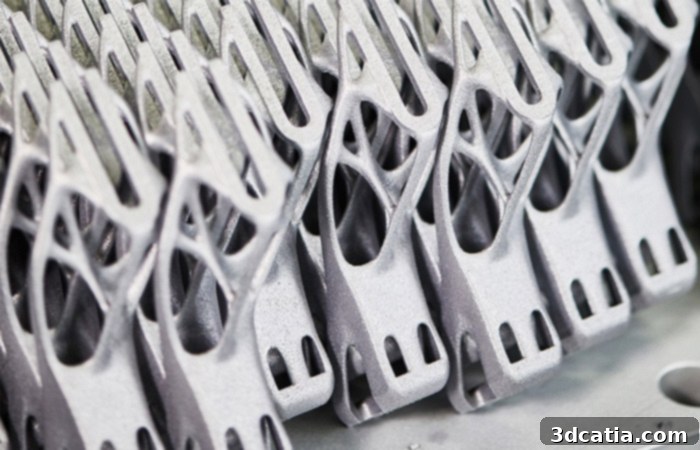
Additive manufacturing is used in the production of small and large series (photo credits: BMW)
Delving deeper into the practical applications of additive manufacturing, the study unequivocally reveals an escalating trend among companies to utilize 3D printing for the creation of finished parts. This is a crucial shift, moving beyond mere prototyping to actual production. Specifically, mechanical parts lead this trend, with 52% of respondents applying AM for their fabrication, closely followed by consumer goods at 27%. The versatility of 3D printing is also evident in its significant adoption for tooling applications and the production of spare parts. This widespread use for functional, end-use components serves as compelling evidence that additive manufacturing can no longer be viewed solely as a niche technology; instead, it is increasingly being recognized and relied upon as a robust and reliable manufacturing method. Furthermore, the rising emphasis on creating spare parts through 3D printing highlights a growing and essential trend towards component reparability. In an era where programmed obsolescence is a major concern, 3D printing offers a remarkably interesting and sustainable alternative, enabling businesses and consumers to extend the lifespan of products by producing on-demand replacements, thereby reducing waste and promoting a more circular economy. This capability not only fosters sustainability but also offers significant economic advantages by minimizing downtime and inventory costs.
Unpacking the Benefits, Challenges, and Persistent Barriers in Additive Manufacturing
“The State of 3D Printing” report consistently serves as a vital platform for reviewing and reinforcing the primary advantages that additive manufacturing brings to various industries. Unsurprisingly, the capacity to create highly complex geometries and the ability to iterate designs with exceptional speed remain firmly entrenched as the top two most valued benefits, cited by 69% and 52% of respondents respectively. These capabilities unlock unprecedented design freedom and drastically shorten product development cycles. What stands out as a significant development this year is the pronounced increase in responses regarding mass customization. For a remarkable 41% of participants, 3D printing is now perceived as a technology that facilitates and accelerates the design and production of custom products, a notable increase from 32% in 2020. This upward trend can be attributed, at least in part, to the pressures and demands exerted by the ongoing global pandemic. During this period, 3D technologies proved instrumental in rapidly manufacturing essential personal protective equipment (PPE), highly personalized medical devices, and other critical supplies. The medical sector, in particular, has reaped immense benefits from additive manufacturing, which offers an unparalleled ability to produce patient-specific tools, implants, and prosthetics, precisely adapted to individual anatomical needs and requirements, thereby revolutionizing personalized healthcare solutions.
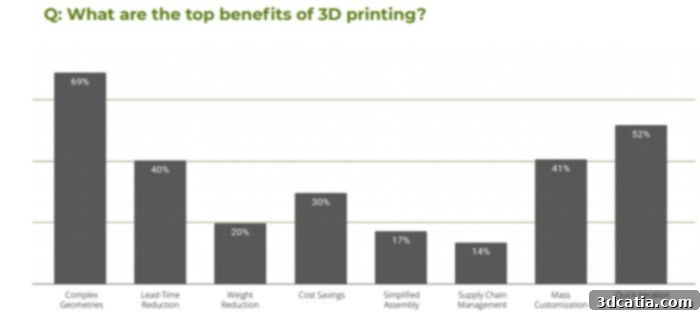
The main benefits of 3D printing (photo credits: Sculpteo)
Despite its numerous advantages, additive manufacturing continues to face a set of limitations and challenges that have remained largely consistent with those identified in previous years. Foremost among these are the difficulties associated with consistently controlling the quality of a 3D printed part, ensuring it meets rigorous industrial specifications, and the often-time-consuming nature of post-processing operations. Professional users of 3D printing technologies consistently emphasize the critical importance of repeatability within their manufacturing processes. The fundamental question they grapple with is: how can one reliably guarantee that every part produced, from one print batch to the next, exhibits identical characteristics and performance? This quest for consistency is paramount for industrial adoption. Moreover, a significant 59% of respondents articulate that the perceived lack of reliability in current 3D printing technologies actively impedes optimal market growth. This issue, coupled with the typically high initial entry costs associated with advanced AM systems and a perceived scarcity of truly innovative materials, constitutes a substantial barrier to wider industrial integration. François Minec, Managing Director of BASF Forward AM, succinctly articulates this sentiment: “Batch-to-batch consistency and reliability of the technology, total cost of ownership, and materials enabling new applications are the keys to further driving the industrialization of Additive Manufacturing. But the whole industry also needs to raise awareness of the potentials of Design for Additive Manufacturing (DfAM).” His statement underscores the multi-faceted approach required to overcome these hurdles, encompassing technological advancement, economic viability, material innovation, and the crucial education surrounding optimized design principles for AM.
Continuing the discourse on critical factors influencing additive manufacturing, the question of materials was a recurrent theme thoroughly explored within the report. For a significant 72% of the participants, material strength emerged as the single most important characteristic they actively seek in 3D printing materials. This finding is hardly surprising, given the increasing trend of companies utilizing additive manufacturing to produce finished parts destined for demanding industrial applications where structural integrity and durability are non-negotiable. This preference directly correlates with the observable growth in the development and adoption of high-performance materials in recent years, including advanced polymers, composites, and metal alloys specifically engineered for AM processes. These materials are designed to withstand harsh operating conditions, provide superior mechanical properties, and meet stringent regulatory requirements. Beyond strength, price and ease of use were identified as two other pivotal criteria that companies weigh heavily when selecting materials for their 3D printing projects. The balance between cost-effectiveness, material performance, and the simplicity of integrating new materials into existing workflows remains a key consideration for optimizing additive manufacturing operations and expanding its applications across various industries.
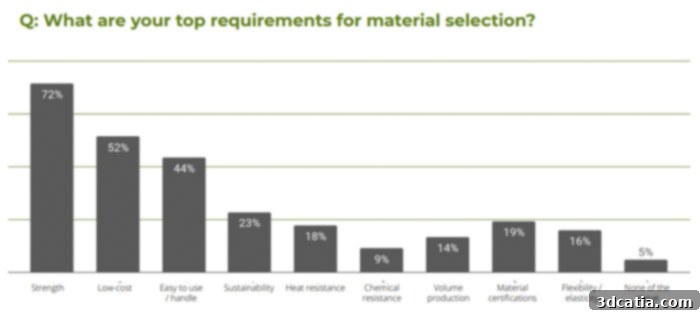
Companies are looking for resistant materials (photo credits: Sculpteo)
The Transformative Impact of COVID-19 on the 3D Printing Market Landscape
Contrary to initial fears, the global health crisis brought on by COVID-19 did not significantly harm the additive manufacturing industry. Instead, it arguably propelled it into an unprecedented spotlight, showcasing its inherent flexibility, adaptability, and remarkable ability to mend fractured global supply chains. According to Sculpteo’s comprehensive study, a striking 37% of the surveyed companies identified new business opportunities and experienced a surge in demand for 3D printing services and products during this challenging period. This surge was primarily driven by the urgent need for rapid, localized production of critical components, ranging from medical devices and personal protective equipment to essential spare parts. While it’s plausible that the market could have experienced even more substantial growth in the absence of the pandemic, the crisis undeniably served as a powerful catalyst, demonstrating AM’s invaluable role in crisis response and its potential to revolutionize traditional manufacturing paradigms. The insights gleaned from this period signal immense promise and continued expansion for the additive manufacturing sector in the coming years, as industries increasingly recognize the strategic advantages of agile and decentralized production capabilities.
Ramon Pastor, VP & GM 3D Printing at HP, offers a concluding perspective that resonates deeply with the report’s findings: “COVID-19 and geopolitical and economic uncertainty have accelerated interest in adopting 3D printing to build resilient supply chains and enable local, on-demand manufacturing. As COVID-19 disrupted global supply chains and limited the ability to efficiently deliver critical materials, 3D printing emerged as a key technology to fulfill some of the most in-demand supplies. Although many companies understand the importance of digital transformation, the pandemic has led to business disruption including capital expenditure limitations, resulting in slower 3D printing growth over the past year.” Pastor’s statement encapsulates the dual impact of the pandemic: while it highlighted AM’s strategic value in crisis, promoting concepts like distributed manufacturing and supply chain resilience, the economic repercussions also imposed limitations on capital expenditure, which, in some instances, tempered the pace of overall 3D printing growth despite increased interest. Nevertheless, the underlying momentum towards digital manufacturing and the undeniable proven utility of additive technologies during a global emergency strongly position the industry for sustained future growth and innovation.
For those eager to delve deeper into these fascinating trends and comprehensive data, the full study is available HERE. We encourage you to share your thoughts on the maturation of additive manufacturing and its evolving role in the global industrial landscape. Feel free to leave a comment below or join the conversation on our Linkedin, Facebook, and Twitter pages! To stay abreast of the very latest news and developments in 3D printing, sign up for our free weekly Newsletter here, delivered straight to your inbox. Additionally, explore all our engaging videos and educational content on our dedicated YouTube channel, offering a visual journey through the innovations shaping the additive manufacturing world.