
Transforming Defense: How 3D Printing Revolutionizes Electronic Connector Manufacturing at Sandia National Labs
The defense industry, a sector historically characterized by stringent regulations, long development cycles, and traditional manufacturing processes, is experiencing a profound transformation. At the forefront of this evolution is additive manufacturing, commonly known as 3D printing. From creating robust components for tanks and advanced propulsion systems to developing customized helmets and enabling on-ship spare parts production, 3D printing is rapidly gaining traction across various facets of military and defense operations. Its unique ability to produce complex geometries, reduce lead times, and facilitate rapid prototyping makes it an invaluable tool for modernizing defense capabilities. New applications emerge almost monthly, highlighting the technology’s accelerating integration into national security strategies.
A prime example of this innovative integration comes from Sandia National Laboratories, a world-renowned institution that has announced its successful utilization of 3D printing and other cutting-edge manufacturing technologies to revolutionize the development of custom electronic connectors for highly critical weapons systems. This initiative underscores a significant shift in how specialized, high-reliability components can be designed, produced, and deployed, promising unprecedented efficiencies and strategic advantages.
Sandia National Laboratories operates as a multimission laboratory under the management of Sandia LLC, a wholly owned subsidiary of Honeywell International. Its primary mission is to serve the U.S. Department of Energy’s National Nuclear Security Administration (NNSA). As a hub of scientific and technological innovation, Sandia receives substantial funding from various governmental and private sources, positioning it at the cutting edge of research in crucial fields such as nuclear deterrence, global security, and advanced energy technologies. The lab’s extensive experience with additive manufacturing is well-documented. For instance, in a project previously highlighted in March, Sandia collaborated with Oregon State University to pioneer a 3D printable construction material engineered with the remarkable capability to trap carbon dioxide, showcasing its commitment to diverse applications of AM technology beyond defense. This deep institutional knowledge and existing infrastructure in advanced manufacturing were pivotal in launching the Rapid Development Connectors program.
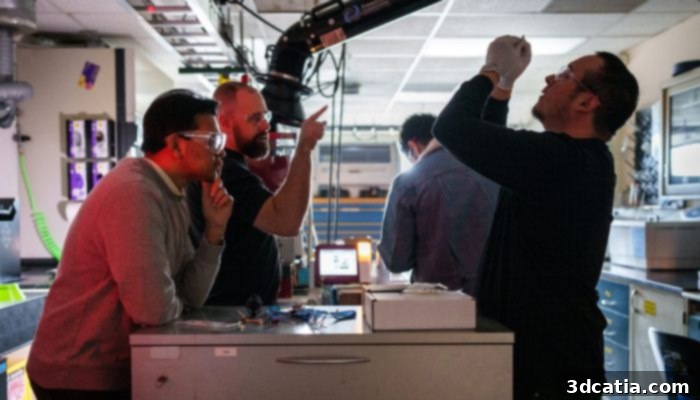
Sandia National Laboratories engineers analyzing PEEK inserts (photo credits: Craig Fritz/Sandia National Laboratories)
The Rapid Development Connectors program stands apart from previous initiatives due to its exclusive focus on leveraging advanced manufacturing techniques for the swift development of highly specialized connectors, particularly those critical for sensitive weapons systems, including nuclear armaments. This ambitious five-year project, generously funded by the National Security Administration, aims to establish and cultivate a highly skilled team capable of fabricating and delivering fully functional connectors in an unprecedented timeframe – less than four weeks. This represents a monumental leap forward from the current industry standard, which often requires a year or even longer for similar components. Crucially, this accelerated timeline must be achieved without any compromise on the superior quality and rigorous reliability standards essential for defense applications.
Sandia Labs Pioneers 3D Printed Electronic Connectors for Advanced Weapons Systems
In the contemporary geopolitical landscape, the principle of nuclear deterrence, while often a subject of debate, remains a cornerstone of defensive strategies for numerous governments worldwide. The concept posits that the credible threat of nuclear retaliation can prevent a first strike, thus maintaining global stability. Given this critical role, ensuring the impeccable condition and operational readiness of a nation’s nuclear arsenal is paramount. The United States, possessing the second-largest stockpile of nuclear warheads globally (an estimated 3,748 in September 2023, compared to Russia’s 5,580), faces a considerable and ongoing challenge in this regard. Electronic connectors are not merely minor components; they are indispensable elements in this complex ecosystem. These specialized components are vital for maintaining the intrinsic safety mechanisms of nuclear weapons, preventing accidental activation, and, when absolutely necessary, reliably triggering them. Any delay or failure in connector development or performance could have profound national security implications.
So, where exactly does 3D printing fit into this highly sensitive and demanding environment? The Rapid Development Connectors program has swiftly recognized and harnessed the multifaceted value of additive manufacturing. One significant way 3D printing contributes is as a powerful complementary technology, enhancing existing manufacturing workflows and addressing critical bottlenecks.
A recent press release from Sandia National Laboratories elaborates on the strategic advantage of co-locating different manufacturing techniques. This approach has demonstrably proven the efficacy of combining 3D printing with traditional injection molding, especially for the low-volume production of highly specific parts. The benefits of employing 3D printing to create more cost-effective and rapidly produced molds for injection molding are now well-established across various industries. Traditionally, manufacturing molds involves intricate and time-consuming machining processes that can take weeks or even months and incur substantial costs. By contrast, 3D printed molds offer a significantly quicker turnaround time, drastically reducing the lead time from design to functional prototype. Furthermore, 3D printing empowers engineers with greater design freedom, allowing for more complex geometries and intricate internal features within the mold itself, such as optimized cooling channels. This capability facilitates numerous design iterations in a fraction of the time, leading to more refined and higher-performing final components. The ability to quickly iterate and test different mold designs accelerates the entire development process, making it more agile and responsive to evolving requirements. Beyond molds, the lab has also innovatively explored the creation of hermetic seals using additively manufactured glass. Hermetic seals are crucial for protecting sensitive electronic components from environmental factors like moisture, dust, and corrosive gases, thereby ensuring long-term reliability and performance in extreme conditions. 3D printing allows for the precise fabrication of these seals in custom shapes and sizes, tailored to exact specifications, which would be challenging or impossible with conventional glass manufacturing methods.
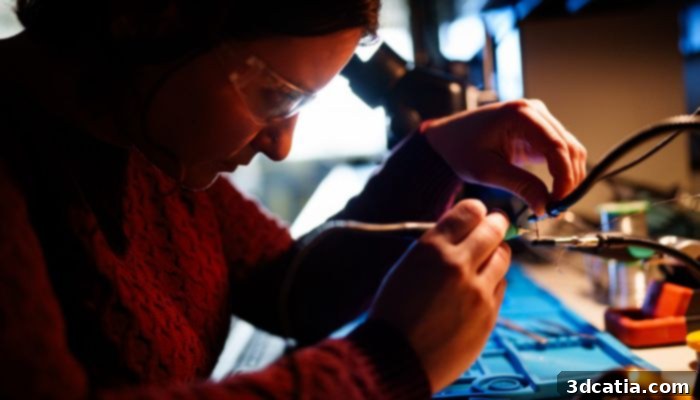
An electrical engineer working on socket contacts as part of Sandia’s Rapid Development Connectors Program (photo credits: Craig Fritz/Sandia National Laboratories)
The immediate beneficiaries of these groundbreaking electronic connectors include teams working on the W93 weapon system. The W93 is a next-generation nuclear warhead slated to replace the aging W76 and W88 warheads on United States Navy submarines, with deployment anticipated from 2034 onwards. The successful application of 3D printed connectors in such a critical and future-defining program unequivocally demonstrates the success and reliability of Sandia’s Rapid Development Connectors program. This success is further validated by the significant planning underway to incorporate the program’s budget into new weapons initiatives once its current NNSA funding cycle concludes. This strategic move signals a long-term commitment and institutional recognition of additive manufacturing’s indispensable role in modern defense procurement and development. It highlights a shift towards integrating these advanced capabilities not just for individual projects, but as a foundational element of future national security infrastructure. The ability to rapidly prototype, test, and produce critical components domestically also enhances supply chain security, reducing reliance on external vendors and mitigating potential vulnerabilities. More detailed insights into this pivotal development are available in the official press release HERE.
The implementation of 3D printing at Sandia National Laboratories for defense applications represents a significant leap forward in the capabilities of national security. By embracing additive manufacturing, Sandia is not only accelerating the development of essential electronic connectors but also setting a new standard for efficiency, reliability, and innovation in the highly demanding defense sector. This approach ensures that critical systems, particularly those vital for nuclear deterrence, remain at the pinnacle of operational readiness, safeguarding national interests for decades to come.
What are your thoughts on these innovative 3D printed electronic connectors for advanced weapons systems? We invite you to share your insights and comments below, or connect with us on our LinkedIn, Facebook, and Twitter pages! Don’t miss out on the latest advancements in additive manufacturing – subscribe to our free weekly newsletter here for direct updates to your inbox! For visual content and deeper dives, explore all our videos on our dedicated YouTube channel.
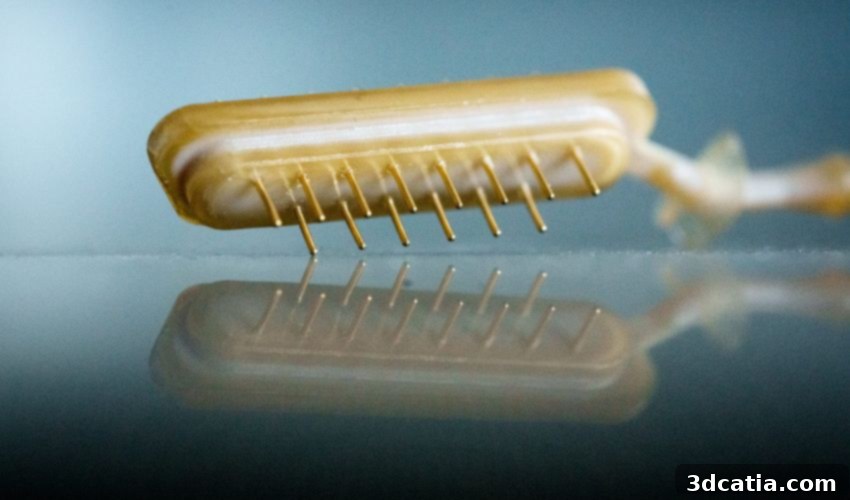
*Cover: A PEEK part made using a 3D printed molding tool (photo credits: Craig Fritz/Sandia National Laboratories)