
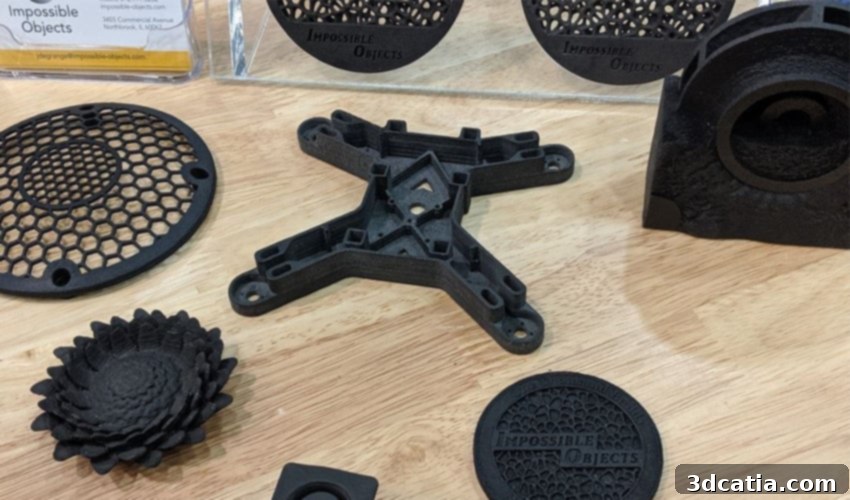
Revolutionizing 3D Printing: Ricoh 3D and Impossible Objects Pioneer New Composite Materials
The landscape of additive manufacturing is undergoing a significant transformation, with an increasing number of companies recognizing the unparalleled advantages offered by composite materials for developing high-performance parts. This burgeoning trend is precisely why Ricoh 3D, a prominent Japanese 3D printing service provider renowned for its innovation and precision, has forged a strategic alliance with Impossible Objects, a pioneering manufacturer specializing in composite 3D printers. This landmark collaboration is set to redefine possibilities in industrial manufacturing by focusing on the development of an innovative range of powder-based 3D composite materials. For those unfamiliar with the terminology, a composite material is fundamentally composed of two or more distinct materials, which, when combined, yield properties superior to those of their individual constituents. In contemporary additive manufacturing, the term “composite” predominantly refers to materials reinforced with fibers, such as carbon or glass fibers. These reinforcements are instrumental in manufacturing parts that are not only significantly lighter but also considerably stronger and more durable. Recognizing these critical advantages and the vast potential they unlock, Impossible Objects has dedicated its expertise to specializing in this advanced field, pushing the boundaries of what is achievable with additive manufacturing.
Impossible Objects stands at the forefront of composite additive manufacturing, leveraging its groundbreaking Composite-Based Additive Manufacturing (CBAM) technology. This proprietary process enables the production of parts characterized by their exceptionally complex geometries and remarkable resistance to stress and wear. According to the company, CBAM technology is unique in its ability to seamlessly combine long fiber reinforcements with high-performance polymer powders. This integration results in the creation of continuous fiber composites, offering structural integrity and performance levels previously unattainable through conventional 3D printing methods. Bob Swartz, Founder and President of Impossible Objects, articulates the significance of their innovation, stating, “Our CBAM process represents a significant leap forward in 3D printing, offering substantial improvements in speed, superior material properties, and a much wider selection of available materials. Leading Fortune 100 companies, various government agencies, and diverse industrial sectors have already successfully deployed CBAM technology to produce a vast array of components—ranging from intricate car and aircraft parts that demand extreme durability to lightweight and robust athletic gear designed for peak performance.” Swartz further emphasizes the strategic importance of the collaboration with Ricoh 3D, adding, ”By collaborating with the esteemed team at Ricoh 3D, who share our vision and recognize the transformative potential of additive manufacturing, we are confident that together we will be able to extend these crucial competitive advantages to a greater number of organizations across Europe, empowering them to innovate and excel in their respective markets.” This partnership is poised to democratize access to high-performance composite parts, facilitating advanced manufacturing solutions across the continent.
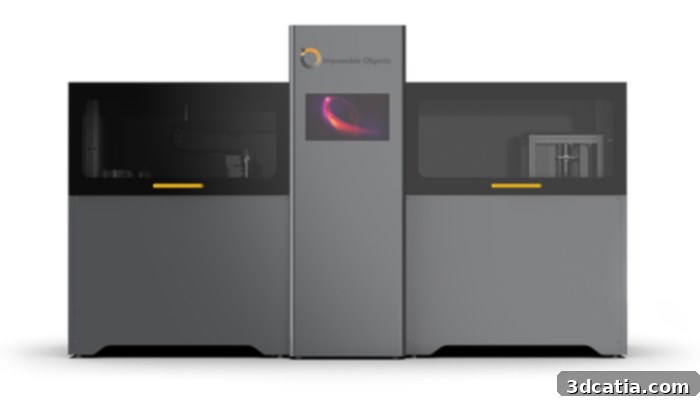
The CBAM-2 3D printer, a key technology for advanced composite manufacturing. (Photo credits: Impossible Objects)
Unlocking Superior Performance: The Power of Fiber-Reinforced Composites in Additive Manufacturing
Composite materials represent a paradigm shift in engineering and manufacturing. At their core, composites combine a matrix material (typically a polymer in 3D printing) with a reinforcing material (fibers) to create a new material with enhanced properties. The magic lies in the synergy: the fibers provide strength and stiffness, while the matrix binds them together, protecting them and transferring loads. In the context of 3D printing, especially for demanding industrial applications, fiber-reinforced composites offer an array of benefits that traditional plastics or even metals struggle to match. These benefits include significantly higher strength-to-weight ratios, allowing for lighter designs without compromising structural integrity—a critical factor in industries like aerospace and automotive where every gram counts. They also exhibit superior stiffness, excellent fatigue resistance, and improved dimensional stability under varying thermal and mechanical loads. Furthermore, specific composite formulations can offer enhanced chemical resistance and thermal performance, making them suitable for use in harsh environments where conventional materials would degrade rapidly. The ability to precisely control the orientation and density of continuous fibers within a 3D printed part, as enabled by CBAM technology, allows engineers to tailor material properties to specific load paths and application requirements, leading to optimized designs and unprecedented performance capabilities.
Strategic Partnership: Ricoh 3D’s Vision for European Additive Manufacturing
Ricoh 3D’s decision to partner with Impossible Objects underscores its commitment to delivering cutting-edge additive manufacturing solutions to its clientele across Europe. As a leading 3D printing service provider, Ricoh 3D recognizes the increasing demand for advanced materials that can meet the stringent requirements of industrial applications. The integration of Impossible Objects’ CBAM technology and its advanced composite materials into Ricoh 3D’s service portfolio signifies a strategic move to address this market need. This collaboration empowers Ricoh 3D to offer parts that are not only lighter and stronger but also capable of withstanding extreme conditions, thus expanding the scope of applications for additive manufacturing. European industries, from high-performance automotive to specialized medical devices and robust industrial machinery, stand to benefit immensely from this enhanced capability. The partnership will facilitate faster iteration cycles for prototypes, enable on-demand production of highly specialized components, and ultimately drive innovation by providing access to materials that push the boundaries of design and functionality.
Introducing the New Range: Carbon Fiber PEEK and Carbon Fiber PA12
The much-anticipated new range of materials, developed through the collaborative efforts of Ricoh 3D and Impossible Objects, will initially feature advanced carbon fiber PEEK and carbon fiber PA12. These materials are meticulously engineered to serve a broad spectrum of industrial applications where conventional materials fall short. The primary objective is to enable the manufacture of industrial parts with an optimized strength-to-weight ratio, which is crucial for efficiency and performance in sectors such as aerospace, automotive, and robotics. Furthermore, these materials are designed to significantly mitigate geometric restrictions often encountered with traditional manufacturing methods, allowing for greater design freedom and the creation of highly complex, integrated components. Beyond mechanical strength, these specific composite materials are engineered to offer superior performance at elevated temperatures and exhibit significantly enhanced chemical resistance, making them ideal for challenging operational environments.
Deep Dive into Material Properties and Applications: Carbon Fiber PEEK and PA12
Carbon Fiber PEEK: The Pinnacle of Performance
Polyether Ether Ketone, commonly known as PEEK, is a high-performance thermoplastic polymer renowned for its exceptional properties even before fiber reinforcement. It offers outstanding mechanical strength, stiffness, and creep resistance, coupled with excellent thermal stability, allowing it to maintain its integrity at high operating temperatures (often up to 260°C). PEEK also boasts superb chemical resistance, being largely unaffected by a wide range of organic and inorganic chemicals, and is inherently biocompatible, making it a material of choice for medical implants. When reinforced with carbon fibers, PEEK’s already impressive properties are significantly amplified. Carbon fiber PEEK composites exhibit even greater tensile strength, stiffness, and fatigue resistance, while simultaneously becoming lighter. This combination makes carbon fiber PEEK an ideal candidate for critical applications in the aerospace industry (e.g., structural components, brackets, fairings), automotive sector (e.g., engine components, high-stress parts), and medical field (e.g., custom prosthetics, surgical tools, implants). Its ability to withstand extreme conditions, from harsh chemicals to high thermal loads, ensures long-term reliability and performance in the most demanding environments.
Carbon Fiber PA12: Enhanced Strength and Versatility
PA12, or Nylon 12, is a widely used polymer in additive manufacturing, prized for its excellent balance of mechanical properties, including good strength, ductility, and impact resistance. It also offers good chemical resistance to oils, greases, and fuels, along with commendable dimensional stability. While PA12 is a versatile material on its own, its capabilities are significantly extended when reinforced with carbon fibers. Carbon fiber PA12 composites achieve a dramatic increase in stiffness and tensile strength, transforming the material into one capable of replacing metal components in many applications. The addition of carbon fibers also improves its heat deflection temperature and reduces thermal expansion, making parts more stable under varying thermal conditions. This enhanced performance profile opens up new avenues for carbon fiber PA12 in industrial applications requiring robust, lightweight parts with improved structural integrity. Examples include jigs and fixtures in manufacturing, drone components, functional prototypes, and end-use parts in various consumer and industrial goods where a combination of strength, toughness, and reduced weight is paramount. The enhanced characteristics allow designers to create intricate geometries that would be challenging or impossible to produce with traditional manufacturing processes, all while benefiting from the superior mechanical properties of the composite.
The Future of Additive Manufacturing: Composites Leading the Charge
Mark Dickin, Director of Additive Manufacturing and Molding Engineering at Ricoh 3D, succinctly captures the profound impact of this collaboration and the broader market trend: “Composites are unequivocally set to be an area of immense growth and revolutionary innovation within additive manufacturing in the coming years. The introduction of these new advanced materials—carbon fiber PEEK and carbon fiber PA12—is not just an incremental improvement; it will fundamentally change the game across a multitude of industries by enabling applications previously thought impossible for 3D printed parts. Impossible Objects’ CBAM process is nothing short of a revolution in the way high-performance composite parts are designed and manufactured, offering unparalleled capabilities in terms of material properties and geometric freedom. Therefore, we at Ricoh 3D are immensely proud to be working hand-in-hand with Impossible Objects, actively positioning ourselves at the forefront of this transformative movement across the European additive manufacturing landscape. This partnership signifies our commitment to providing our customers with access to the most advanced and impactful technologies available, helping them achieve new levels of performance and efficiency in their product development and production cycles.” This vision highlights a future where additive manufacturing, powered by composite materials, transcends its traditional prototyping role to become a mainstream method for producing end-use industrial components.
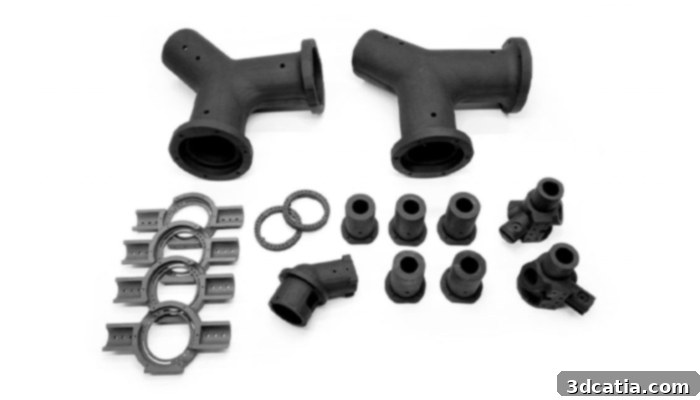
Examples of high-performance 3D printed parts utilizing PEEK and PA12 reinforced with carbon fibers. (Photo credits: Ricoh 3D)
The collaboration between Ricoh 3D and Impossible Objects represents a pivotal moment for the additive manufacturing industry, particularly in Europe. By combining Ricoh 3D’s extensive service network and manufacturing expertise with Impossible Objects’ cutting-edge CBAM technology and new composite materials, the partnership is set to accelerate the adoption of high-performance 3D printed composites across various sectors. This will lead to the creation of lighter, stronger, and more resilient parts that can operate under extreme conditions, ultimately driving innovation and efficiency in product design and production.
What are your thoughts on the transformative potential of composite materials in additive manufacturing? We invite you to share your valuable opinions and insights in the comments section below this article, or engage in a discussion with fellow enthusiasts and experts within the vibrant 3Dnatives forum. Stay updated with the latest advancements by finding all our insightful videos on our YouTube channel. For real-time updates and news, make sure to follow us on Facebook and Twitter!