
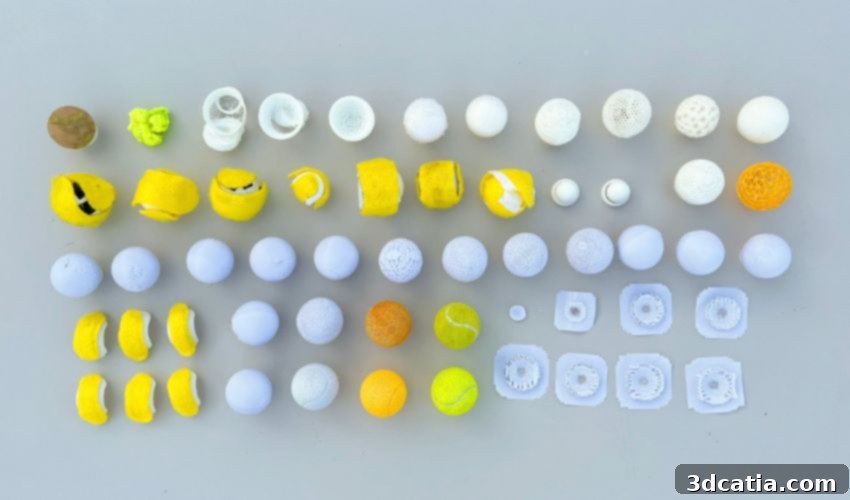
Revolutionizing Tennis: How 3D Printed, Eco-Friendly Balls Are Changing the Game
Tennis, a sport enjoyed by millions globally, faces a significant environmental challenge: the short lifespan and disposal of its primary equipment – the tennis ball. Traditional tennis balls are notorious for their limited durability, typically lasting anywhere from a few hours in competitive play to a few weeks for recreational users. This rapid degradation is due to the constant impact that wears down the felt and causes internal pressure to drop, leading to an inconsistent and lifeless bounce. The environmental consequences are staggering: over 300 million tennis balls are manufactured worldwide each year, and the vast majority of these discarded balls end up in landfills. Here, they can take an alarming 400 years to fully decompose, contributing to plastic pollution and environmental degradation on a massive scale. This unsustainable cycle highlights an urgent need for innovative solutions within the sports industry.
A Sustainable Revolution: Introducing POINT
Addressing this critical environmental issue head-on, Noé Chouraqui, a visionary third-year Product and Industrial Design student at Central Saint Martins, has developed a groundbreaking solution: POINT. POINT is a pioneering 3D printed tennis ball meticulously crafted from eco-friendly materials. Designed to be both exceptionally durable and fully recyclable, these innovative balls represent a compelling sustainable alternative to their conventional counterparts. Chouraqui’s ambition for POINT extends beyond mere sustainability; he aims for these balls to potentially earn official approval from the International Tennis Federation (ITF) for use in professional matches, signaling a transformative shift in how tennis equipment is perceived and produced. This project showcases the potential of combining cutting-edge technology with ecological responsibility to forge a greener future for sports.
The Genesis of POINT: Noé Chouraqui’s Vision
Noé Chouraqui embarked on the POINT project with a clear objective: to demonstrate that high-performance standards and environmental sustainability are not mutually exclusive but can, in fact, coexist and thrive. His journey involved extensive research and development, driven by a desire to create a tennis ball that not only performs at an elite level but also minimizes its ecological footprint throughout its lifecycle. Chouraqui’s design philosophy centered on leveraging the capabilities of additive manufacturing to overcome the limitations of traditional ball production, allowing for greater control over material properties, internal structure, and ultimately, the ball’s bounce and durability. The very essence of POINT lies in challenging the status quo, proving that innovation can indeed lead to a significantly reduced environmental impact, inspiring a ripple effect of change across the entire sports equipment manufacturing sector.
Innovative Design and Material Science: The Heart of POINT
The creation of POINT involved a meticulous and iterative design process, reflecting Chouraqui’s commitment to both performance and sustainability. He conducted extensive testing, experimenting with a variety of 3D printing filaments, diverse internal lattice structures, and fine-tuning numerous printing parameters. This rigorous exploration was facilitated by sophisticated software tools such as Fusion 360 for advanced 3D modeling and BambuLab Studio for precise slicing and print management. Through countless iterations, Chouraqui was able to achieve a perfect equilibrium of strength, consistent bounce, and unparalleled durability, essential characteristics for any high-performance tennis ball. This intensive development process culminated in a unique and highly effective patented design that stands as a testament to the potential of additive manufacturing in sports innovation.
The Power of PLA-HR Filament
In an insightful interview with Dezeen, Chouraqui revealed a pivotal aspect of POINT’s eco-friendly design: the selection of High Resilience PLA (PLA-HR) as the primary filament. Unlike traditional synthetic rubber and felt materials, PLA-HR is derived from plant-based sources, predominantly corn starch, making it a biodegradable and renewable material. This choice significantly reduces the reliance on petroleum-based products, which are common in conventional tennis ball manufacturing. The “High Resilience” property of this PLA variant is particularly crucial, as it ensures the ball maintains the necessary elasticity and energy return for a consistent and dynamic bounce, closely mimicking the performance of standard balls while offering vastly superior environmental credentials. The adoption of PLA-HR not only supports the ball’s sustainability claims but also challenges preconceived notions about the performance limitations of eco-friendly materials in demanding applications like sports equipment.
Advanced 3D Printing Techniques
The use of 3D printing technology for POINT allowed for unparalleled precision in designing the ball’s internal structure. Chouraqui could experiment with various lattice patterns, optimizing them for specific characteristics such as weight distribution, impact absorption, and rebound consistency. This level of customization is virtually impossible with traditional manufacturing methods. The ability to prototype rapidly and test different internal geometries meant that each iteration brought the design closer to the ideal balance required for a professional-grade tennis ball. This iterative additive manufacturing approach not only accelerated the development cycle but also ensured that the final product was engineered for peak performance and durability, pushing the boundaries of what is possible in sports equipment design.
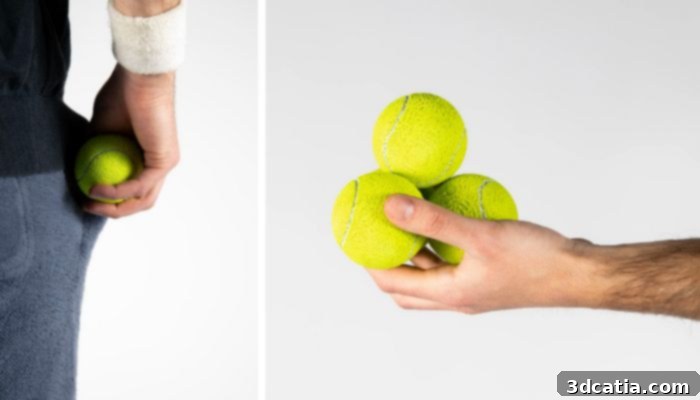
The neon yellow POINT tennis balls mimic the look of classic tennis balls while offering superior sustainability.
Rigorous Testing and Official Endorsement: A Step Towards the Future
For POINT to truly revolutionize the sport, gaining official recognition and approval from governing bodies like the International Tennis Federation (ITF) is paramount. In a significant step forward, Jamie Capel Davies, the Head of Science and Technical at the ITF, officially tested the POINT balls. This rigorous evaluation is crucial for assessing whether these 3D printed alternatives can meet the stringent performance standards required for professional play. Currently, the ITF Technical Commission is meticulously reviewing the data collected from POINT’s testing, signaling a genuine interest in exploring and potentially integrating sustainable alternatives into official match regulations. According to Chouraqui, the initial prototypes have already shown “promising aerodynamic performance closely matching conventional tennis balls,” a crucial indicator that POINT could indeed hold its own on the court. This engagement with the ITF underscores the seriousness and potential impact of Chouraqui’s innovation, paving the way for a greener future for competitive tennis.
Beyond the Ball: Holistic Sustainability
Chouraqui’s commitment to sustainability extends beyond just the tennis ball itself. Recognizing that packaging plays a vital role in a product’s overall environmental impact, he also meticulously designed sustainable cardboard tubes to accompany the POINT balls. These recyclable packaging solutions further reduce the project’s ecological footprint, offering a comprehensive eco-conscious approach from product to presentation. This holistic view of sustainability ensures that every aspect of POINT’s lifecycle, from manufacturing to eventual disposal or recycling, aligns with its core mission of environmental responsibility. By integrating sustainable packaging, Chouraqui sets a new standard for sports equipment, demonstrating that a commitment to the planet can be woven into every stage of product development and consumer experience.
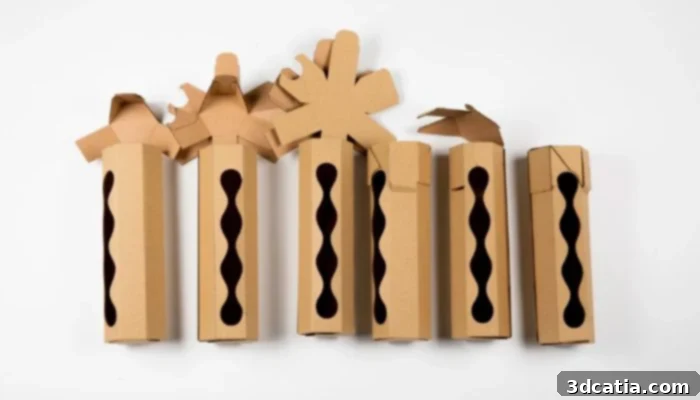
The innovative recyclable packaging is designed to hold four POINT balls, emphasizing comprehensive sustainability.
Additive Manufacturing: A Catalyst for Green Innovation
The POINT project stands as a powerful testament to how additive manufacturing (3D printing) can serve as an indispensable tool in working towards a more sustainable future. This technology enables the creation of complex geometries with minimal material waste, allows for on-demand production that reduces inventory and transportation costs, and facilitates the use of innovative, eco-friendly materials like PLA-HR. As Chouraqui articulates in his project description, “I created POINT to showcase that sustainability and high-performance standards can coexist.” He further elaborates, “It demonstrates that innovation and technology can reduce environmental impact significantly, transforming tennis equipment and inspiring change across the sports industry.” POINT is not just a new tennis ball; it’s a blueprint for how other sports and industries can harness additive manufacturing to develop environmentally responsible, high-performance products. To delve deeper into this inspiring project, you can click HERE. Furthermore, to explore more ways additive manufacturing is being utilized in the world of sports, we invite you to review our insightful infographic here.
Conclusion: Serving Up a Greener Future for Tennis
The POINT 3D printed tennis ball represents a monumental leap forward in the quest for sustainable sports equipment. By tackling the pervasive issue of waste generated by conventional tennis balls, Noé Chouraqui has not only engineered a high-performance alternative but has also ignited a conversation about environmental responsibility within the global sports community. The potential for ITF approval means that eco-friendly solutions could soon become the standard, rather than the exception, on courts worldwide. This innovation underscores the transformative power of additive manufacturing in creating products that are both functionally superior and environmentally benign. As we look towards a future where sustainability is no longer a niche concern but a fundamental aspect of design and production, POINT stands as a beacon of what is achievable. It inspires us to rethink our approach to consumption and production, proving that with creativity and technological prowess, we can indeed serve up a greener, more sustainable future for tennis and beyond.
What are your thoughts on 3D printed tennis balls and their potential impact on the sport and environment? We’d love to hear your perspective! Feel free to share your comments below or engage with us on our LinkedIn or Facebook pages. Additionally, don’t miss out on the latest advancements in 3D printing and sustainable technologies; sign up for our free weekly Newsletter to get cutting-edge news delivered directly to your inbox. You can also find all our engaging videos and content on our YouTube channel.
*Cover Photo: Iterations of the POINT design. All Photo Credits: Noé Chouraqui