
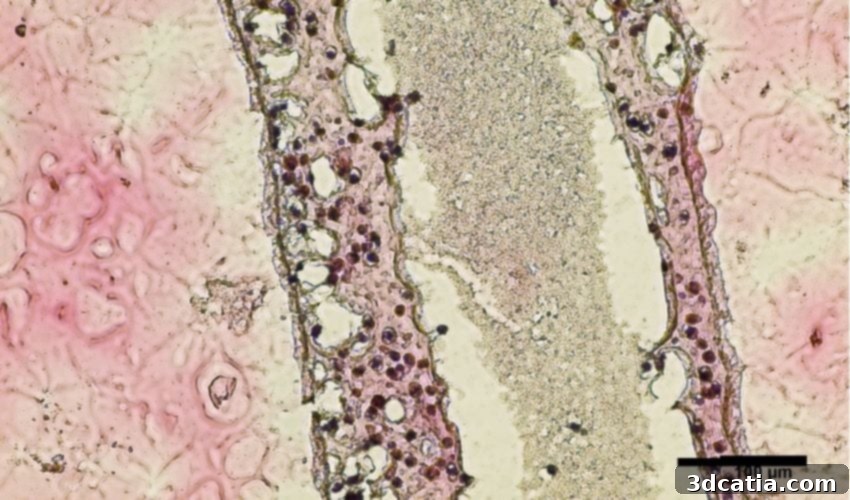
Revolutionizing Male Fertility: UBC’s 3D Bioprinting Breakthrough for Testicular Cells
The landscape of reproductive medicine is witnessing a transformative era, largely propelled by incredible advancements in additive manufacturing, specifically bioprinting. A recent and truly groundbreaking achievement comes from the University of British Columbia (UBC), where a dedicated team of researchers, spearheaded by the distinguished Dr. Ryan Flannigan, has successfully accomplished a world first: the 3D printing of human testicular cells. This pivotal development marks a significant stride in addressing one of the most challenging medical issues globally – male infertility. After a meticulous process of cultivation and maturation spanning several days, these pioneering cells demonstrated a remarkable capacity to evolve into precursors capable of producing sperm. While the ultimate goal of bioprinting fully functional and viable male reproductive cells remains a long-term objective, this breakthrough represents an indispensable step forward for the medical sector. It promises to unlock new avenues and offer much-needed solutions for countless men grappling with various forms of infertility, thereby providing hope where options were previously limited.
The continuous evolution of medical additive manufacturing consistently delivers innovations that inspire awe and push the boundaries of what’s possible, particularly within the sensitive and complex field of fertility studies. This recent development at UBC builds upon a foundation of previous successes that highlight bioprinting’s immense potential. Back in 2017, for instance, a collaborative effort between Northwestern University and the McCormick School of Engineering yielded another significant milestone: the successful bioprinting of functional ovaries. These bioprinted ovaries were then implanted into sterile mice, astonishingly enabling them to produce healthy offspring. Such achievements underscore the incredible versatility and promise of bioprinting in recreating complex biological structures. Now, with this latest research, bioprinting has turned its transformative attention to male reproductive health, creating a comprehensive approach that allows doctors and researchers to address fertility challenges on both sides of the reproductive equation, offering more inclusive and holistic treatment prospects for couples worldwide.
The Silent Struggle: Understanding Male Infertility and NOA
Infertility is a widespread health concern, impacting approximately 15 percent of couples globally. What is often less recognized is the significant role male factors play, contributing to at least half of these cases. For many men, the emotional and psychological toll of infertility can be profound, yet treatment options for certain conditions remain severely limited. Dr. Flannigan’s groundbreaking research project directly aims to tackle these currently untreatable forms of male infertility, offering a beacon of hope where conventional medicine often falls short. One particularly challenging condition is non-obstructive azoospermia (NOA). This severe form of male infertility is characterized by a complete absence of viable sperm during ejaculation, not due to a blockage (obstructive), but because the seminiferous tubules – the tiny tubes within the testicles responsible for sperm production – have a significantly diminished or entirely absent capacity to produce sperm. For men with NOA, the path to biological fatherhood is often fraught with immense difficulty and emotional distress.
Current medical interventions for NOA are often invasive and have limited success rates. In some rare instances, a surgical procedure known as testicular sperm extraction (TESE) can be performed to attempt to locate and retrieve reproductive cells directly from the testicles. However, this delicate operation is successful in recovering sperm in only about half of the cases, and even when sperm is found, it may be scarce or of suboptimal quality. This leaves a substantial percentage of men with NOA with no viable options for having biological children, leading to profound personal challenges and heartache. The limitations of existing treatments highlight the urgent need for innovative solutions, making Dr. Flannigan’s research into 3D bioprinting testicular cells not just a scientific curiosity but a deeply humanitarian endeavor that could redefine the possibilities for countless families.
Bioprinting’s Expanding Horizon: From Ovaries to Testicular Cells
Bioprinting, a cutting-edge field within additive manufacturing, involves the use of 3D printing technologies to fabricate biological structures, such as tissues and organs, by depositing layers of living cells. This revolutionary technique has opened up unprecedented possibilities in regenerative medicine, drug discovery, and, increasingly, reproductive health. The journey of bioprinting in reproductive studies has already seen remarkable milestones. As previously mentioned, the 2017 success at Northwestern University, where researchers were able to bioprint functional ovaries and restore fertility in sterile mice, demonstrated the immense potential of this technology. That project marked a critical step in addressing female infertility, proving that complex reproductive organs could be artificially constructed and integrated into biological systems with functional outcomes.
Building on these foundational achievements, the focus of bioprinting has now strategically expanded to encompass male reproductive challenges. The UBC team’s work represents a pivotal shift, ensuring that the benefits of this advanced technology can address fertility issues comprehensively, on both the female and male sides. This holistic approach is crucial for couples, as infertility is a shared journey, often requiring solutions that cater to the unique physiological complexities of both partners. By successfully demonstrating the ability to 3D print human testicular cells, Dr. Flannigan and his colleagues are paving the way for parallel innovations in male reproductive medicine, promising a more balanced and complete array of treatment options for infertility worldwide.
The Pioneering Process: Harvesting, Printing, and Cultivating Cells
The methodology employed by the UBC researchers for this groundbreaking project is a testament to the sophistication of modern regenerative medicine. The initial crucial step involved harvesting stem cells directly from the testicles of a patient diagnosed with non-obstructive azoospermia (NOA). These stem cells are pluripotent, meaning they possess the remarkable ability to differentiate into various specialized cell types, including those responsible for sperm production. Once these precious stem cells were successfully collected, the UBC team meticulously prepared them for the bioprinting process. The challenge was not merely to print cells but to arrange them in a structure that would encourage their natural physiological function – mimicking the intricate environment of the human testicle.
To achieve this, the researchers utilized advanced 3D bioprinting technology to arrange the harvested stem cells into a highly specific, hollow tubular structure. This artificial construct was carefully designed to closely resemble the seminiferous tubules, the functional units within the testicles where sperm development, known as spermatogenesis, naturally occurs. Dr. Flannigan eloquently emphasizes the rationale behind this precise architectural replication: “We’re 3D printing these cells into a very specific structure that mimics human anatomy, which we think is our best shot at stimulating sperm production.” This biomimetic approach is believed to provide the optimal microenvironment for the cells to mature and differentiate correctly, fostering the necessary cell-to-cell interactions and biochemical signals required for healthy sperm formation. He further elaborates on the potential impact of this method, stating, “If successful, this could open the door to new fertility treatments for couples who currently have no other options.” This highlights the profound hope this research offers to those for whom conventional treatments have been ineffective.
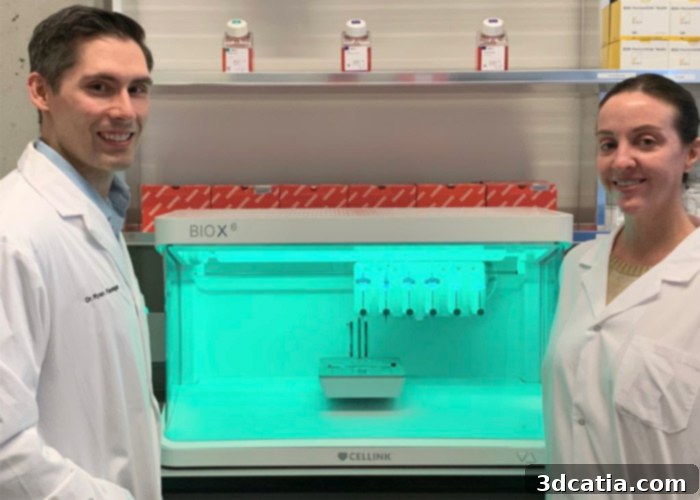
Dr. Flannigan, left, and his assistant Meghan Robinson in front of the 3D bioprinter (photo credit: UBC)
Encouraging Early Results and the Path Forward
The initial results emanating from this groundbreaking bioprinting phase have been remarkably encouraging and provide a strong impetus for continued research. Just twelve days after the 3D printing of the testicular cells into their biomimetic tubular structures, the UBC researchers meticulously observed the cultured constructs. What they discovered was profoundly significant: the majority of the 3D printed cells had not only survived the complex bioprinting process but had also begun to evolve. Crucially, some of these cells had successfully differentiated into specialized cell types, showing promising signs indicative of their inherent ability to produce sperm. This differentiation is a critical step, demonstrating that the engineered environment created by the bioprinter can effectively guide stem cells toward a specific reproductive fate.
While these initial findings are a powerful validation of the methodology, the researchers are acutely aware that the journey is far from complete. The next critical step in this elaborate research trajectory involves further training these newly differentiated cells. This training will entail exposing them to a carefully orchestrated regimen of various growth factors and essential nutrients, all designed to optimize their development and function. Concurrently, the team plans to refine the structural arrangement of the bioprinted constructs. The goal is to enhance cell-to-cell interactions within the printed tubules, as these intricate communications are fundamental for efficient and healthy sperm production. By continually optimizing both the biochemical environment and the physical architecture, the researchers hope to significantly improve the rate and quality of sperm generation from these engineered tissues. The road ahead is undoubtedly long, and significant research hurdles remain before clinical applications can be realized. However, the initial differentiation and survival of these 3D printed cells offer profound hope and represent a monumental leap forward in the quest to overcome male infertility, solidifying the potential of regenerative medicine.
Personalized Medicine: Tailoring Solutions for Unique Challenges
Beyond the immediate goal of producing sperm-generating cells, this research project by Dr. Flannigan’s team is simultaneously serving another vital purpose: it is significantly advancing our understanding of the complex factors that contribute to non-obstructive azoospermia (NOA). By carefully harvesting stem cells from individual patients with NOA, the researchers gain an unparalleled opportunity to delve into the unique genetic expression and specific characteristics of each cell. This deep dive into individual cellular profiles is critical because, as the team increasingly recognizes, infertility is rarely a monolithic condition.
Dr. Flannigan articulates this nuanced understanding, stating, “Increasingly, we’re learning that there are likely many different causes of infertility and that each case is very patient specific.” This insight underscores the necessity for a departure from one-size-fits-all treatments towards a more tailored, personalized approach. He elaborates on their strategy: “With that in mind, we’re taking a personalized, precision medicine approach – we take cells from a patient, try to understand what abnormalities are unique to them, and then 3D print and support the cells in ways that overcome those original deficiencies.” This precision medicine paradigm is revolutionary. By first identifying the specific cellular and genetic abnormalities unique to an individual patient’s NOA, the researchers can then customize the bioprinting process and subsequent cell culture conditions to specifically address and overcome those particular deficiencies. This ensures that the generated testicular cells are not just generic but are intrinsically supported and nurtured to maximize their potential for sperm production, offering a truly individualized therapeutic strategy that holds immense promise for improving treatment efficacy and patient outcomes in the future.
The Future of Reproductive Bioprinting
The pioneering work at UBC in 3D printing human testicular cells signifies far more than just a scientific accomplishment; it represents a profound shift in how we approach and treat male infertility. This breakthrough brings us closer to a future where men diagnosed with severe forms of infertility, such as non-obstructive azoospermia, may have a viable pathway to biological fatherhood that was previously unimaginable. The ability to create functional, sperm-producing tissues from a patient’s own cells not only addresses a significant unmet medical need but also paves the way for a new era of regenerative medicine in reproductive health.
This research opens up incredible possibilities for future innovations. Imagine a scenario where fully functional testicular organoids could be bioprinted, capable of sustained sperm production. Beyond direct clinical applications, this technology will also serve as an invaluable platform for understanding the intricate biology of spermatogenesis and the underlying causes of male infertility at a cellular and genetic level. While challenges remain, including scaling up production, ensuring long-term viability, and navigating regulatory pathways, the foundational work by Dr. Flannigan and his team provides immense hope. It underscores the transformative potential of bioprinting to offer personalized, effective solutions, ultimately enhancing the lives of millions of individuals and couples striving to build families. You can find more information about this groundbreaking research HERE.
What do you think about using bioprinting to design reproductive cells and address infertility? Let us know in a comment below or on our Linkedin, Facebook, and Twitter pages! Don’t forget to sign up for our free weekly Newsletter here, to get the latest 3D printing news straight to your inbox! You can also find all our videos on our YouTube channel.