
Revolutionizing Medical Device Manufacturing: Nexa3D and Henkel Unveil High-Performance, Biocompatible xMED412 3D Printing Material
The landscape of additive manufacturing is continually evolving, driven by strategic partnerships that bring together complementary expertise. A prime example of such a synergistic collaboration is the alliance between Nexa3D, a trailblazing manufacturer of ultrafast stereolithography 3D printers, and Henkel, an international conglomerate recognized globally as a leading supplier of high-impact additive materials. These two innovation-oriented companies recently marked a significant milestone with the commercialization of their second jointly developed material, aptly named xMED412. This groundbreaking, polypropylene-like material is specifically engineered to meet the stringent demands of the medical sector, proving ideal for the rapid and efficient manufacturing of a diverse range of biocompatible, medical, and wearable devices. The introduction of xMED412 underscores a commitment to advancing healthcare through high-speed, high-performance 3D printing solutions.
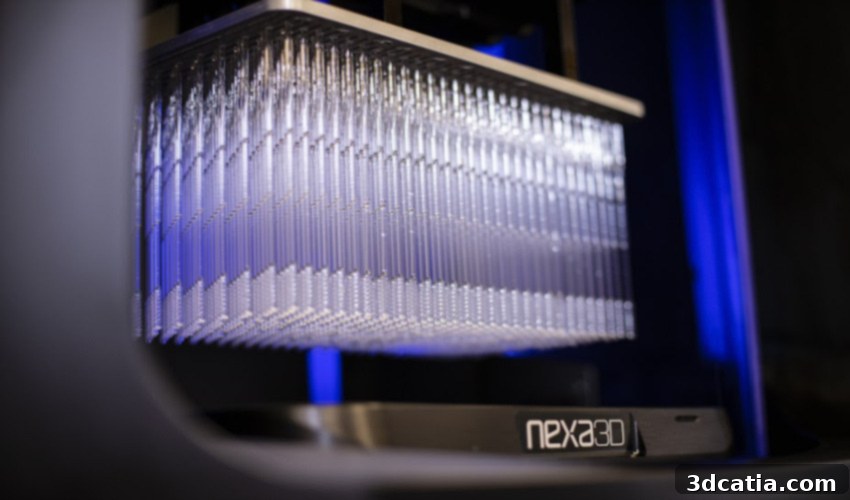
Nexa3D, headquartered in California, is at the forefront of designing and producing industrial-grade SLA 3D printers that redefine speed and productivity. The company’s innovative printers are powered by its proprietary Lubricant Sublayer Photo-curing (LSPc) technology, complemented by a patented structured light matrix. This advanced combination enables their machines to achieve unparalleled print speeds, reaching up to 1 centimeter per minute. Such remarkable velocity drastically curtails 3D printing cycles for precision functional parts, transforming what traditionally took hours into mere minutes. This capability is crucial for industrial applications where time-to-market and production efficiency are paramount. Nexa3D’s collaboration with Henkel began in April 2020, a partnership that quickly bore fruit with the successful introduction of their first joint material, xABS Black, showcasing their shared vision for advanced additive solutions.
All image credits: Nexa3D
While their initial material, xABS Black, demonstrated the potential of their partnership in general industrial applications, the most recent announcement centers squarely on xMED412. This new material is a high-impact, exceptionally durable 3D printing photopolymer, uniquely suited for the rigorous demands of medical and athletic devices. xMED412 boasts mechanical attributes remarkably similar to those of polypropylene, a material widely valued for its chemical resistance, lightweight nature, and excellent flexibility. Specifically, xMED412 exhibits fantastic elongation and impressive compression strength, critical properties for parts that must withstand stress and deformation without failing. The increasing global demand for advanced additive plastics like xMED412 has been further amplified by the extraordinary circumstances of the COVID-19 pandemic, highlighting the urgent need for flexible and rapid manufacturing of essential supplies.
One of xMED412’s most compelling features is its combination of being lightweight yet inherently sturdy. This material is designed with intrinsic insulating properties and is engineered to effectively withstand impact, moisture, and vibration—environmental challenges frequently encountered by medical devices. These highly desirable characteristics make xMED412 an ideal choice for components that require rigorous sterilization or disinfection protocols, and for devices that must be reliably shipped globally for critical use in diverse settings, from homecare environments to professional healthcare facilities. Ken Kisner, Henkel’s Head of Innovation for 3D printing, emphasized the material’s timely relevance, stating: “With regard to the current Covid-19 pandemic, we are pleased that nasopharyngeal swabs manufactured with xMED412 on the NXE400, in accordance with our published procedures, have already been cleared through clinical trials.” This rapid qualification underscored the material’s readiness and reliability in critical applications.
The robust properties of xMED412, combined with Nexa3D’s high-speed printing technology, have enabled unprecedented agility in responding to global health crises. The NXE400 printer, with its advanced LSPc capabilities, proved instrumental in demonstrating the material’s potential under pressure. During the height of the pandemic, the ability to rapidly produce vital medical components became a defining factor in patient care. This partnership effectively addressed immediate needs, leveraging cutting-edge additive manufacturing to deliver solutions where they were most urgently required. The synergy between material science and advanced printing hardware was clearly showcased.
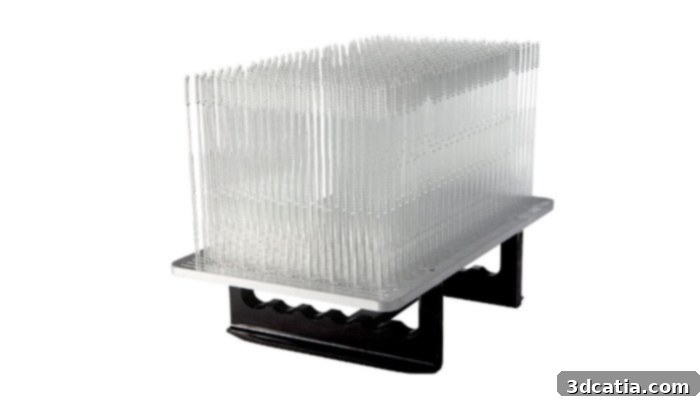
Nasal swabs 3D printed on NXE400
Michele Marchesan, Nexa3D’s Chief Growth Officer, highlighted the impressive scalability achieved during this critical period: “In the U.S., we quickly qualified and scaled up single printer production capacity to 5400 swabs a day at our Nexa3D flexible factory in support of the ongoing demand for nasal swabs. Elsewhere, we are printing ventilator parts and other medical device parts, including venturis and connectors at productivity and scale, which are fast achieving the new standard for flexible series production.” This remarkable feat demonstrates the power of additive manufacturing to rapidly pivot and scale production for essential medical supplies, proving that 3D printing can indeed be a cornerstone of resilient supply chains. This rapid response capability is not just about speed, but also about the integrity and performance of the printed parts.
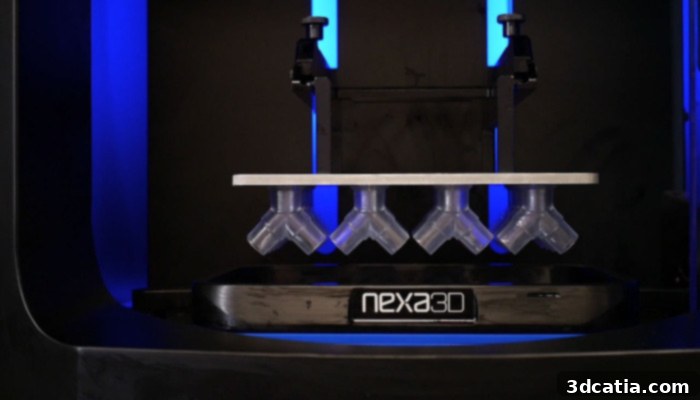
For companies dedicated to manufacturing single-use or reusable medical devices, numerous critical components often necessitate a degree of flexibility and pliability, particularly those used on or near a patient’s body. Such parts must be designed to bend and flex, requiring materials that are inherently elastic, pliable, and frequently kink-resistant. This is precisely where the combination of xMED412, as a high-performance material, and its seamless integration with the NXE400 printer truly distinguishes itself. The ability to produce flexible yet robust parts at high volumes opens doors for innovations in custom orthotics, patient-specific surgical guides, complex wearable sensors, and even advanced prosthetics. The collaboration ensures that these critical requirements are not just met, but exceeded, pushing the boundaries of what is achievable in personalized healthcare and rapid device prototyping.
The development of xMED412 signifies a pivotal advancement for the entire medical device industry. By providing a material that combines biocompatibility with outstanding mechanical properties and the capability for high-speed, high-volume production, Nexa3D and Henkel are enabling manufacturers to accelerate their design cycles, reduce costs, and bring innovative products to market faster. This partnership directly addresses the complex challenges of modern healthcare, from emergency response to the ever-present demand for more comfortable, effective, and patient-specific medical solutions. It sets a new benchmark for material and hardware synergy in additive manufacturing, illustrating the immense potential when leaders in technology and materials science converge.
Beyond the immediate applications like nasal swabs and ventilator components, xMED412’s characteristics suggest a vast array of future possibilities. Its insulation properties and durability against moisture and vibration make it suitable for durable medical equipment housings, components in diagnostic devices, or even custom inserts for protective gear. The material’s polypropylene-like attributes mean it can potentially replace traditionally injection-molded parts with customized, 3D printed alternatives, offering greater design freedom and faster iterations without compromising on performance or safety. This flexibility in application, coupled with the rigorous testing and clinical clearance, positions xMED412 as a versatile workhorse for the medical sector for years to come.
What do you think about the impactful partnership between Nexa3D and Henkel, culminating in their second crucial joint material development, xMED412? We invite you to share your thoughts and insights in a comment below or join the conversation on our Facebook and Twitter pages! Don’t miss out on the latest advancements and breaking news in the world of 3D printing. Sign up for our free weekly Newsletter to receive all the essential updates straight to your inbox and stay ahead of the curve in this rapidly evolving industry!