

Leading the Future of Additive Manufacturing: An Exclusive Interview with EOS CEO Marie Langer
In a pivotal moment for the additive manufacturing industry, Marie Langer was appointed CEO of the EOS GmbH Group last October. This significant leadership transition saw her succeed her father, Dr. Hans Langer, the visionary founder who established the German company in 1989. Since its inception, EOS has rapidly distinguished itself as a global leader in providing industrial additive manufacturing solutions. The company’s comprehensive portfolio includes advanced plastic and metal 3D printing systems, meticulously designed to meet the rigorous demands of diverse industrial sectors worldwide. From the high-stakes aerospace and medical fields to the precision-driven automotive and intricate jewelry industries, EOS machines are instrumental in enabling innovation and efficient production. The announcement of this leadership change prompted widespread interest, as stakeholders sought to understand the group’s evolving ambitions and the strategic direction it would pursue under new stewardship. To delve deeper into these crucial aspects and explore the challenges EOS anticipates in 2020 and beyond, we had the privilege of sitting down with Marie Langer, who embraced the responsibility of leading the family business at the young age of 33.
3DN: Could you tell our readers about your previous experience in the additive manufacturing (AM) sector?
My connection to additive manufacturing runs deep, quite literally from my earliest years. My father, Dr. Hans Langer, founded EOS when I was just three years old, meaning 3D printing technology has been an integral part of my life and upbringing. I had the unique opportunity to witness firsthand the incredible growth and evolution of this company over three decades, watching my father transform his pioneering vision into a global industry leader. During this extensive period, I actively engaged in various capacities, initially as a Co-Owner within the broader EOS ecosystem, contributing to the strategic oversight through its supervisory board. My direct involvement expanded significantly as I took on key responsibilities, including spearheading the social venture program. This initiative allowed me to explore how EOS technology could create positive societal impact, aligning business goals with broader community benefits. Furthermore, I was deeply involved in corporate development across the entire EOS GROUP, playing a crucial role in shaping its strategic growth and exploring new market opportunities. A particularly exciting venture was my support in the establishment of AM Global, an entity specifically designed to accelerate the adoption and scaling of additive manufacturing for serial production. These experiences provided me with a holistic understanding of the AM landscape, from technological development and market dynamics to strategic planning and the practical challenges of industrial implementation.
3DN: What about your current work and vision for EOS within the additive manufacturing industry?
My appointment as CEO of EOS GmbH last October marks a significant chapter for both myself and the company. This leadership transition was a carefully considered family decision, aimed at reinforcing our long-term commitment to the additive manufacturing sector while simultaneously establishing a robust foundation to optimally position EOS within what is an incredibly dynamic and constantly evolving market environment. While some might view stepping into the footsteps of a founder like my father as a daunting task, challenges have always served as a powerful catalyst for action and innovation in my journey. Consequently, the past few months since taking the helm have been exceptionally exciting, energizing me with a profound sense of purpose and positive momentum. My immediate priorities as CEO are clear and multifaceted. Foremost among them is to intensely push the boundaries of technology advancements, ensuring that EOS not only maintains but significantly extends its technology leadership in industrial 3D printing. This involves continuous investment in research and development, fostering an environment of relentless innovation, and bringing groundbreaking solutions to market. Equally critical is our commitment to providing exceptional aftersales service and unparalleled support to our valued EOS customers. We understand that the success of our customers directly reflects on our own, and therefore, ensuring their operations run smoothly and efficiently with our systems is paramount. This commitment to both cutting-edge technology and unwavering customer support forms the bedrock of our strategy moving forward.
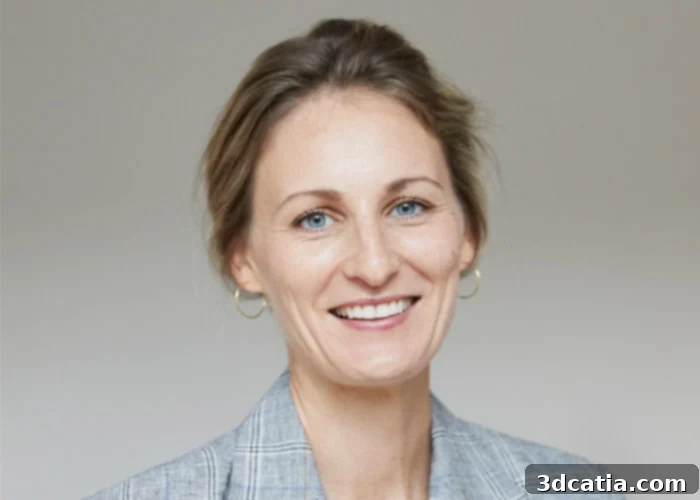
Marie Langer, CEO of the EOS GmbH Group
3DN: Could you tell us more about your new role as EOS CEO? What strategic changes will it bring to the company?
As the CEO of EOS, my primary responsibility is to orchestrate the strategic positioning of the entire EOS Group, encompassing all its subsidiaries and global operations. In this multifaceted function, my focus areas are broadly distributed across several critical pillars: strategy formulation and execution, driving global sales initiatives, enhancing our marketing and communications outreach, and critically, nurturing our corporate culture, organizational development, and people development. These areas are intrinsically linked and vital for our sustained success.
EOS has always been celebrated for its robust team spirit and its undeniable role as a pioneer in the additive manufacturing space. I am incredibly enthusiastic about collaborating with such a passionate and dedicated team. For me, true leadership is not about rigid control, but rather about establishing the right framework and fostering a positive, empowering culture. This means creating an environment where every individual feels empowered, clearly understands how their contributions align with our overarching goals, and where teams can work together trustfully and collaboratively towards a common vision. This ethos of empowerment and collaboration is central to how we will innovate and grow.
A significant strategic shift that I am implementing relates to product development and innovation. Moving forward, these crucial functions at EOS will be driven much more intensely from the customer side. This means our development cycles and innovation pipeline will be profoundly shaped by direct customer feedback, market demands, and evolving industry needs. To facilitate this customer-centric approach and ensure maximum agility, I have consciously delegated more authority and independence to our three key regional divisions: Americas, EMEA (Europe, Middle East, and Africa), and APAC (Asia-Pacific). This decentralization empowers our regional teams to adapt to specific customer needs and market dynamics as swiftly as possible, ensuring that EOS remains highly responsive and relevant in every corner of the globe. This structural change is designed to bring us closer to our customers, allowing us to react with unprecedented speed and precision to their requirements, ultimately delivering more tailored and effective additive manufacturing solutions.
SLS 3D printing process | Credits: EOS
3DN: What aspects of additive manufacturing have particularly caught your eye in the last few months?
My enduring fascination with additive manufacturing technology stems profoundly from its inherently sustainable and groundbreaking nature. For me, the most compelling aspect is the seamless intertwining of these two critical dimensions. A central focus of my tenure is to vividly demonstrate that 3D printing is not merely a catalyst for economic growth and industrial advancement, but also a powerful force for positive ecological and social impact. Ultimately, I believe this technology possesses an incredible capacity to significantly improve people’s lives across various societal strata.
In this context, one of the most truly inspiring moments I experienced recently was meeting the world-class Paralympic cyclist, Denise Schindler, at Formnext 2019. Denise has been wearing prostheses since she was two years old, highlighting a lifelong journey of adaptation and incredible athletic achievement. What makes her story particularly poignant and relevant to our work is the role of advanced manufacturing. It is, of course, absolutely crucial that a prosthesis functions flawlessly, enduring the rigors of everyday life, but for an athlete like Denise, it must also withstand the significantly higher and more demanding stresses of competitive sports. This exceptional level of performance and durability is achieved precisely by manufacturing her prostheses using additive manufacturing techniques. I am immensely proud and genuinely happy that EOS technology can play such a vital role in enabling Denise’s athletic prowess and, more importantly, contributing so meaningfully to her overall well-being and quality of life. Her story perfectly encapsulates the human-centric impact of our technology.
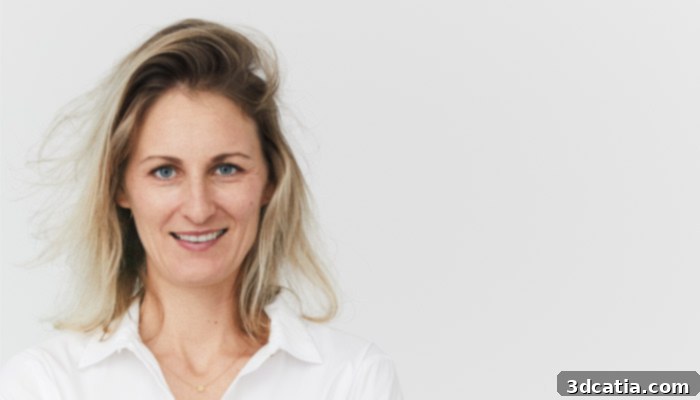
Marie Langer wishes to invest more into in-house R&D projects
Beyond such personal impact stories, the scope of benefits our technology offers is vast. I am committed to ensuring that everyone fully comprehends the profound advantages that additive manufacturing can bring. Consider, for example, the production of lightweight parts for the aerospace industry, which not only enhances fuel efficiency and reduces emissions but also improves performance and safety. These benefits extend across numerous sectors, from energy to consumer goods, offering solutions that were previously unimaginable. To effectively communicate and strategically position these advantages, we are currently dedicated to developing a robust framework centered around “responsible manufacturing.” This initiative aims to highlight how EOS technologies contribute to more sustainable, efficient, and ethical production practices. Furthermore, to continually push the boundaries of what’s possible and solidify our commitment to pioneering new applications, I am planning to significantly increase investment in our internal research and development (R&D) projects. This heightened focus on in-house innovation will enable us to explore new materials, optimize processes, and develop next-generation additive manufacturing solutions that further drive the industry forward, delivering even greater value and impact to our customers and society at large.
3DN: What do you think are the remaining challenges to the global adoption of industrial additive manufacturing across various industries?
For the widespread global adoption of industrial 3D printing, particularly for demanding serial production applications, I identify three paramount factors that require continuous innovation and refinement: consistent quality, absolute repeatability, and optimized costs. These three pillars are crucial for transitioning additive manufacturing from prototyping and niche applications to becoming a mainstream production technology across diverse industries.
It is essential to strike a delicate and effective balance between the required productivity levels and the necessary part quality. Achieving this equilibrium is paramount to fully unlock the immense potential of 3D printing in industrial manufacturing. While the capability to create vastly more complex part geometries is undoubtedly a compelling advantage for countless applications, often serving as a key differentiator and enabling market entry for innovative products, it is frequently the cost per part that ultimately dictates whether a technology can truly be considered disruptive or merely supplementary. Therefore, the development and implementation of highly productive production processes are becoming increasingly vital. This necessitates advancements in machine speed, efficiency, and automation. Concurrently, it is non-negotiable that the manufactured parts must exhibit a defined and consistently reproducible quality. This dual requirement – high productivity coupled with unwavering quality and repeatability – represents the core challenge we must overcome to drive broader industrial adoption.
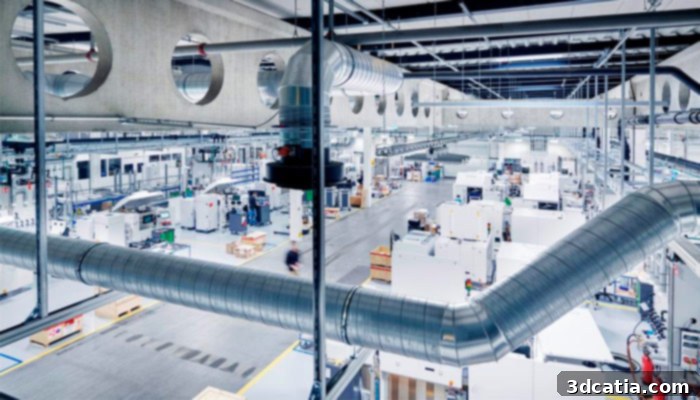
A new manufacturing site opened in 2018 in Maisach: thanks to its 9,000 m2, EOS can design 1,000 machines per year | Credits: EOS
At Formnext, we proudly showcased our innovative solution, EOS Shared Modules, which is precisely engineered to address these critical demands. This system is designed with advanced hardware and software components that fundamentally simplify and parallelize the workflow, both upstream and downstream of the actual AM build process. This comprehensive approach significantly streamlines the entire production chain, enhancing efficiency and reducing potential bottlenecks. EOS Shared Modules proves particularly advantageous when operating multiple 3D printing systems simultaneously. By centralizing and optimizing shared resources and processes, it makes it possible to manufacture high-quality metal parts on an incredibly efficient, scalable, and ultimately profitable basis. This solution represents a significant step forward in making industrial additive manufacturing a truly viable and compelling option for high-volume serial production, directly tackling the challenges of cost-effectiveness, consistency, and throughput that are essential for global industry adoption. Our commitment is to continue developing such integrated solutions that push the boundaries of industrial 3D printing and enable our customers to achieve unparalleled manufacturing excellence.
We invite you to share your thoughts on Marie Langer’s strategic ambitions for EOS and the future of additive manufacturing. Let us know in a comment below or engage with us on our Facebook and Twitter pages! For all the latest news and developments in the world of 3D printing, remember to sign up for our free weekly Newsletter, delivered straight to your inbox.