
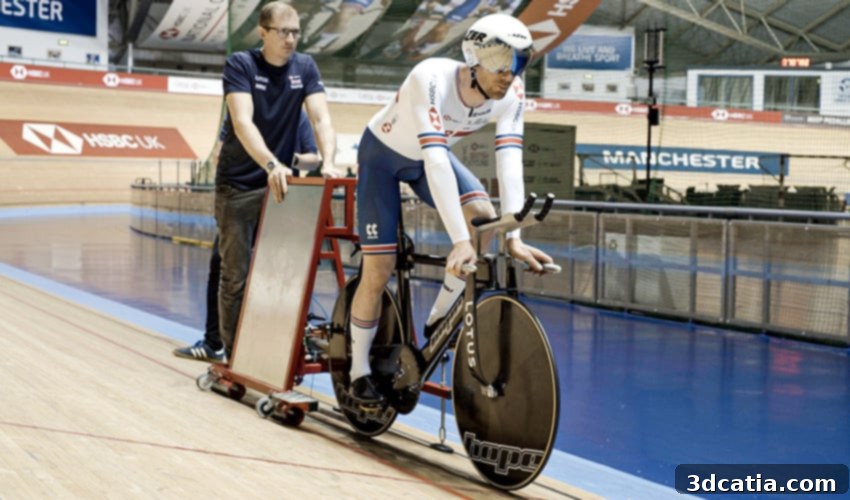
Revolutionizing Olympic Track Cycling: British Cycling and Renishaw’s 3D Printing Partnership for Paris 2024
The world of elite sports is a constant race for marginal gains, where fractions of a second can determine victory. In track cycling, this pursuit is particularly intense, demanding not only supreme athletic prowess but also the most advanced equipment imaginable. Recognizing this critical need, British Cycling, the governing body for cycling in Great Britain, forged a groundbreaking partnership in 2019 with Renishaw, a global leader in metal 3D printing and additive manufacturing. Their initial goal was ambitious: to design and produce cutting-edge, lightweight, and high-performance components that would give British athletes an unparalleled advantage at the 2020 Tokyo Olympics. This collaboration proved immensely successful, contributing to an impressive haul of 7 medals at the championships and continued triumphs through the Commonwealth Games. Building on this established foundation of innovation and success, British Cycling and Renishaw are proud to announce the renewal of their pivotal partnership, now setting their sights firmly on the ultimate challenge: the 2024 Paris Olympics.
Track cycling is arguably one of the most exhilarating and demanding Olympic disciplines. Athletes propel themselves to breathtaking speeds, often exceeding 75 km/h, on a banked velodrome. Yet, despite these incredible velocities, competitors are frequently separated by less than a second at the finish line. This unforgiving nature of the sport means that every element, from the rider’s physical condition to the minute details of their equipment, must be optimized to perfection. High-quality, technologically superior equipment is not merely an advantage; it’s an absolute necessity for improving performance and securing a place on the podium. In this highly competitive environment, 3D printing has already demonstrated its transformative potential across various industries, including high-performance cycling. A notable example is Pinarello’s Bolide F HR 3D, often lauded as the fastest high-speed bike in the world, which leverages additive manufacturing to achieve its extraordinary design and capabilities. The partnership between British Cycling and Renishaw aims to build upon this legacy, pushing the boundaries even further.
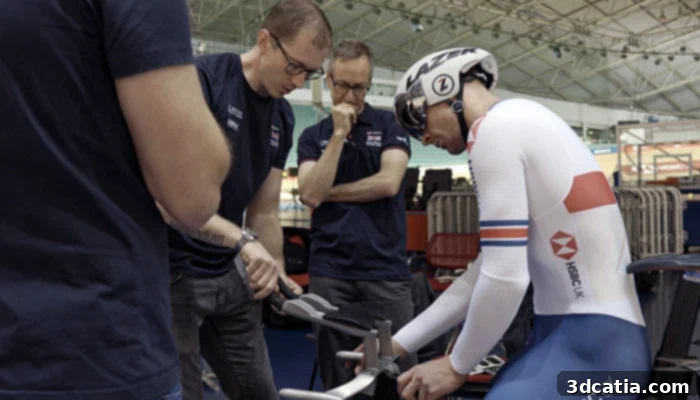
Three-time Olympic gold medalist Ed Clancy Obe with British Cycling designers (photo credits: Renishaw)
Renishaw’s Additive Manufacturing: Engineering the Future of Track Bikes
Renishaw’s expertise in additive manufacturing has been instrumental in British Cycling’s quest for speed and efficiency. To design and validate better-performing parts for the elite athletes’ bikes, Renishaw initially employed 3D printing for rapid prototyping. This crucial first step involved producing both plastic and metal prototype parts. These prototypes were subjected to rigorous aerodynamic tests, ensuring that each component was not only lightweight but also supremely efficient and robust enough to withstand the immense stresses of Olympic-level competition. This iterative design process, facilitated by 3D printing, allowed for quick adjustments and optimizations, dramatically accelerating the development cycle.
Once designs were finalized, the British manufacturer utilized its advanced RenAM 500Q systems for the production of flight-ready components. The RenAM 500Q is a cutting-edge quad-laser metal additive manufacturing system known for its productivity, precision, and ability to produce complex geometries. Using these systems, Renishaw 3D printed critical components from high-performance materials such as aluminum and titanium. These materials were chosen for their exceptional strength-to-weight ratios and durability, qualities that are paramount in track cycling. Among the most impactful innovations were customized handlebars, individually tailored for each athlete. These bespoke handlebars were engineered to be significantly lighter and stronger than conventionally manufactured alternatives, offering improved ergonomics, better power transfer, and a perfectly aerodynamic tuck for each rider. Beyond handlebars, Renishaw also contributed to the overall frame design, incorporating sophisticated carbon fiber structures meticulously developed to minimize aerodynamic drag and enhance the overall speed potential of the bike and rider.
The Science of Speed: How 3D Printing Delivers a Competitive Edge
The renewed partnership between Renishaw and British Cycling is poised to unlock even greater levels of performance for the upcoming Paris 2024 Olympics. The core objective remains to produce bikes with an improved design that will directly translate into enhanced athletic performance. Renishaw’s ambition for this next phase is clear: to create even lighter, more complex, and more intricately optimized parts for track bike design. This involves pushing the boundaries of material science, design freedom, and manufacturing precision that only additive manufacturing can provide.
Additive manufacturing offers several distinct advantages that are crucial for elite sports equipment:
- Unprecedented Customization: Unlike traditional manufacturing methods, 3D printing allows for the creation of components that are perfectly tailored to individual athletes. This means handlebars, extensions, and even saddle components can be designed to match an athlete’s unique physiology, improving comfort, reducing fatigue, and optimizing power transfer. Every millimeter of adjustment can lead to significant performance gains over a race.
- Superior Lightweighting: Weight is the enemy of speed in track cycling. 3D printing enables engineers to utilize advanced design techniques like topology optimization and lattice structures. These methods remove material from areas where it’s not structurally necessary, resulting in incredibly lightweight yet strong components. Reducing the bike’s weight translates directly to faster acceleration and less energy expended by the rider to maintain high speeds.
- Advanced Aerodynamics: Aerodynamic drag is a major hurdle at high speeds. Additive manufacturing’s ability to create complex, organic geometries allows for highly optimized, integrated designs that seamlessly manage airflow. Components can be shaped to minimize turbulence and reduce drag coefficients, making the bike “slice” through the air with greater efficiency. This often involves intricate internal channels and external contours that would be impossible to achieve with traditional machining or molding.
- Enhanced Strength and Durability: While lightweight, these components must also withstand immense forces. Renishaw’s rigorous testing and choice of high-strength alloys like titanium ensure that the 3D printed parts are not only light but also incredibly durable and reliable, crucial for athlete safety and consistent performance under extreme conditions.
- Rapid Iteration and Innovation: The ability to quickly move from design concept to physical prototype, test it, and then refine it is a game-changer. This rapid iteration cycle allows British Cycling and Renishaw to experiment with more radical designs and quickly validate improvements, leading to faster development and a continuous competitive edge.
Ben Collins, Senior Applications Engineer for Renishaw’s Additive Manufacturing Group, underscored the significance of their work: “Creating a bike light enough for Olympic competition that also stayed within the Union Cycliste Internationale guidelines was a challenge, but it also gave us the chance to showcase how beneficial additive manufacturing can be across all industries.” This statement highlights not only the technical complexities involved but also the broader implications of this partnership as a testament to the power of advanced manufacturing. The continuous drive for innovation is not just about medals; it’s about pushing the boundaries of engineering itself. Further details can be found in the official press release HERE, or by watching the video below:
A Blueprint for Success: Beyond the Velodrome
The collaboration between British Cycling and Renishaw serves as a compelling case study for how advanced manufacturing technologies, particularly 3D printing, can revolutionize performance in elite sports. It demonstrates a clear pathway for achieving “marginal gains” that, when accumulated, translate into significant competitive advantages on the world stage. For Paris 2024, the focus will intensify on refining existing components and exploring entirely new possibilities for additive manufacturing in cycling equipment. This includes investigating new material combinations, further optimizing structural designs for maximum stiffness-to-weight ratios, and enhancing aerodynamic profiles in ways previously considered impossible.
The success story of British Cycling and Renishaw also has far-reaching implications beyond the realm of sports. It showcases the transformative potential of additive manufacturing for industries requiring precision engineering, lightweight components, and customized solutions – from aerospace and automotive to medical devices and industrial machinery. The lessons learned on the velodrome, under the intense pressure of Olympic competition, are directly transferable to other sectors striving for efficiency, performance, and innovation.
What are your thoughts on this exciting renewed partnership between Renishaw and British Cycling? How do you envision 3D printing continuing to shape the future of high-performance sports? We invite you to share your insights in a comment below or join the conversation on our LinkedIn, Facebook, and Twitter pages! Don’t forget to sign up for our free weekly Newsletter here, bringing the latest 3D printing news straight to your inbox! You can also find all our compelling videos on our YouTube channel for more in-depth content.
*Cover Photo Credits: Renishaw