
Relativity Space Forges New Era in Rocket Manufacturing with NASA Partnership and Advanced 3D Printing
In a monumental move set to redefine the aerospace industry, Relativity Space, a pioneering leader in autonomous rocket factories and launch services, announced a landmark agreement with the National Aeronautics and Space Administration (NASA) in early June. This strategic alliance will see Relativity establishing a significant portion of its advanced production capabilities at one of NASA’s renowned facilities. The company is set to leverage an expansive area exceeding 20,000 square meters, dedicated to the intricate manufacturing and assembly of its groundbreaking rockets, with ambitious plans to commence launches into space by the close of 2020. This transformative partnership is poised to dramatically accelerate Relativity’s rocket development lifecycle, granting the company unparalleled flexibility and efficiency in its manufacturing processes. This development represents not only a significant milestone for Relativity but also a resounding validation of additive manufacturing’s increasingly vital role in shaping the future of space exploration and advanced engineering.
Relativity Space has garnered considerable attention for its audacious vision and innovative approach. An interview conducted by 3Dnatives last year offered insights into a startup brimming with ambition and driven by cutting-edge technology. At the heart of Relativity’s capabilities lies its proprietary metal 3D printing system, a technological marvel that enables the rapid production of complex rocket components. Bolstered by substantial investments that now total an impressive $45 million, Relativity has the resources to back its bold claims. The company proudly states that an astonishing 95% of its rocket components are meticulously designed and manufactured using advanced 3D printing technologies. This revolutionary approach is expected to enable the complete design and production of an entire rocket in a mere 60 days, drastically shrinking traditional aerospace manufacturing timelines. Currently operating from a former NASA building in New Orleans, Relativity benefits immensely from a wealth of existing infrastructure, including powerful overhead cranes, which significantly boost its productivity and operational efficiency. This facility is slated to become the primary hub for installing Relativity’s robotic arms and establishing the crucial test center for its flagship rocket, the Terran 1.

The initial tests for the Terran 1 rocket. | Credits: Relativity Space
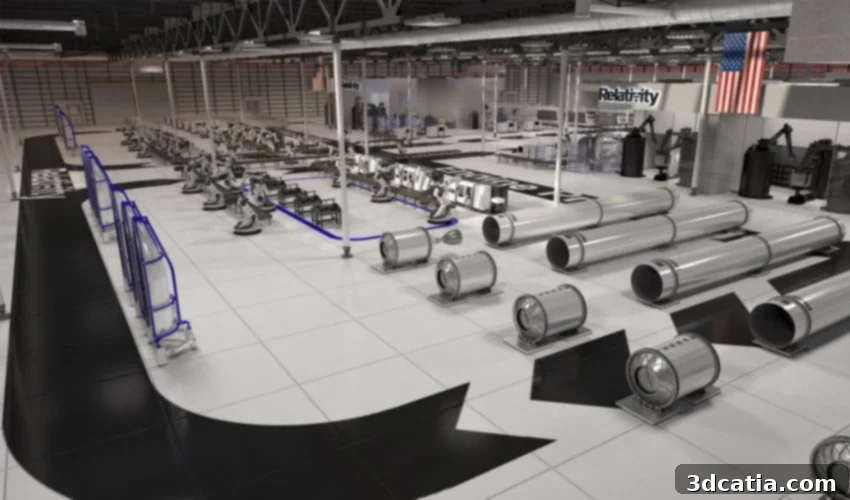
Revolutionizing Production: The Autonomous Rocket Factory at NASA Stennis
The establishment of this new, sprawling printing and testing center marks a pivotal moment for Relativity Space, significantly accelerating its capacity to create and iterate rocket designs. The Californian company has already demonstrated the profound impact of its additive manufacturing capabilities. Through the innovative use of its proprietary Stargate robotic arm, Relativity successfully reduced the total number of components required to manufacture a rocket by an astonishing factor of 100. This drastic simplification not only streamlines the assembly process but also enhances reliability and reduces potential points of failure. Tobi Duschl, Vice President of Relativity Operations, emphasized the profound implications of this new agreement: “The partnership with NASA will undoubtedly accelerate our development trajectory. This substantial new space will allow us to scale production significantly, enabling the output of 12 to 24 Terran rockets each year. More importantly, it provides us with unprecedented flexibility in our manufacturing schedule and drastically shortens the lead time from production to launch.” This enhanced agility positions Relativity to respond more dynamically to market demands and rapidly innovate in the highly competitive space launch sector.
Economic Impact and Strategic Advantages in Mississippi
Beyond its technological advancements, Relativity’s expansion also brings substantial economic benefits, particularly to the employment sector. As part of its commitment, Relativity has pledged to create 200 new, high-tech jobs within the state of Mississippi, injecting fresh talent and expertise into the local economy. Furthermore, the company is investing an impressive $59 million into the state, signaling a long-term commitment to its new operational base. A key strategic advantage of the chosen NASA site is its geographical proximity to Relativity’s existing propulsion test facilities, located approximately 5 kilometers away. This close alignment is a logistical game-changer; it allows for rockets to be meticulously tested and integrated without the costly, time-consuming, and complex process of shipping them across vast distances. Tobi Duschl further elaborated on this synergistic arrangement, stating, “The integration of our 3D rocket printing and comprehensive test facilities onto a single, cohesive site dramatically enhances Relativity’s ability to offer greater flexibility and efficiency to both commercial and government entities. This unified approach means our clients can access space faster, more frequently, and significantly more economically than ever before.” This streamlined workflow is essential for meeting the growing demand for reliable and cost-effective launch services in the burgeoning NewSpace economy.

Relativity Space’s advanced testing facilities. | Credits: Relativity
Navigating Industry Skepticism: The Debate Over Fully 3D-Printed Rockets
While Relativity’s ambitious goals have garnered widespread admiration, they have also prompted a degree of scrutiny and debate within the aerospace community. A recent article published in MIT Technology Review, provocatively titled ‘Does the world need a 3D-printed rocket?’, offered a nuanced perspective on Relativity’s activities. The author highlighted that even other leading rocket companies, themselves aggressively pursuing 3D printing technologies, aren’t entirely convinced that a fully 3D-printed rocket represents the ultimate future of additive manufacturing in space. Rocket Lab, for instance, a prominent small satellite launcher that has successfully conducted numerous commercial flights, extensively relies on additive manufacturing for creating intricate and high-performance components, particularly in its engine design.
The Peter Beck Perspective: Where to Draw the Line?
Peter Beck, the astute CEO of Rocket Lab, provided a critical perspective in the MIT Technology Review article, articulating the prevailing sentiment among some industry veterans. He explained, “There’s no way that we can produce the volume and the performance of the engines that we’re producing now without 3D-printing technology.” This statement underscores the undeniable value of additive manufacturing for complex, high-performance parts like rocket engines, where intricate geometries and advanced material properties are crucial. However, Beck’s skepticism emerges when the discussion shifts to an *entire* rocket: “But an entire rocket? To go and print an avionics box or tank or something like that doesn’t make any sense, because there’s much more efficient processes for doing that.” This viewpoint highlights a fundamental debate within the aerospace sector: where is the optimal balance between traditional manufacturing methods and cutting-edge 3D printing? While additive manufacturing excels at complex, consolidated parts and rapid prototyping, conventional techniques like machining, welding, and sheet metal fabrication often remain more cost-effective and efficient for simpler, larger structures like fuel tanks or standardized electronics enclosures. Relativity’s audacious goal of printing 95% of its rocket challenges these established norms, pushing the boundaries of what is conventionally considered feasible and economically viable in rocket production. This inherent tension between innovation and practicality is one of the most interesting insights from the discussion, posing a crucial question for the future trajectory of space manufacturing.
Charting the Course: Future Launches and Commercial Readiness
Despite the industry discussions, Relativity Space is rapidly moving forward with its commercial operations and has already secured significant interest from global clients. For the years 2021 and 2022, the company has publicly announced that three key clients have formally booked launches aboard its Terran 1 rockets. These include Telesat, a leading Canadian communications company known for its global satellite services; Washington-based Spaceflight, a company specializing in rideshare and mission management services for small satellites; and Thailand’s mu Space, an ambitious startup focused on satellite and space technology. These confirmed bookings underscore the growing confidence in Relativity’s innovative approach and its capability to deliver reliable and cost-effective launch solutions. As Relativity continues to refine its autonomous rocket factory concept and expand its production capabilities at the NASA Stennis Space Center, it is poised to play a transformative role in the commercial space launch market, offering unprecedented speed and flexibility to a diverse range of customers.
For more comprehensive information and the official press release regarding this exciting development, you can find further details HERE.
What are your thoughts on Relativity Space’s groundbreaking approach to 3D-printed rockets and its new partnership with NASA? Do you believe fully 3D-printed rockets are the future, or will traditional methods continue to play a crucial role? Share your insights and join the conversation by leaving a comment below, or engage with us on our Facebook and Twitter pages! Don’t miss out on the latest advancements and news in the world of additive manufacturing and space technology – sign up for our free weekly Newsletter to receive all the essential updates straight to your inbox!