
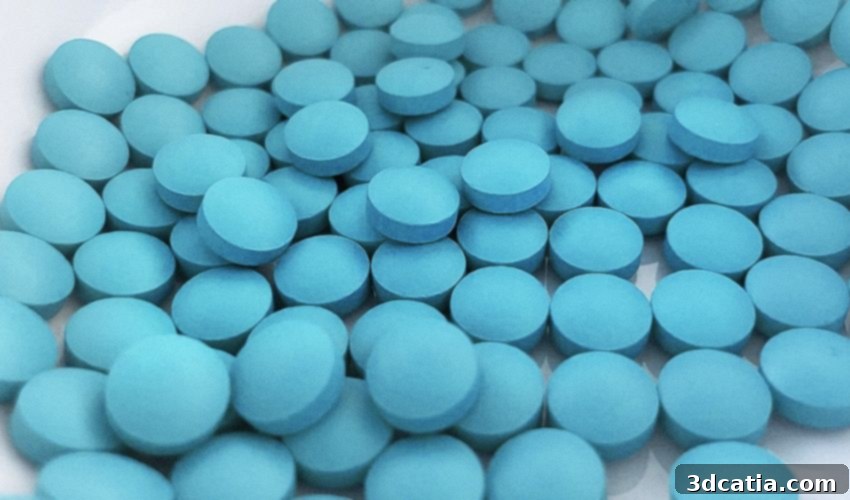
Revolutionizing Healthcare: The Future of Personalized Medicine with 3D Printed Drugs
The global pharmaceutical industry, valued at an impressive $1.4 trillion in 2022, is on the cusp of a transformative era. While additive manufacturing has been a significant player in the medical sector for years, driving advancements in bioprinting, 3D printed prostheses, and surgical guides, a new wave of innovation is now capturing attention: 3D printed medications. This emerging field promises to revolutionize how we approach therapeutic treatments, offering unique options that traditional mass-produced pills simply cannot match. Leading companies and researchers are actively exploring and implementing these technologies, paving the way for a new generation of pharmaceuticals tailored precisely to individual patient needs.
Unlike conventional mass-produced drugs, which adhere to a one-size-fits-all model, 3D printed pharmaceuticals open the door to fully personalized treatments. This advanced method provides unprecedented control over several critical aspects of medication delivery. Firstly, it allows for the creation of exact dosages, a crucial factor often challenging with standard pills, especially for sensitive populations. Secondly, it enables the combination of multiple active pharmaceutical ingredients into a single pill, simplifying complex medication regimens and potentially improving patient adherence. Thirdly, and perhaps most innovatively, 3D printing technology facilitates precise control over the drug’s release profile within the body, allowing for tailored immediate, sustained, or multi-phase release. This level of customizability is particularly beneficial for the most vulnerable patient populations, such as children and the elderly, whose unique physiological characteristics often demand more attentive planning and modified dosages to ensure efficacy and minimize adverse effects.
Advancing Pediatric Care with 3D Printed Medications
The profound implications of personalized medicine are particularly evident in pediatric care. Children, due to their rapidly changing physiology, weight fluctuations, and varying metabolic rates, require precise medication dosages that evolve with their growth. The risks associated with incorrect dosing – whether under-dosing leading to ineffective treatment or over-dosing resulting in toxicity – are significantly higher for pediatric patients. Recognizing this critical need, the National Institutes of Health (NIH) has taken a proactive step, awarding a substantial three-million-dollar grant to researchers at Texas A&M University. This funding is dedicated to further studying the feasibility and practical application of producing tailor-made, 3D printed medicine specifically for pediatric use.
The research at Texas A&M is a testament to interdisciplinary collaboration, bringing together experts from the university’s Colleges of Engineering, Pharmacy, and the School of Veterinary Medicine and Biomedical Sciences. This diverse team is focusing on two primary areas of investigation. The first aspect delves into the manufacturing process itself, meticulously examining the structural qualities, integrity, and overall effectiveness of 3D printed drugs. This includes rigorous testing to ensure these novel pharmaceuticals are stable, consistent, and deliver their active ingredients as intended, performing comparably or superiorly to existing conventional pharmaceuticals. The researchers are exploring various additive manufacturing techniques and material science innovations to optimize drug fabrication, addressing challenges related to drug stability, printability, and dissolution profiles. They aim to understand how different printing parameters and excipients influence the final drug product, ensuring safety and reliability.
The second crucial aspect of the research is patient-centric, focusing on how 3D printing methods can revolutionize dosage adaptation throughout a patient’s growth trajectory. This involves developing methodologies to precisely adjust medication dosages for pediatric patients ranging from infants to 17-year-olds. The ability to incrementally modify dosage sizes in response to a child’s weight changes, age, and specific medical requirements is a game-changer. It promises to minimize the need for complex compounding by pharmacists, reduce medication errors, and ensure that children receive the optimal therapeutic dose at every stage of their development. This level of precision could significantly enhance treatment outcomes, reduce side effects, and improve the overall quality of life for young patients with chronic conditions or complex medication needs.
Dr. Mathew A. Kuttolamadom, associate professor from the Department of Engineering Technology and Industrial Distribution and co-principal investigator of the research team, elaborates on the intrinsic challenges of this groundbreaking work: “The additive manufacturing of pharmaceuticals presents a relatively new process that differs significantly from the additive manufacturing of metals or ceramics. Our primary challenge lies in comprehending this novel process and unraveling the unique aspects specific to pharmaceuticals. Overcoming these challenges is essential as we strive to advance the field and ensure the drug’s efficacy remains intact throughout [and] beyond the manufacturing process.” This highlights the critical need for a deep understanding of how pharmaceutical ingredients behave under 3D printing conditions, from thermal stability during extrusion to solubility and bioavailability post-printing. Ensuring the integrity and chemical stability of the drug substance while achieving precise geometric control is paramount for the success of 3D printed medications.
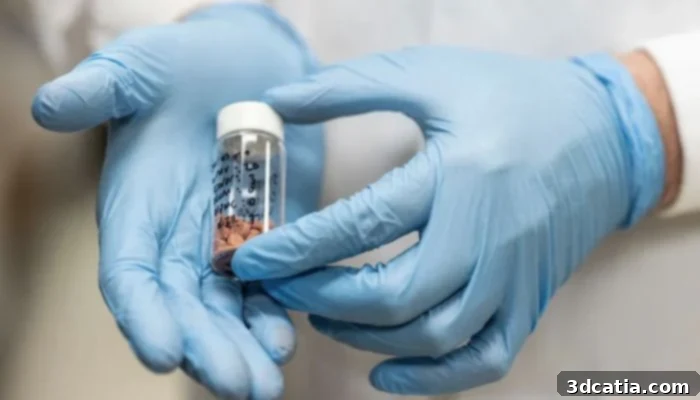
Part of the research will cover the efficacy and integrity of 3D printed drugs compared to mass-produced drugs (photo credits: Cameron Johnson/Texas A&M Health Marketing & Communications)
One of the most vital requirements for both pediatric and geriatric medicine is unparalleled flexibility. This is precisely where standard drug production often falls short. Traditional manufacturing processes produce fixed-dose tablets or capsules, necessitating pharmacists to compound custom formulations or parents/caregivers to manually split pills – practices prone to error and inconsistency. Furthermore, the limited forms of conventional drugs (e.g., large tablets, bitter liquids) can lead to significant patient adherence issues, especially in children who may resist taking medicine due to taste, size, or difficulty swallowing. For the elderly, polypharmacy (taking multiple medications) is common, and difficulty swallowing (dysphagia) or cognitive impairments can complicate adherence to complex regimens.
3D printing medicine offers the perfect solution to these challenges, ushering in an era of unprecedented flexibility for the patients who need it most. Imagine a child’s medication being printed in a small, easily swallowable size, perhaps in a preferred flavor, or even in a fun shape to encourage acceptance. For an elderly patient, a single 3D printed pill could combine several necessary drugs into one, reducing pill burden and improving compliance. The ability to precisely control the geometric shape and porosity of the printed drug can also influence its dissolution rate, offering tailored release profiles that are optimized for individual pharmacokinetic needs. This innovative technology moves beyond mere dosage adjustment; it empowers the creation of patient-specific drug delivery systems that consider not just the active ingredient, but also the patient’s age, weight, medical conditions, and even personal preferences. This level of customization has the potential to dramatically improve therapeutic outcomes, reduce adverse drug reactions, and enhance the overall patient experience.
The research being conducted at Texas A&M University represents a crucial step toward realizing this future, pushing the boundaries of what is possible in pharmaceutical manufacturing and patient care. By addressing the specific needs of vulnerable populations, 3D printed medications are poised to usher in a truly personalized healthcare revolution. You can learn more about Texas A&M University’s research HERE.
What are your thoughts on the transformative potential of 3D printed medicine in personalized healthcare? We invite you to share your insights in a comment below or join the conversation on our LinkedIn, Facebook, and Twitter pages! For the latest updates and breaking news in the world of 3D printing, don’t forget to sign up for our free weekly Newsletter here, delivered straight to your inbox. You can also explore all our videos and in-depth content on our YouTube channel.
*Cover Photo Credits: Jesus A. Reina/Texas A&M Engineering