
3D Printing Recyclable and Edible Foam: Paving the Way for Sustainable Space Exploration with Thomas Pesquet
In a monumental leap for sustainable space exploration, French astronaut Thomas Pesquet recently embarked on his second mission to the International Space Station (ISS), a six-month journey where he holds the distinguished position of the ISS’s first French commander. What truly captured the imagination of the scientific and additive manufacturing communities was the integral role 3D printing played in his journey. Pesquet’s mission included innovative 3D printed components, notably packaging for meals supplied by the Hénaf group and a protective casing for his sleep study headband. These crucial parts were ingeniously crafted from a groundbreaking, recyclable and even edible foam. This remarkable material is derived from Polyhydroxyalkanoate (PHA), a naturally occurring polymer synthesized by bacteria. Designed by the ComposiTIC technical platform, these advanced foams offer exceptional protection, effectively isolating sensitive equipment from the shocks and vibrations inherent in space travel, a feature undeniably vital for any object destined for orbit.
The ComposiTIC technical platform, a hub of innovation, was established in 2014 at Southern Brittany University (UBS). Its core mission revolves around the development of cutting-edge composite materials through state-of-the-art robotized fiber placement technology. This platform was specifically commissioned by CNES (Centre National d’Études Spatiales) as part of the European Space Agency’s (ESA) ambitious Alpha mission, spearheaded by Thomas Pesquet. Over the course of the next six months, Pesquet, a highly skilled French engineer and astronaut, is slated to undertake a myriad of tasks. These include conducting vital maintenance operations and executing over a hundred diverse scientific experiments aboard the ISS. Crucially, additive manufacturing, or 3D printing, has been instrumental in the preparation and execution of many aspects of this mission, showcasing its transformative potential for space logistics and on-orbit operations.
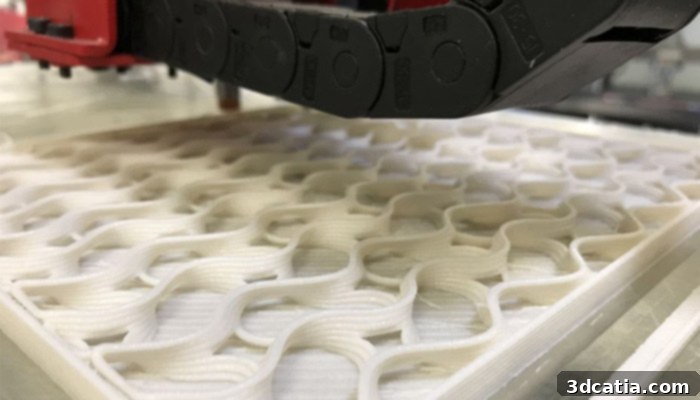
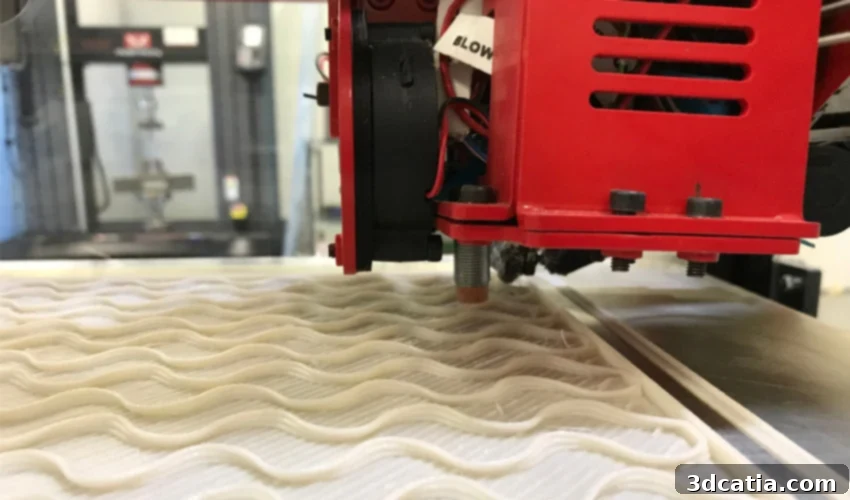
PHA granules were transformed into filament to 3D print the parts (photo credit: UBS)
Revolutionizing Space Packaging: The Power of 3D Printed Recyclable Foam for Scientific Equipment
Conducting scientific experiments in the unforgiving environment of space presents a unique set of challenges that are markedly different from those encountered on Earth. A primary concern, particularly critical for delicate scientific instruments, is packaging. Every piece of experimental equipment destined for the ISS must be meticulously stored within a protective enclosure, typically a specialized foam box engineered to shield against the relentless vibrations encountered during launch and throughout its journey and operational life in orbit. The paramount objective is to guarantee that the equipment remains fully functional, reliable, and undamaged upon its arrival and subsequent deployment on the ISS. For the Alpha mission, Thomas Pesquet, deeply committed to sustainability, made a significant request: to move beyond traditional, petroleum-based packaging materials. His vision was to replace them with a truly recyclable foam that would not only occupy less precious space but, more importantly, drastically reduce the generation of waste – a vital consideration in the closed ecosystem of the ISS.
One of Thomas Pesquet’s critical experiments focuses on understanding the intricate dynamics of sleep in space, a crucial area of research for long-duration missions. To facilitate this, the astronaut wears a specialized headband, meticulously designed by the innovative startup Dreem, which precisely analyzes both the duration and quality of his sleep. Yves-Marie Corre, the technical manager of the ComposiTIC technical platform, sheds light on their pivotal involvement: “We were contacted as part of the ‘Renewable Foam’ experiment with the specific goal of designing a recyclable foam, produced through 3D printing, that would serve to protect Thomas Pesquet’s sleep study headband. This custom-designed packaging is intended to effectively isolate the sensitive device from the disruptive shocks and vibrations it might encounter during its journey and operation in space, ensuring its integrity and accuracy.” The development of such bespoke, high-performance packaging underscores the tailored solutions that additive manufacturing can provide for complex scientific endeavors.
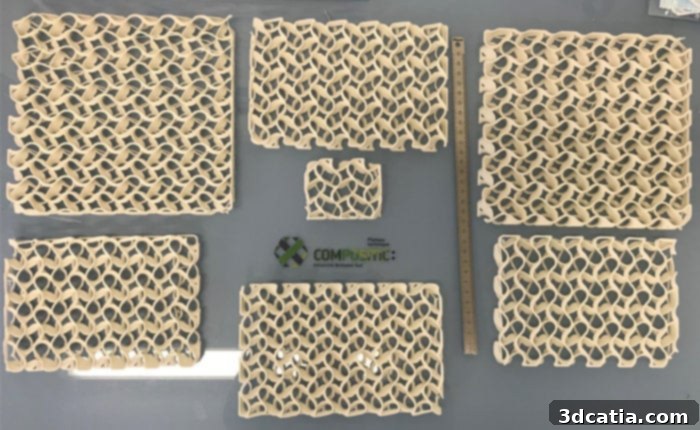
Several panels have been 3D printed (photo credits: ComposiTIC)
Responding to this critical need, the ComposiTIC technical platform successfully 3D printed a robust protective casing using a revolutionary recyclable foam derived from PHA. Leveraging advanced design for additive manufacturing (DfAM) methodologies, the team ingeniously devised a honeycomb internal structure. This particular design choice was pivotal, allowing them to precisely optimize both the weight and the structural strength of the part, a critical balance for aerospace applications where every gram counts. However, beyond the innovative design, the true brilliance lies in the choice of material itself. Yves-Marie Corre emphasizes its significance: “Even though it is still a form of plastic, this time it is no longer derived from petroleum-based sources but rather synthesized by living organisms, specifically bacteria. This biological origin imbues these bioplastics with the remarkable ability to degrade very quickly and safely in the natural environment.” This represents a profound shift from conventional plastics, which persist for centuries. Approximately 20 individual plates were 3D printed to construct four specialized boxes. These boxes were not only designed to protect the delicate sleep headband but also to safeguard other vital scientific equipment during the challenging journey to the ISS.
The innovation doesn’t stop at mere protection. These pioneering PHA components are designed for a groundbreaking second life once their primary function as packaging is complete. On board the ISS, the material is intended to degrade, releasing its inherent nutrients and serving as a substrate to grow vegetables. This ingenious closed-loop system is a testament to sustainable resource management in space, where every item must serve multiple purposes to minimize waste and maximize utility. By providing essential nutrients for plant growth, these 3D printed PHA foams contribute to the potential for future long-duration missions to become more self-sufficient, reducing reliance on costly resupply missions from Earth and paving the way for sustained human presence beyond low-Earth orbit. This multifaceted application truly highlights the versatility and environmental benefits of PHA in an extraterrestrial context.
Beyond protective packaging for scientific instruments, ComposiTIC also explored an equally fascinating application: packaging for food. This second element designed with 3D printing is called “Edible Foam.” This innovative packaging concept features 3D printed walls composed of, as the name suggests, edible foam. The visionary idea is that these walls could potentially be consumed by astronauts, thereby eliminating packaging waste entirely and even contributing to their caloric intake. It is important to note, however, that for the Alpha mission, only the primary storage functionality of this foam was activated, meaning the foam itself was not consumed by the astronauts. This was likely a precautionary measure for a first-of-its-kind deployment, allowing for thorough evaluation of its structural integrity and performance in microgravity before consumption. Nevertheless, the inherent edible character of this material holds immense promise and is anticipated to be of significant interest for future space missions, offering a revolutionary approach to food packaging and waste reduction that could transform space cuisine and logistics for long-duration voyages to the Moon and Mars.
The implications of these advancements are vast, extending far beyond Thomas Pesquet’s mission. The successful deployment of 3D printed recyclable and potentially edible PHA foam marks a significant stride towards more sustainable space travel. It demonstrates how additive manufacturing, combined with cutting-edge bioplastics, can address critical challenges in space exploration: reducing launch mass, minimizing waste in closed environments, and enabling resource reuse. Such innovations are crucial for establishing long-term human outposts on lunar or Martian surfaces, where resupply options are limited and self-sufficiency is paramount. Furthermore, the lessons learned from developing and utilizing these materials in space could easily translate into impactful terrestrial applications, fostering a more circular economy and promoting sustainable practices here on Earth, particularly in packaging industries. This mission serves as a powerful reminder of how innovation in one extreme environment can inspire and drive progress across many others.
What do you think of the 3D printed parts and the recyclable, multi-functional PHA foam that Thomas Pesquet brought to the ISS? The future of space exploration is clearly being shaped by such pioneering technologies. Let us know your thoughts in a comment below or connect with us on ourFacebook,Twitter andLinkedIn pages! Don’t miss out on the latest advancements in additive manufacturing – sign up for our free weeklyNewsletter here, delivering the most up-to-date 3D printing news straight to your inbox!