
PEEK vs. PEKK: Unlocking High-Performance 3D Printing with Advanced PAEK Polymers
In the rapidly evolving landscape of additive manufacturing, the choice of material is paramount, directly influencing the chemical properties, mechanical characteristics, and overall performance of the final printed part. The market today offers an extensive array of materials, ranging from versatile polymers to robust metals, intricate ceramics, and even specialized organic inks. Among these, plastics represent a vast and diverse category, varying significantly in their technical demands for 3D printing. Whether you’re working with filaments, liquid resins, or fine powders, each material type possesses unique attributes.
This article will delve into the fascinating world of high-performance polymers, with a specific focus on the polyaryletherketone (PAEK) family. Within this esteemed group, two materials are increasingly gaining traction and widespread adoption across various industrial sectors: PEEK (Polyether Ether Ketone) and PEKK (Polyether Ketone Ketone). While traditionally utilized in conventional manufacturing processes like plastic injection molding and machining, both PEEK and PEKK have, in recent years, proven their compatibility with advanced additive manufacturing techniques, including material extrusion (commonly known as FDM/FFF) and selective laser sintering (SLS). These polymers are celebrated for their exceptional thermal characteristics and remarkable strength, often drawing comparisons to metals. But what precisely distinguishes these two formidable high-performance thermoplastics? And how does one determine the optimal choice for a specific application? Join us as we explore the fundamental differences, processing considerations, and diverse applications of PEEK and PEKK.
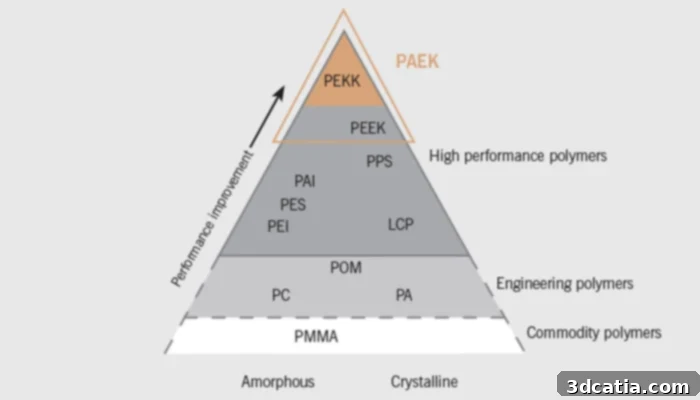
PEEK and PEKK are considered high performance polymers
Composition and Intrinsic Characteristics of PEEK and PEKK
To truly understand the capabilities and optimal applications of high-performance polymers like PEEK and PEKK, it is essential to begin with an examination of their fundamental chemical composition and resulting intrinsic properties. These factors are crucial for predicting their behavior during the manufacturing process and can be a decisive element in material selection. Both PEEK and PEKK belong to the illustrious PAEK family, a group of high-performance, semi-crystalline, and amorphous thermoplastics renowned for their superior attributes.
Within the PAEK family, PEEK stands out as one of the most widely recognized and utilized polymers. Its molecular structure is characterized by a precise arrangement of repeating units, specifically one ketone group flanked by two ether groups (K-E-E). This specific molecular backbone contributes to PEEK’s balanced set of properties. In contrast, PEKK presents an inverse molecular structure, featuring two ketone groups and one ether group (K-K-E or K-E-K), which results in a polymer with distinctly different characteristics. The presence of more ketone bonds in PEKK’s structure imparts greater flexibility to the polymer chain. This increased flexibility directly influences critical thermal properties: PEKK typically exhibits a higher glass transition temperature (Tg), which is the temperature at which the polymer transitions from a rigid, glassy state to a more pliable, rubbery state, and a higher melting temperature (Tm) compared to PEEK. These elevated thermal thresholds make PEKK particularly advantageous for applications requiring exceptional thermal stability.
Both PEEK and PEKK share a remarkable array of advantageous properties. They are characterized by exceptionally high mechanical strength, capable of withstanding significant loads and stresses, making them ideal substitutes for certain metals in lightweighting applications. Their outstanding high-temperature resistance allows them to perform reliably in extreme thermal environments. Furthermore, both exhibit excellent fatigue resistance, meaning they can endure repeated stress cycles without degradation, and possess low flammability, enhancing safety in critical applications. Beyond these commonalities, PEKK offers superior resistance to a broader range of chemical fluids, boasts excellent dielectric stability (making it suitable for electrical insulation), and critically, does not emit toxic fumes when subjected to high temperatures, a crucial safety feature for aerospace and medical applications. PEEK, on the other hand, is particularly renowned for its exceptional balance of mechanical properties and a superior strength-to-weight ratio, which is highly sought after in industries where performance and mass reduction are critical. A notable advantage shared by both polymers is their sterilizability, a property that facilitates their extensive use in the demanding healthcare and medical sectors, including for implants and surgical instruments.
While their shared PAEK heritage means PEEK and PEKK possess many common properties, their distinct molecular compositions lead to key differentiators. The most significant distinction lies in their degree of crystallinity and the rate at which they crystallize. Crystallinity refers to the proportion of ordered, crystalline regions within a polymer, expressed as a percentage. Both PEEK and PEKK are semi-crystalline polymers, meaning they contain both amorphous (disordered) and crystalline regions. However, their degree of crystallinity is highly dependent on processing conditions. Generally, in the context of 3D printing, PEEK typically achieves a higher overall level of crystallization, developing a more robust crystalline structure, while PEKK often exhibits a more controlled and weaker crystalline structure, which can be modified through processing. The degree of crystallinity profoundly impacts the final mechanical, thermal, and chemical properties of the printed part. Concurrently, the speed of crystallization and the rheological properties (flow behavior) of the molten polymer significantly influence the ease and success of the printing process, particularly in managing part warping and layer adhesion.
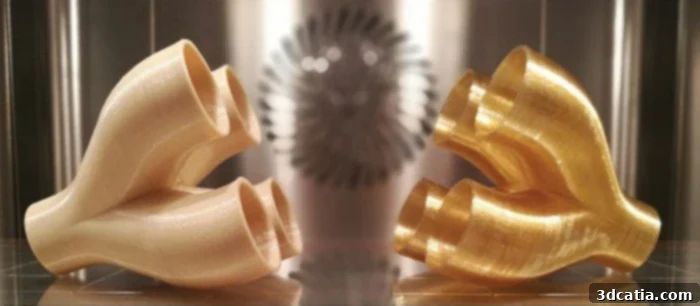
Parts printed using PEKK (photo credits: miniFactory)
Ease of Printing: Navigating the Challenges of High-Performance Polymers
When discussing the printability of PEEK and PEKK, our primary focus is often on Fused Deposition Modeling (FDM), also known as Fused Filament Fabrication (FFF), as it is one of the most common additive manufacturing processes for these materials. Working with high-performance polymers demands specialized expertise and precision to avoid common printing errors, which can be particularly costly given the high price point of these advanced materials. Furthermore, successful printing necessitates a 3D printer specifically engineered to meet stringent temperature requirements.
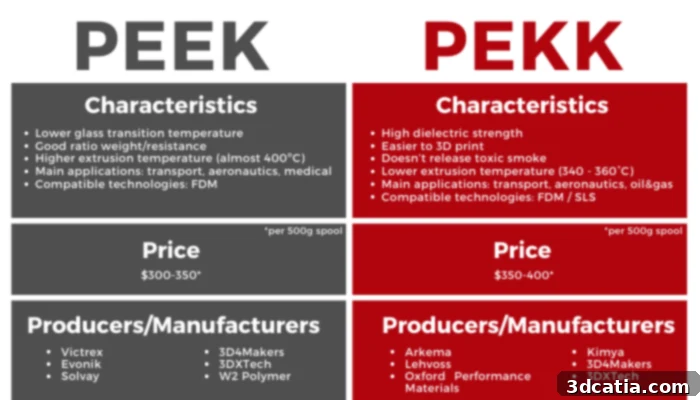
For PEEK 3D printing, the demands are quite rigorous. The printer must be equipped with an extruder capable of reaching exceptionally high temperatures, typically up to 752°F (400°C), to ensure proper material melting and flow. Additionally, a heated build chamber, maintained at temperatures around 248°F (120°C), is essential to control the ambient environment around the printed part. The build plate itself must also achieve high temperatures, often up to 446°F (230°C), to ensure excellent initial layer adhesion and to facilitate the controlled cooling of the part. These elevated temperatures are critical for preventing warping, delamination, and ensuring optimal layer fusion, thereby achieving the desired mechanical properties and dimensional accuracy in the final PEEK component.
PEKK, while also a high-temperature polymer, generally offers slightly less stringent printing requirements, making it marginally easier to process for some users. Its extrusion temperature typically ranges between 644 and 680°F (340 and 360°C). Similar to PEEK, PEKK also requires both a heated build plate and a heated chamber to manage thermal stresses and promote successful layer bonding. The ability to crystallize more slowly and with a lower overall degree of crystallinity under certain conditions can contribute to PEKK’s enhanced printability, particularly in terms of reducing internal stresses that lead to warping.
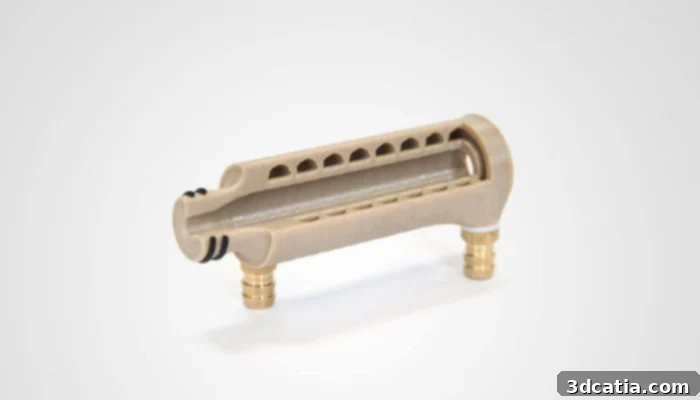
3D printed cooling system with PEEK (photo credits: Apium)
From a technical perspective, as an extruded filament cools and solidifies, the molecular chains of the polymer undergo a partial alignment process. Around tiny crystallization nuclei, these molecular chains begin to fold and organize into highly ordered, crystalline regions. The lower the concentration of crystallization nuclei within the polymer, the more controlled and often slower the cooling process needs to be, which typically results in better interlayer adhesion. If the cooling and solidification occur too rapidly, the molecular chains do not have sufficient time to properly align and fold into ordered crystalline structures. This rapid cooling can lead to significant internal stresses, which directly impact the adhesion of the part to the print bed and, more importantly, can severely compromise the final mechanical properties and dimensional stability of the component, often manifesting as warping or cracking.
As previously highlighted, PEKK generally exhibits a lower intrinsic degree of crystallization or a more controllable crystallization rate compared to PEEK. This characteristic implies that PEKK is inherently less susceptible to the adverse effects of rapid cooling once the part has been 3D printed. Consequently, in terms of overall ease of 3D printing, PEEK presents a more complex and technical challenge. It demands a deeper understanding of material science and additive manufacturing principles to precisely control extrusion parameters, chamber temperatures, and, most critically, the cooling profiles to mitigate warping and optimize part integrity. On the other hand, when considering selective laser sintering (SLS) technology, the behavior of these polymers can vary depending on the geometry and size of the desired part. For smaller models, warping deformations tend to be minimal or entirely absent. However, as the part size increases, controlling the printing parameters to prevent deformation becomes progressively more challenging, requiring sophisticated temperature management within the powder bed.
Post-processing Techniques for PEEK and PEKK Components
Post-processing PEEK and PEKK parts can be a nuanced and challenging endeavor, primarily due to the inherent high-temperature requirements of these advanced materials. In FDM, the utilization of support structures is often indispensable for creating complex geometries with overhangs and intricate features. However, finding suitable support materials that can withstand the extreme processing temperatures required for PEEK and PEKK, and that are simultaneously easily removable without damaging the final part, is a significant hurdle. Most conventional support materials simply cannot endure the high build chamber temperatures, making them incompatible with these demanding thermoplastics.
Fortunately, some innovative players in the additive manufacturing industry have risen to this challenge by developing specialized 3D printing supports designed specifically for high-performance materials. Companies like 3DGence and AquaSys have introduced solutions that can withstand the elevated temperatures and provide reliable support. It is important to note, however, that these specialized support materials are typically more expensive than their conventional counterparts, adding to the overall cost of printing with PEEK and PEKK.
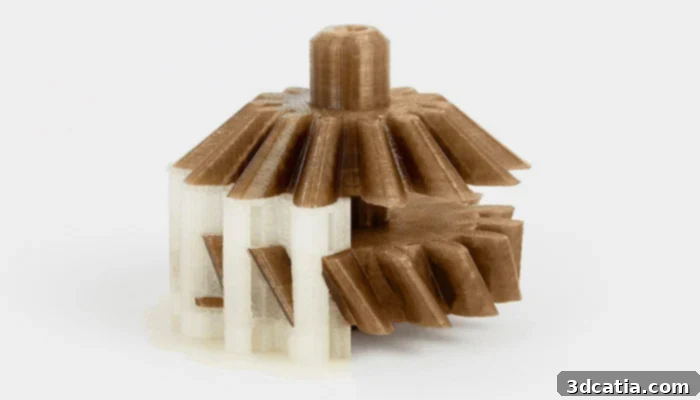
3DGence printing support is compatible with high performance materials (photo credits: 3DGence)
When employing the sintering process (e.g., Selective Laser Sintering), the need for traditional support structures is eliminated, as the un-sintered powder acts as its own support. However, users must still account for the significant cost per kilogram of the specialized polymer powder, which, as we will discuss later, is considerably higher than for standard polymers.
Beyond support removal, advanced post-processing methods can further enhance the properties of 3D printed PEEK and PEKK parts. One highly effective technique is annealing. Annealing involves subjecting the printed part to a controlled thermal cycle, typically heating it to a specific temperature below its melting point and then slowly cooling it. This process significantly improves the fusion between printed layers, relieves internal stresses, and encourages further crystallization within the polymer structure. The result is a final part with even higher mechanical characteristics, improved dimensional stability, and enhanced chemical resistance. Some advanced 3D printers, such as the miniFactory Ultra, integrate this annealing step directly into their workflow, optimizing the properties of the printed components automatically.
Furthermore, the robust nature of PEEK and PEKK allows for various conventional post-processing techniques. Parts printed with PEEK, for instance, can be precisely machined using methods like drilling, milling, and turning to achieve tight tolerances or specific surface finishes. If required for specific applications (e.g., electromagnetic shielding or aesthetic purposes), these parts can also be metallized, adding a metallic coating to their surface.
Diverse Applications of PEEK and PEKK in Modern Industries
The exceptional properties of PEEK and PEKK translate into a broad spectrum of applications across various demanding industries. Both polymers find extensive use in sectors that require materials capable of performing under extreme conditions. The aerospace, automotive, and aviation industries are among the most significant adopters, leveraging the advanced characteristics such as outstanding mechanical strength, high-pressure resistance, inherent lightness, and excellent rigidity. For instance, PEEK and PEKK are utilized in manufacturing components for aircraft interiors, engine parts, structural brackets, and specialized connectors, where their high strength-to-weight ratio contributes to fuel efficiency and overall performance. Their ability to maintain structural integrity at elevated temperatures is crucial for components exposed to engine heat or high-speed flight.
A particularly vital application area for both polymers is the medical sector. Their excellent biocompatibility means they are non-toxic and well-tolerated by the human body, making them ideal for implants and surgical instruments. PEEK, in particular, possesses properties that actively facilitate osseointegration – the direct, structural, and functional connection between a living bone and the surface of an implant under functional load. This makes PEEK an outstanding material for spinal implants, cranial implants, and orthopedic prostheses. Its radiolucency also allows for clear imaging of surrounding tissues, a significant advantage over metallic implants. PEKK, with its superior resistance to chemical fluids, finds more specialized applications, particularly in the oil and gas industry. Here, it is used for components that must withstand aggressive chemicals, high pressures, and corrosive environments, such as seals, valve parts, and downhole tools. Additionally, PEKK can achieve stringent fire/smoke/toxicity (FST) certifications, making it a preferred material for railway interior components where passenger safety and regulatory compliance are paramount.
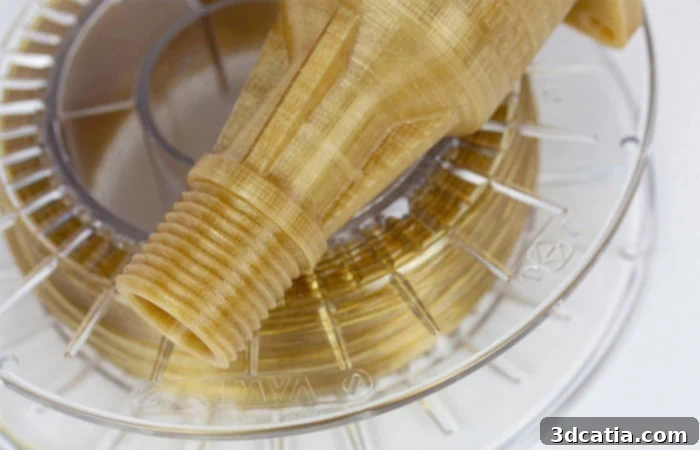
PEKK is used more in the oil and gas sector (photo credit: Kimya)
The Cost Implications of PEEK and PEKK in Additive Manufacturing
As anticipated for materials possessing such exceptional properties and characteristics, PEEK and PEKK command a significantly higher price point compared to most other polymers available on the market. This premium cost reflects the extensive research and development involved in their creation, the specialized manufacturing processes required to produce them, and their high purity necessary for demanding applications. On average, a 500-gram roll of PEEK filament typically ranges between €300 and €350 (approximately $350 to $420). PEKK filament, often considered even more advanced or specialized, tends to be slightly more expensive, with the same quantity costing between €350 and €400 (roughly $415 to $480). It is important to note that if you opt for high-performance variants, such as those reinforced with carbon fiber for enhanced mechanical properties, the price will be even higher, reflecting the added material and processing complexities.
For powder-based additive manufacturing, particularly Selective Laser Sintering (SLS) with PEKK, the cost structure is equally substantial. A kilogram of PEKK powder can typically cost around €500 (approximately $597 for about 2.2 lbs). The financial implications become even more pronounced when considering industrial-scale SLS machines. For instance, a large machine like the EOS P800, depending on its build volume, might require an initial fill of approximately 100 kilograms of powder. While a significant portion of unused powder (often around 50%) can be recycled and reused in subsequent builds, the initial investment and ongoing material consumption make SLS printing jobs with these high-performance materials considerably more expensive than those using more common polymers like nylon. Therefore, meticulous preparation is crucial: ensuring the 3D model is flawless and that printing parameters are perfectly dialed in is paramount, as errors can lead to substantial financial losses due to wasted material and machine time.
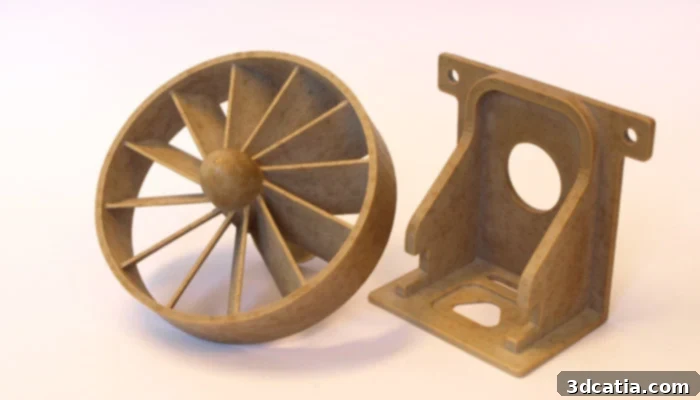
Parts 3D printed with PEKK via a powder sintering process (photo credits: Arkema)
Key Manufacturers and Market Landscape for PEEK and PEKK
The production and supply of PEEK and PEKK for additive manufacturing are primarily driven by specialized chemical companies and a growing number of 3D printing material developers. While both materials are predominantly available in filament form for FDM/FFF, PEKK also sees significant use in powder form for selective laser sintering, whereas PEEK powder for SLS is less common but gaining traction. In the realm of PEEK, the market is dominated by major chemical giants such as Victrex, Evonik, and Solvay. These companies have not only pioneered the development of PEEK but have also diversified their offerings to include specialized grades optimized for additive manufacturing. For example, Victrex provides its proprietary Low Melt PAEK (LMPAEK) and actively collaborates with leading high-performance 3D printer manufacturers like Intamsys and 3DGence to ensure optimal processing. Evonik, another industry leader, has developed its VESTAKEEP® range, specifically tailored for the 3D printing of medical implants, highlighting the material’s criticality in biocompatible applications.
Beyond these primary chemical producers, numerous 3D printing material manufacturers have entered the market, offering PEEK filaments and compounds. Notable names include 3DXTECH, 3D4Makers, W2 Polymer, and OPM, each providing tailored PEEK solutions for various industrial needs. Furthermore, some 3D printer manufacturers have integrated PEEK materials directly into their ecosystems, such as Zortrax with its Z-PEEK filament, ensuring seamless compatibility and optimized print profiles for their machines.
For PEKK, the French chemical company Arkema remains a preeminent manufacturer, supplying both powder and granular forms of the polymer. Its Kepstan® PEKK range is highly regarded and meets the demanding specifications of a wide array of industrial clients, particularly for aerospace and defense applications. Lehvoss, another significant player, offers its LUVOCOM 3F PEKK 50082 NT in granulated form, catering to specialized industrial applications. Oxford Performance Materials (OPM) is also a key supplier of PEKK powder, with a strong focus on the medical sector, leveraging PEKK’s biocompatibility for advanced implants. In the filament market for PEKK, prominent brands include the French company Kimya, the Dutch firm 3D4Makers, the American manufacturer 3DXTECH, and Nanovia, all contributing to the accessibility and versatility of PEKK for FDM 3D printing.
The choice between PEEK and PEKK for additive manufacturing is a strategic decision that hinges on a deep understanding of their unique compositions, processing requirements, and the specific demands of the intended application. Both stand as pillars of high-performance 3D printing, enabling the creation of parts that push the boundaries of conventional manufacturing. Do you utilize PEEK or PEKK in your additive manufacturing processes? Share your insights and experiences in a comment below or connect with us on our Facebook, Twitter, and LinkedIn pages! Stay informed with the latest innovations in 3D printing by signing up for our free weekly Newsletter here, delivered straight to your inbox!