
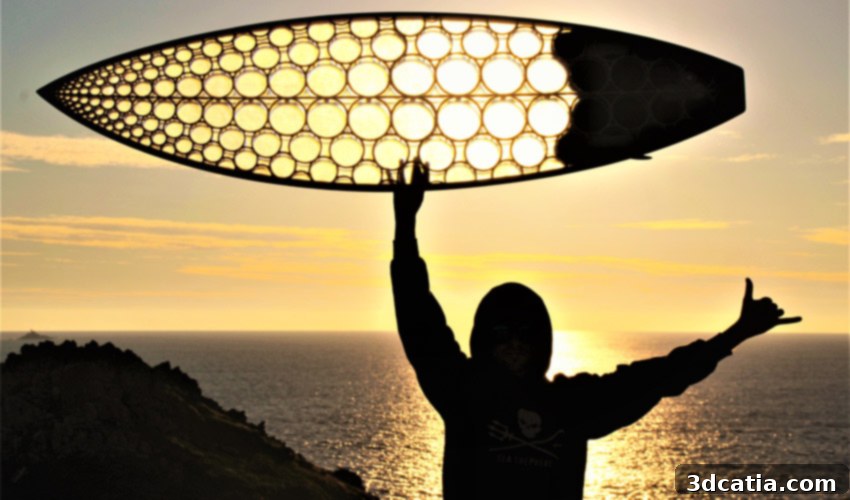
Paradoxal Surfboards: Pioneering Sustainable 3D Printed Surfboards from Green Algae
In an inspiring effort to make surfing more environmentally conscious, Paradoxal Surfboards emerges as a groundbreaking project. Led by Jérémy Lucas, a visionary young Frenchman, this initiative is reshaping the surfboard manufacturing landscape by utilizing 3D printing technology with incredibly greener materials – moving away from the petrochemical-derived components that dominate the industry. Jérémy has ingeniously developed a novel material compatible with 3D printing, primarily sourced from the abundant green algae washing up on the picturesque Breton coast. This innovative approach not only offers a sustainable alternative for surfboard production but also provides a valuable solution for recycling marine waste, transforming an environmental nuisance into a resource. We recently had the opportunity to speak with Jérémy Lucas to delve deeper into the Paradoxal Surfboards project and learn about his ambitious plans for the future of eco-friendly surfing.
3DN: Can you introduce yourself? How did you discover 3D printing?

Jérémy Lucas
Hello, I’m Jérémy Lucas, a 32-year-old entrepreneur and passionate surfer, originally from France. I am the proud founder and driving force behind the Paradoxal Surfboards project. My journey into the world of surfing began about a decade ago during an unforgettable road trip across Australia, where I truly discovered the exhilaration of riding the waves. My initial encounter with 3D printing came several years later, through specialized press articles that highlighted advancements in new technologies. At that time, the concept felt incredibly futuristic and somewhat inaccessible, so I didn’t pursue it further or delve into its potential applications.
However, everything changed in 2019 when I decided to co-found a Mechanical Design office in Douarnenez with my then-partner. Our company, named FL3D, focused primarily on two distinct activities. The first involved providing industrial design and CAD services to professionals in various sectors, including boilermakers, metalworkers, and sheet metal fabricators. The second activity, which proved more challenging to monetize effectively, involved fulfilling highly specific requests for individual clients using our Ultimaker 3D printer, which was housed in our modest 9m² office. Despite the enthusiasm for innovation, making this aspect of the business consistently profitable proved difficult.
Given that 3D printing, especially for custom applications, can be a relatively time-consuming technology, we faced a critical strategic decision. Our vision for FL3D became clear: either we commit to scaling up significantly, investing in a substantial park of industrial 3D printers to meet large-scale manufacturing demands, or we pivot towards developing a predefined product with exceptionally high added value. This pivotal moment laid the groundwork for the innovative direction Paradoxal Surfboards would eventually take, moving beyond general services to focus on a unique, sustainable product.
3DN: How did you get the idea to create Paradoxal Surfboards?
The genesis of Paradoxal Surfboards struck me in December 2019. I went surfing with some colleagues on Ris beach in Douarnenez, right in the middle of a storm. The conditions that day were intense: powerful swell, strong back-wash, and unfortunately, the spot was heavily saturated with green algae – a persistent and disheartening phenomenon along this coast. During that session, I went under the waves multiple times, ingesting a significant amount of water and algae. I emerged from the water feeling quite unwell, suffering from severe headaches and vomiting, which left me bedridden for two days. This deeply unpleasant experience served as a powerful environmental trigger. It made me realize that it was imperative to act, even on a local scale and with our limited resources, to address and mitigate the pervasive issue of green algae pollution.
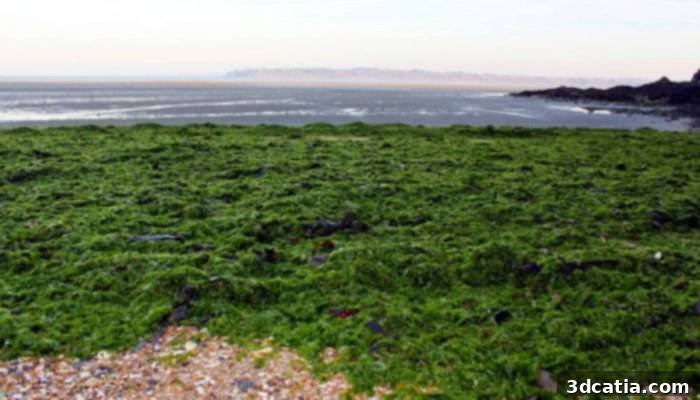
Green algae are more and more numerous on the Breton coasts (photo credits: Reporterre)
Just a week later, while we were hand-delivering a 3D printing order at our FL3D office, a curious customer inquired about the origins of the materials we used for our prints. We explained that our primary material was PLA, a vegetable plastic that doesn’t rely on petroleum. The customer, clearly well-informed about sustainable practices, then highlighted a crucial point: the PLA we were using, though plant-based, was derived from corn sugar. She explained that corn cultivation for PLA is incredibly water-intensive and often leads to the devastation of dedicated biodiversity areas, not to mention that it’s frequently sourced from genetically modified organisms (GMOs). This conversation further solidified my growing conviction that we needed genuinely sustainable alternatives.
Inspired by these insights, we decided to embark on the challenging task of developing a new, truly eco-friendly thermoformable material suitable for 3D printing. The question then became: why not derive this material from green algae, a waste product that had just caused me such distress? The connection was almost instantaneous when recalling my recent arduous surf session: “We’re going to 3D print surfboards using beached green algae!” The idea was audacious, but it felt right – a true full-circle solution.
We chose the name “Paradoxal Surfboards” for several profound reasons. As our colleagues at YUYO eloquently explain, our initiative aims to address what they term the “paradox of the surfer.” Surfers, by the very nature of their sport, are intimately connected with the ocean and often embody an eco-conscious lifestyle, striving for environmental respect. Yet, paradoxically, they have historically been left with no choice but to rely on petro-composite materials for their essential gear – from neoprene wetsuits to polystyrene or polyurethane boards, gloves, and leashes. Paradoxal Surfboards seeks to dismantle this contradiction by offering genuinely sustainable alternatives.
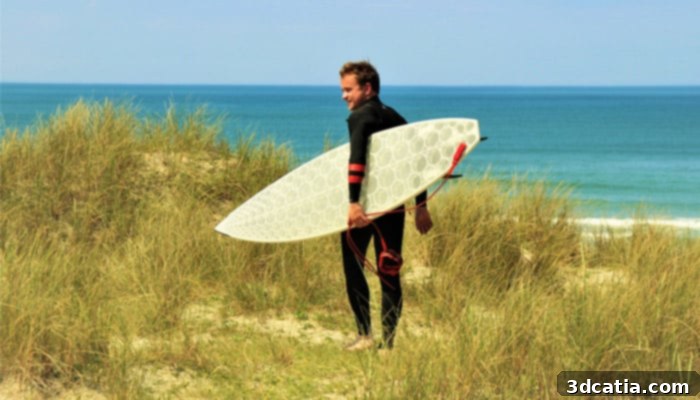
The objective is to not use materials from the oil industry to manufacture the boards
The name “Paradoxal” also reflects our commitment to valorizing, or more accurately, “upcycling,” the vast quantities of beached green algae found along the entire Breton coast – material often considered mere waste. Embracing a “cradle-to-cradle” philosophy, we intend to transform this undesirable marine detritus into high-performance sports equipment. These innovative boards will directly replace traditional, oil-based materials like polyurethane (PU) or expanded polystyrene (EPS) commonly used in surfboard manufacturing. Crucially, our goal is that these eco-friendly boards will, at the end of their life cycle, naturally return to the ocean without causing harm, completing a truly circular economy model.
This undesirable material, green algae, traditionally holds negative commercial value; people simply haven’t known what to do with it. Its primary use, once collected, treated, and stabilized, has been limited to mixing it with other green waste as fertilizer for agricultural fields. While this offers some recycling, it often feeds into a production system that already seems overwhelmed and environmentally stressed. Paradoxal Surfboards envisions a more innovative and impactful use for this abundant resource.
Without delving into the precise quantities of algae collected each year in our vicinity or the exact amount needed to produce a single surfboard, Paradoxal Surfboards focuses its efforts not on the prevention or curative aspects of the algae problem, but on proposing an entirely new valorization strategy. We see this “waste” as an abundant resource here in Brittany, offering an excellent alternative to the petrochemical-derived products that constitute nearly all conventional surfboards. These traditional materials are toxic, often non-recyclable, and typically transported from afar, contributing significantly to a larger carbon footprint. Our green algae-based boards offer a localized, sustainable, and performance-driven solution.
Looking ahead, we recognize that the future might hold new challenges. The day when there is no longer a problem with green algae (a hopeful but distant prospect), we are prepared to shift our focus. We would then turn our attention to creating boards from other prevalent marine waste, such as beached plastic, whose alarming quantities are unfortunately even more mind-boggling. In line with this adaptable vision, we are currently actively studying the feasibility of 3D printing our surfboards from recycled fishing nets also recovered from beach clean-ups. This demonstrates our commitment to a flexible and ever-evolving approach to sustainable material sourcing.
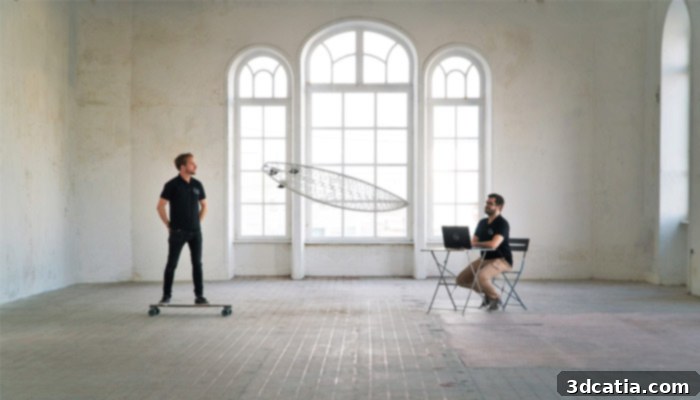
Photo Credits: Paradoxal Surfboards
3DN: How are the 3D printed surfboards made?
The methodology for crafting our 3D printed surfboards, while appearing straightforward once established, is actually quite intricate in its implementation. It demands a significant degree of multidisciplinary expertise, combining several key competencies. For the successful realization of this ambitious project, three essential pillars were identified and meticulously developed:
Designing the board – Industrial Design – CAD:
Starting from a blank slate and conceptualizing high-performance 3D printed surfboards is no trivial undertaking. We faced the complex challenge of striking a delicate balance. Our design needed to be innovative, visually appealing, and optimized to utilize the precise amount of printable material to control production costs and minimize manufacturing time. Concurrently, we had to meticulously consider the board’s hydrodynamic performance, its final weight distribution for optimal balance, and ensure that it required minimal post-production finishing. The viability of our entire business model hinges on achieving this intricate equilibrium in design.
3D printing and creating a new material:
Once the surfboard’s design is finalized, the next crucial step is its fabrication using an appropriate material and a large volume 3D printer. For our initial prototype, the core of the board – which traditionally consists of foam blocks – was ingeniously 3D printed in two distinct parts. These sections were then precisely thermo-clipped together to form a robust internal structure. The setting of the 3D printing parameters proved to be particularly complex, requiring numerous iterations and extensive testing to achieve a final product that not only met our structural requirements but also delivered peak performance on the water.
While this first prototype utilized PLA, our primary focus for future models is on the development of a revolutionary new thermoformable material. This advanced material will be formulated from a combination of finely powdered green algae, meticulously collected from beachings, integrated with recycled Dyneema fibers sourced from decommissioned offshore racing boats. The detailed specifications and testing for this cutting-edge composite are currently a major area of our research and development efforts, promising a truly sustainable and high-performance material for surfboards.
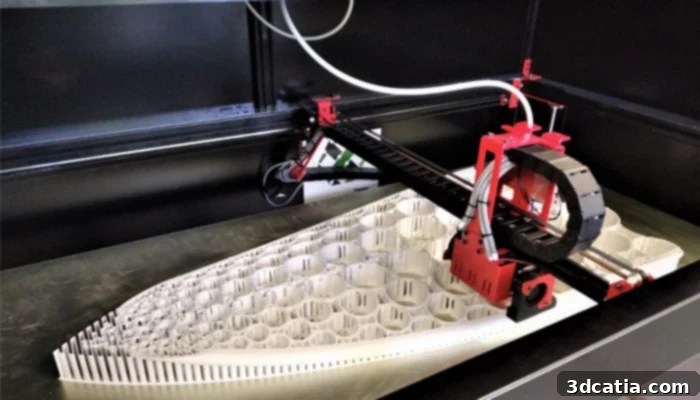
Printing the board prototype on a large format 3D printer (photo credits: Paradoxal Surfboards)
Layering (Lamination):
Once the intricate internal 3D printed structure is complete, the board must be meticulously sealed to ensure its durability and water resistance. This crucial step, known as lamination, involves covering the internal structure with a protective fiber and then saturating it with a specialized resin. For our initial model, and given the relatively large structural cells within the 3D printed core, selecting the appropriate fiber range presented a considerable challenge. To overcome this, we innovatively adopted a “reverse lamination” process. This involved precisely machining molds – essentially the negative form of the surfboard – using CNC (Computer Numerical Control) technology. These molds allowed us to accurately integrate the 3D printed internal structure and then proceed with the lamination process from the outside in. This exceptionally complex step was made possible through a remarkable collaborative effort with several highly skilled engineers and technicians specializing in composite materials, all based here in Brittany, highlighting the importance of local expertise in our manufacturing process.
3DN: Why 3D printing?
Despite the current time-consuming nature of some of its processes, 3D printing, or additive manufacturing, fundamentally remains a low-energy technology, which aligns perfectly with our sustainability goals. Crucially, it empowers us to create internal structures with incredibly complex, organic designs that would be virtually impossible for a craftsman to achieve using conventional, manual methods. Moreover, 3D printing offers unparalleled versatility in material utilization, allowing us to experiment with and deploy a wide array of materials, each possessing distinct properties tailored for performance and environmental impact. We drew profound inspiration from the natural world, specifically through biomimicry, by studying the intricate, resilient structure of green algae itself. Given that the core mission of our project is to 3D print surfboards from beached green algae, we found the concept of letting nature inspire the internal design of our boards to be not only logical but also incredibly compelling and aesthetically profound. We are continually developing new designs, all steadfastly inspired by this very principle of biomimicry, ensuring our boards are as functional as they are environmentally responsible.
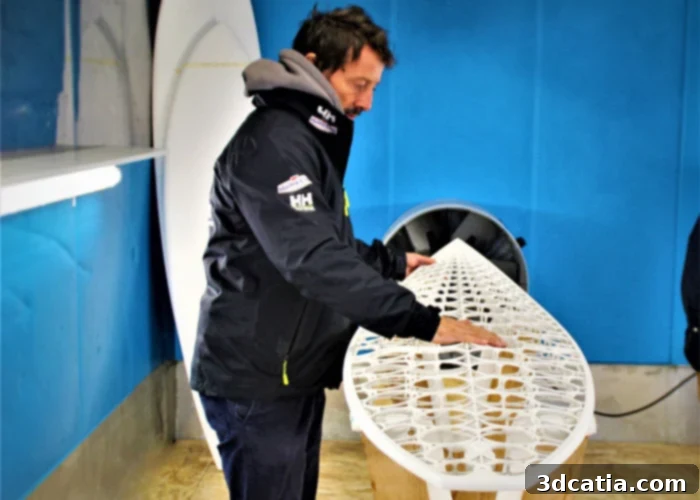
Photo Credits: Paradoxal Surfboards
Beyond the main surfboard, 3D printing also extends its utility to the associated equipment. For instance, we have successfully 3D printed the core of the daggerboards (fins) using biodegradable corn starch. These cores are then expertly laminated with recycled carbon fiber, meticulously salvaged from high-performance ocean racing boats, including those from prestigious events like the Vendée Globe. This holistic approach ensures that even the smaller components of our surfing gear adhere to the highest standards of environmental responsibility and material innovation.
3DN: What are the challenges you are still facing today with your 3D printed surfboards?
The journey of Paradoxal Surfboards has seen its share of evolutions and hurdles. Until last March, it operated as an intrapreneurial project, fostered within a promising young start-up based in Douarnenez, which I had the privilege to co-direct. Regrettably, that company no longer exists today. This unexpected turn of events has inevitably caused the project to slow down considerably. My most significant and immediate challenge now is to ensure the project’s continuity, allowing it to “continue” to thrive as a singular, driven initiative under my leadership, rather than as an established company. This requires significant personal commitment and resourcefulness.
Another formidable challenge we face is successfully formulating and refining this pioneering new thermoformable material derived from beached green seaweed. The development involves navigating incredibly complex technical specifications, securing adequate financing for advanced research and testing, and conducting numerous iterative experiments to achieve the desired material properties – strength, flexibility, durability, and environmental integrity. There is a substantial amount of intensive work ahead on this front. However, despite these formidable obstacles, there’s a burgeoning network of collaborators and supporters who have rallied around the creation of this first green algae surfboard. For the time being, I am determined to continue developing the project, making progress even if it sometimes feels like I am advancing a little blindly, guided by passion and a strong belief in our mission.
3DN: Any last words for our readers?
I want to extend my sincere gratitude to everyone who took the time to read this article and for your interest in our journey, and perhaps even for sharing it! I also wanted to seize this opportunity to acknowledge and salute our colleagues at Wyve Surfboards, who are doing truly remarkable work in the field of sustainable surfing. Their pioneering efforts have been a significant source of inspiration for me in the development of this beautiful project. They’ve provided immense motivation to pursue this grand challenge: to make surfing more respectful of our precious environment, from the very initial conception to the final manufacturing of every board. We believe that through collaboration and innovation, we can collectively transform the industry for the better.
What are your thoughts on Paradoxal Surfboards and its innovative 3D printed surfboards? We’d love to hear from you! Please share your comments below or connect with us on our Facebook and Twitter pages. And don’t forget to sign up for our free weekly newsletter to receive all the latest news and innovations in 3D printing delivered directly to your inbox!
*Thumbnail Photo Credits: Paradoxal Surfboards