
Pioneering the Future of Energy: ORNL’s Revolutionary 3D Printed Nuclear Reactor and the Ascent of Additive Manufacturing
At the forefront of energy innovation, a dedicated team of researchers at Oak Ridge National Laboratory (ORNL) is making remarkable strides in the development of a 3D printed nuclear reactor. This ambitious project involves not only the intricate design of a novel reactor core but also the intense validation of the entire additive manufacturing process to ensure the unwavering reliability of its 3D printed components. ORNL’s vision is to commission the first-of-its-kind nuclear reactor by 2023, a development poised to fundamentally transform the nuclear sector by enabling the production of more advanced, sustainable, and economically viable energy systems for the future.
The integration of additive manufacturing, commonly known as 3D printing, into the energy sector is proving to be a game-changer. Beyond its widely recognized benefits, AM technologies excel at rapidly validating complex concepts and significantly accelerating rapid prototyping phases. This speed and agility allow engineers and scientists to iterate designs more efficiently, leading to faster development cycles. Furthermore, additive manufacturing facilitates the creation of components that are inherently more efficient, optimized in both their intricate shapes and their material utilization. By building parts layer by layer, designers are freed from the constraints of traditional manufacturing, enabling the creation of complex geometries previously impossible. While the adoption of additive manufacturing continues to expand across virtually every industry, its breakthrough in the nuclear sector has historically faced unique challenges due to stringent safety regulations and the critical nature of its applications. However, pioneering initiatives like ORNL’s project are clearly demonstrating that the nuclear industry is not only ready but eager to leverage the profound benefits offered by advanced manufacturing techniques.

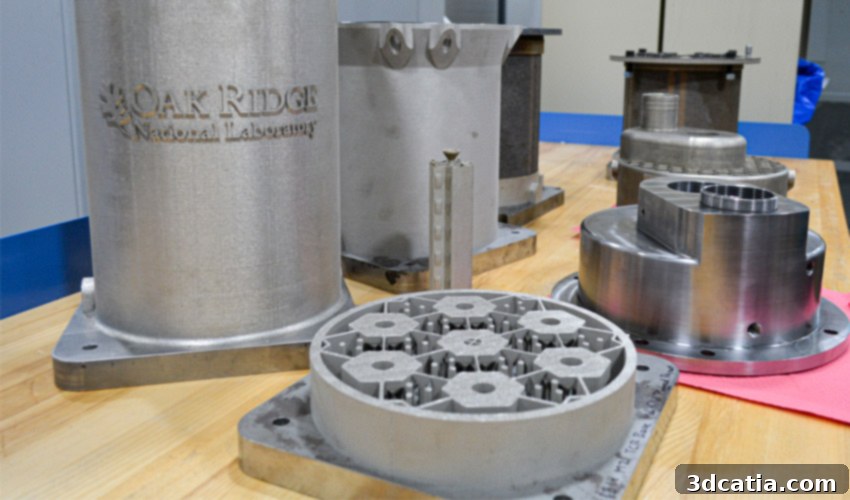
ORNL utilized a metal additive manufacturing process for core components. | Credits: ORNL, Energy Department
Oak Ridge National Laboratory stands as a prime example of an institution embracing 3D technologies across diverse projects and sectors for many years. Their commitment to innovation is exemplified through the “Transformational Challenge Reactor Demonstration” (TCR) program. This groundbreaking initiative, spearheaded by the American laboratory, was conceived to explore and develop energy systems that are not only more efficient but also faster and more economical to deploy. The TCR program has already yielded impressive results, showcasing the inherent agility of additive manufacturing. In an astonishingly short period of just three months, ORNL successfully designed and produced a prototype 3D printed nuclear reactor core. This rapid turnaround highlights the immense potential of additive manufacturing to dramatically reduce development timelines compared to conventional methods. Dr. Thomas Zacharia, director of the laboratory, emphasized the pressing need for such innovation, stating: “The nuclear industry is always forced to think about how we design, build and deploy nuclear power technology. DOE launched this program to seek a new approach to quickly and economically develop transformational energy solutions that deliver reliable, clean energy.” This sentiment underscores the program’s strategic importance in addressing the evolving demands for sustainable and reliable energy sources.
The traditional methods of designing and constructing nuclear reactors are often characterized by prolonged development cycles, immense capital investments, and complex supply chains. The TCR program seeks to disrupt this paradigm by harnessing the power of advanced manufacturing. By integrating 3D printing from the conceptual phase to the final component, ORNL is paving the way for a streamlined approach that promises to deliver next-generation nuclear technology with unprecedented speed and cost-effectiveness. The ability to rapidly prototype, test, and iterate designs is a critical advantage, allowing researchers to explore a broader range of innovative concepts and refine them with greater precision. This agility is crucial for meeting the urgent global demand for clean energy solutions and for maintaining the competitive edge of nuclear power in the evolving energy landscape.
To fabricate this pioneering prototype, researchers employed Directed Energy Deposition (DED) technology, utilizing robust stainless steel as the primary material. DED is particularly well-suited for printing large, complex metal components and offers superior control over material properties, making it an ideal choice for critical applications like nuclear reactors. The team’s current focus is on meticulously refining the chosen design and rigorously validating the performance of the 3D printed components. This includes comprehensive real-time performance evaluation to ensure that the energy supplied will be consistently reliable and optimally efficient. The process involves extensive testing under simulated reactor conditions to verify the structural integrity, thermal performance, and overall operational stability of the printed parts. This rigorous qualification process is paramount for meeting the demanding safety standards of the nuclear industry.
Kurt Terrani, the Technical Director of the TCR program, highlighted the groundbreaking potential that 3D printing unlocks for the nuclear community. He elaborated, “By using 3D printing, we can use technology and materials that the nuclear community has not been able to exploit in recent decades. This includes sensors for near-autonomous control and a data library as well as a new accelerated approach to qualification that will benefit the entire nuclear community. The TCR programme will provide a new model for the accelerated deployment of advanced nuclear energy systems.” This statement encapsulates several key advantages. The ability to embed advanced sensors directly into reactor components during the printing process opens up new possibilities for real-time monitoring and near-autonomous control, enhancing operational safety and efficiency. Furthermore, the creation of a comprehensive data library based on these printed components will be invaluable for future design and qualification efforts, accelerating the adoption of new materials and designs. This innovative approach promises to significantly shorten the typically protracted qualification processes for nuclear technologies, thereby accelerating the deployment of advanced nuclear energy systems.
The benefits of leveraging additive manufacturing in nuclear reactor development extend far beyond just speed and cost. Design freedom, for instance, allows engineers to create highly complex internal geometries within reactor components that are optimized for enhanced heat transfer, improved coolant flow, and greater structural integrity. This level of optimization is often impossible with traditional subtractive manufacturing methods. Moreover, AM enables the use of advanced materials or even functionally graded materials, where material properties can be varied within a single component to meet specific performance requirements in different regions. This capability can lead to more durable and efficient components. The integration of sensors directly into the material lattice, as mentioned by Terrani, represents a paradigm shift for condition monitoring and predictive maintenance, contributing significantly to reactor safety and operational lifespan. These advancements collectively pave the way for smaller, safer, and more flexible nuclear power plants that can be deployed closer to demand centers, offering decentralized power generation capabilities.
Of course, the path to commercializing a 3D printed nuclear reactor is not without its challenges. The nuclear industry operates under some of the most stringent regulatory frameworks globally, demanding unparalleled levels of safety and reliability. Qualifying new materials and manufacturing processes for nuclear applications requires extensive testing, validation, and a deep understanding of long-term performance under extreme conditions (high temperatures, radiation, pressure). ORNL’s rigorous approach to validating every 3D printed component, including comprehensive real-time performance evaluations, is critical to building the necessary confidence in this revolutionary technology. The development of a robust data library, as part of the TCR program, will be instrumental in establishing new qualification standards and demonstrating the long-term viability and safety of additive manufacturing in nuclear contexts. This meticulous attention to detail and commitment to scientific rigor are what will ultimately enable the safe and successful deployment of 3D printed nuclear reactors.
The ORNL team remains steadfast in its ambitious goal of commissioning this groundbreaking 3D printed nuclear reactor in 2023. This timeline underscores the urgency and potential of the project to bring advanced nuclear energy systems online faster than ever before. We are committed to keeping you informed of all the latest developments as this transformative project progresses. For those eager to delve deeper into the specifics of this pioneering work, more detailed information can be found HERE on the official ORNL news page. The implications of such advancements for the global energy landscape are immense, promising a cleaner, more sustainable, and more resilient future. What are your thoughts on these monumental developments in the energy sector and the role of advanced manufacturing? We invite you to share your insights and comments down below, or join the conversation on our Facebook and Twitter pages! Don’t miss out on future updates from the world of 3D printing and advanced manufacturing; be sure to sign up for our free weekly Newsletter, delivering all the latest news directly to your inbox!