
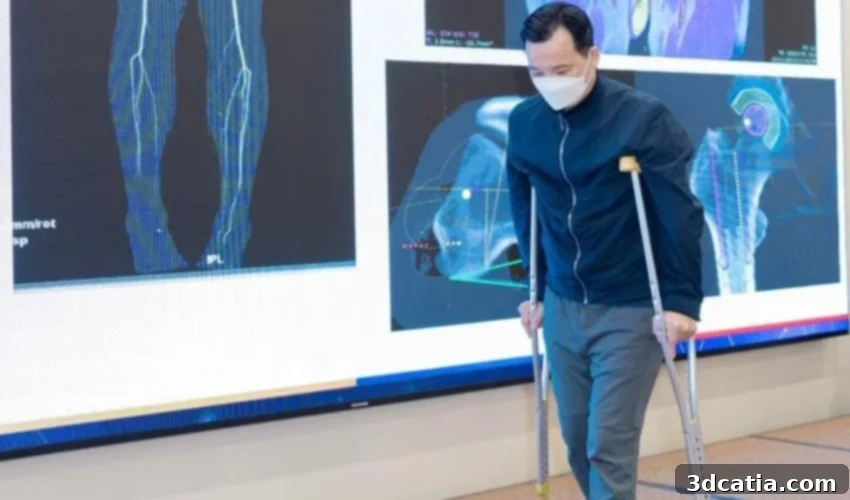
Revolutionary 3D Printed Bone Implants: Vinmec Hospital Achieves Global First in Cancer Treatment
Surgeons at Vinmec General Hospital in Vietnam have achieved a monumental medical milestone, pushing the boundaries of what’s possible in reconstructive surgery and oncology. Their groundbreaking work involved the innovative application of advanced 3D printing technology to create artificial bone implants. These bespoke implants were successfully used to replace a patient’s pelvis and a significant portion of their femur during a complex surgical procedure. While the concept of 3D printing bones for medical use is not entirely new, this specific procedure marks an unprecedented global first. It was meticulously designed to confront the severe challenges associated with metastatic bone cancer, an exceptionally rare and aggressive form of the disease often linked with a grim prognosis and low survival rates.
This landmark achievement represents a profound leap forward in the medical field, vividly demonstrating the transformative potential of 3D printing in tackling life-threatening conditions that previously offered limited hope. The extreme rarity and inherent complexity of metastatic bone cancer necessitated an extraordinary response. This prompted an intensive and collaborative effort between the highly specialized medical and engineering teams at Vinmec General Hospital. Their shared mission was to develop a truly innovative and patient-centric solution for 63-year-old patient Le Dinh Thuan, whose unique and challenging case demanded an unconventional approach to preserve his quality of life and extend his survival.
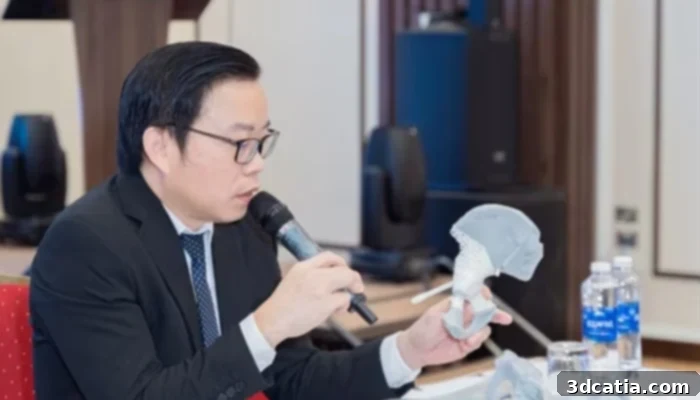
Professor Dr. Tran Trung Dung, the Director of Vinmec Orthopedics Center, explains the treatment process using 3D printed implant models.
Understanding Metastatic Bone Cancer and the Limits of Conventional Treatment
Metastatic bone cancer is a debilitating condition where cancer cells originating from another part of the body spread to the bones, often causing severe pain, pathological fractures, and significant impairment of mobility. When the disease afflicts critical weight-bearing structures like the hip joint, pelvis, and femur, as it did in Mr. Thuan’s case, the situation becomes particularly dire. The cancer had aggressively infiltrated his joint capsules, pelvis, and the upper part of his femur, compromising the structural integrity and functionality of one of the body’s most crucial joints. Such extensive involvement in these complex anatomical regions makes treatment profoundly challenging, as traditional surgical interventions often come with severe trade-offs.
Traditionally, managing advanced metastatic bone cancer in the hip region has involved drastic and often debilitating measures. These conventional treatments typically entailed the radical removal of the entire affected side of the pelvis, a procedure known as hemipelvectomy, alongside parts of the femur. While aimed at excising the cancerous tissue, this approach inevitably led to profound and irreversible disability, significantly impacting the patient’s mobility and overall quality of life. Furthermore, despite the invasiveness of such surgeries, they offered little to no significant increase in post-surgical survival rates for this aggressive form of cancer. Mr. Thuan’s informed refusal of this conventional, life-altering procedure underscored the critical and immediate need for an alternative, less invasive, yet equally effective solution, compelling the Vinmec medical team to explore innovative technological avenues, ultimately leading them to consider the burgeoning field of 3D printing.
Patient-Specific Innovation: Crafting Thuan’s Bespoke Implant
Recognizing the extreme urgency of Mr. Thuan’s condition and the inherent limitations and devastating consequences of traditional treatment methods, the dedicated medical and engineering teams at Vinmec General Hospital embarked on an intensive quest for a revolutionary solution. After meticulously exploring various alternatives, their focus crystallized on the transformative potential of advanced 3D printing technology to custom-produce artificial bone implants. Given the rapid progression of Mr. Thuan’s cancer and his limited time, the Vinmec team undertook an extraordinarily accelerated development process. In a mere two weeks, they designed, fabricated, and rigorously tested nearly 100 prototypes. This rapid iterative prototyping was crucial to meticulously refine the design, ensuring the implant would perfectly match Mr. Thuan’s unique anatomy and provide optimal functionality and structural support, ultimately perfecting the final, life-saving implant.
The artificial bone implant, engineered to precisely replace the removed sections of Mr. Thuan’s pelvis and femur, is a marvel of bio-engineering. It features a unique, highly intricate design meticulously crafted from a biocompatible medical titanium alloy. This material was chosen for its exceptional strength-to-weight ratio, corrosion resistance, and proven compatibility with the human body, minimizing the risk of adverse reactions. What sets this implant apart is its innovative hollow honeycomb structure. This design not only accurately mimics the complex morphology and architectural intricacies of the original pelvis and femur but also contributes significantly to its remarkably lightweight nature. Despite its metallic composition, the implant occupies less than half the volume of natural bone, greatly reducing the overall burden on the patient’s musculoskeletal system and facilitating quicker adaptation.
Beyond its impressive lightweight characteristics, the hollow honeycomb design endows the implant with extraordinary robustness. Despite its internal cavities, it is reportedly capable of withstanding forces up to 10 times greater than those that natural bone can endure, providing unparalleled stability and durability. Crucially, this enhanced strength is achieved while meticulously maintaining an elasticity similar to that of natural bone, which is vital for proper biomechanical function and preventing stress shielding, a phenomenon where stiffer implants can cause surrounding bone to weaken. Furthermore, the implant’s surface, particularly where it interfaces with healthy bone, has been intentionally roughened and equipped with micro-holes. This textured surface is not merely a design aesthetic; it actively promotes and encourages the ingrowth of bone cells (osteointegration) from the surrounding healthy tissue, significantly enhancing the implant’s long-term stability and integration within the patient’s skeletal system post-surgery, promising a more secure and lasting bond.
A Breakthrough in Patient Recovery and the Future of Orthopedic Oncology
One of the most profound benefits of these advanced 3D printed implants lies in their ability to dramatically reduce the patient’s post-operative recovery period. In Mr. Thuan’s remarkable case, he regained significant mobility and was able to walk within a mere 10 days following the complex surgery. This astonishing recovery time represents an approximate 65% reduction compared to the expected recovery duration associated with traditional surgical procedures for similar conditions. Such a rapid return to mobility not only alleviates prolonged hospital stays and associated risks but also profoundly improves the patient’s immediate quality of life, fostering a sense of hope and independence that was previously unattainable for individuals facing such severe diagnoses.
The success witnessed with Mr. Thuan’s pioneering treatment extends far beyond his individual case. This medical milestone has effectively unlocked entirely new treatment avenues for patients suffering from various forms of bone cancer, particularly those in advanced stages where conventional options are limited or severely debilitating. The proven efficacy and remarkable patient outcomes of 3D printed artificial bones, as demonstrated by Vinmec General Hospital, are poised to inspire and encourage more healthcare institutions globally to embrace and integrate this cutting-edge technology into their orthopedic oncology practices. This shift towards personalized, high-precision implants represents a significant paradigm change in how complex bone cancer cases are approached, moving towards solutions that prioritize both survival and an enhanced quality of life.
This breakthrough also underscores the immense potential of personalized medicine, where treatments are meticulously tailored to the individual patient’s unique anatomical and pathological requirements. 3D printing enables the creation of implants that precisely fit the patient’s anatomy, minimizing surgical complexity, optimizing biomechanical function, and improving long-term outcomes. As research and development in biomaterials and additive manufacturing techniques continue to advance, we can anticipate even more sophisticated and integrated solutions. The successful collaboration between medical expertise and engineering innovation at Vinmec General Hospital serves as a powerful testament to the future of healthcare, where technology and human ingenuity converge to tackle the most challenging medical frontiers and offer renewed hope to patients worldwide.
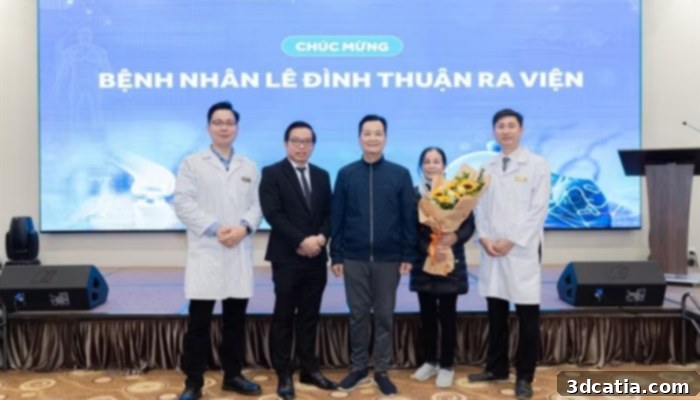
Patient Le Dinh Thuan posing with Vinmec medical team after his discharge from the hospital.
What are your thoughts on Vinmec General Hospital’s pioneering use of 3D printed pelvis and femur implants in the challenging landscape of bone cancer treatment? We’d love to hear your insights! Let us know in a comment below or connect with us on our LinkedIn, Facebook, and Twitter pages! Don’t miss out on the latest advancements and news in the additive manufacturing industry – remember to sign up for our free weekly newsletter here, delivering the most relevant 3D printing updates straight to your inbox! You can also find all our engaging videos and exclusive content on our YouTube channel, exploring innovative applications and breakthroughs in 3D printing technology.
*All Photo Credits: Vietnam.vn