
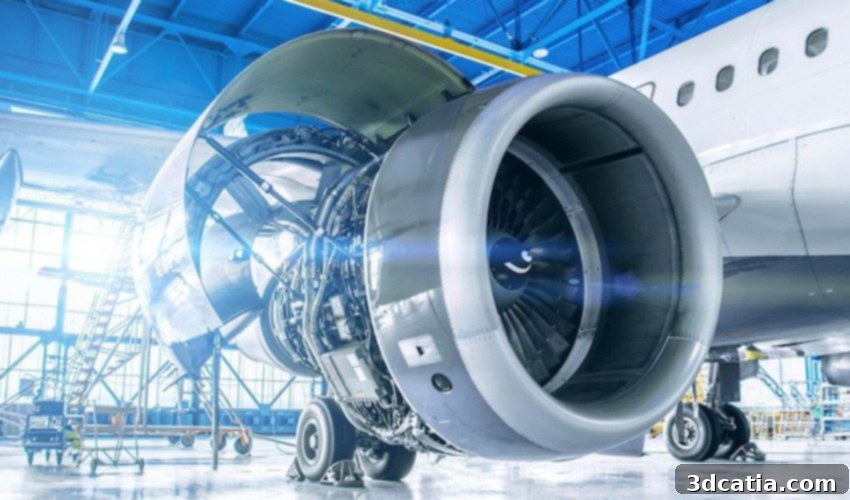
Optomec’s DED Technology Revolutionizes Turbine Blade Repair, Surpassing 10 Million Successes in Aerospace and Energy
Optomec, a pioneering force in the additive manufacturing (AM) sector since 1997, has achieved a remarkable milestone, announcing over 10 million turbine blade repairs using its advanced metal additive manufacturing technology. This significant accomplishment follows a recent comprehensive customer survey, underscoring the widespread adoption and proven efficacy of Optomec’s solutions across critical industrial landscapes. The company proudly states that all leading gas turbine Original Equipment Manufacturers (OEMs) have integrated Optomec AM systems into their operations. These systems are pivotal for maintaining and enhancing both aircraft engines within the demanding Aerospace sector and power generation equipment in the vital Energy sector. Across these high-stakes industries, additive manufacturing technologies have not only facilitated substantial improvements in design efficiency but have also delivered significant cost reductions. Optomec’s core technology, primarily based on Directed Energy Deposition (DED), is specifically engineered to repair high-value components that would otherwise incur prohibitive costs if manufactured from scratch or replaced entirely, thereby extending their operational lifespan and optimizing asset utilization.
At the heart of Optomec’s success are its sophisticated DED-based solutions, which include the renowned Huffman and LENS systems. Directed Energy Deposition stands as a complex and highly precise additive manufacturing technique that empowers industries to meticulously repair existing components or add additional material to enhance their functionality and durability. This process leverages a concentrated energy source, typically a high-power laser or an electron beam, to melt a feedstock material—usually metal powder or wire—as it is precisely deposited through the machine’s nozzle onto the target surface. Unlike traditional repair methods that might involve extensive material removal or complete replacement, DED allows for localized material addition, restoring components to their original specifications or even improving upon them. Optomec highlights that common production applications for their DED systems include the intricate repair of turbine blade tips, critical seals, wear surfaces, compressor blades, vanes, shrouds, and a myriad of other high-value, geometrically complex components. By enabling in-situ repairs and localized material enhancements, DED significantly reduces material waste and streamlines maintenance workflows. Compared to labor-intensive manual operations or conventional welding techniques, Optomec estimates that the Return on Investment (ROI) for adopting their DED systems can exceed a staggering 180%, showcasing the immense economic advantages of this advanced repair methodology.
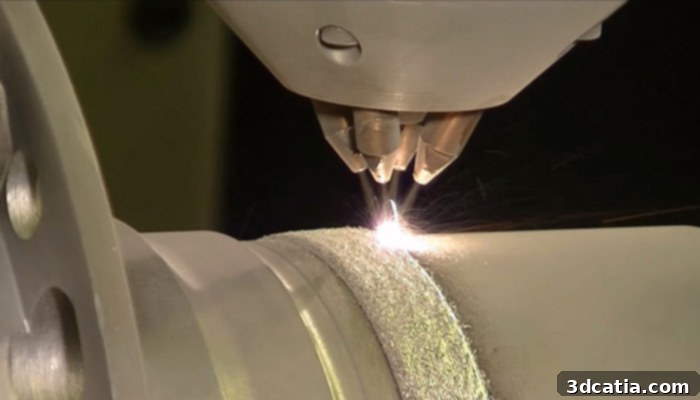
The Optomec DED technology offers precision and efficiency in metal component repair.
While acknowledging that specific detailed testimonials from individual customers regarding their precise usage of the manufacturer’s technology are not publicly available, the overarching benefits of 3D printing and additive manufacturing are undeniably transformative. Particularly for low-volume production, highly customized parts, or on-demand manufacturing scenarios, the advantages of AM are profound. It is a well-established fact that the more unique, complex, or critical a component is, the more compelling the case becomes for utilizing AM instead of conventional manufacturing techniques that often require expensive and time-consuming tooling, such as molds. This holds especially true in sectors like aerospace, where intricate geometries and high-performance materials are paramount. For instance, comprehensive market studies consistently indicate that the aerospace industry is progressively adopting a hybrid approach, strategically integrating both traditional and additive manufacturing technologies. This synergistic approach allows the industry to harness the unique strengths of each methodology—leveraging the economies of scale and material properties of traditional manufacturing for bulk structures, while capitalizing on AM’s unparalleled ability to create complex internal structures, lightweight designs, and specialized repairs, thereby pushing the boundaries of performance and efficiency.
Mike Dean, Marketing Director at Optomec, expressed profound enthusiasm for this achievement, stating, “We are truly excited to reach this important milestone not only for the Additive Manufacturing segment as a whole but, more importantly, for our valued gas turbine customers who rely on our technology. The likelihood is high that if you are a frequent flyer, you have probably flown with an engine that has been meticulously maintained or repaired using an Optomec laser cladder.” This statement powerfully underscores the tangible, real-world impact of Optomec’s technology on ensuring the safety and reliability of critical infrastructure. The flagship LENS system, a prime example of Optomec’s innovation, utilizes a high-power laser to precisely fuse powdered metals, including robust materials such as titanium, nickel, various stainless steels, and cobalt alloys. Beyond material versatility, customers consistently cite several distinct advantages that elevate Optomec’s offerings: 1) advanced proprietary vision and adaptive control software, which ensures unparalleled precision and consistency throughout the repair process; 2) controlled inert atmosphere processing, a critical feature for superior metallurgy that prevents oxidation and maintains the optimal mechanical properties of delicate metal alloys; 3) comprehensive turn-key repair process recipes, streamlining operations and reducing the learning curve for technicians; and 4) integrated automation solutions, which enable higher throughput batch processing, significantly boosting productivity and efficiency for large-scale industrial applications. These combined features not only ensure the highest quality repairs but also contribute to a faster, more economical, and repeatable manufacturing and repair cycle. For more detailed information on Optomec’s pioneering solutions and how they are transforming industrial maintenance, you can find further resources HERE.
The extensive adoption of Optomec’s DED technology, culminating in over 10 million turbine blade repairs, illustrates a broader, transformative trend within global industrial sectors. This milestone is not merely a testament to Optomec’s engineering prowess but also a clear indicator of additive manufacturing’s growing maturity and indispensable role in maintaining critical infrastructure. By enabling the repair and restoration of high-value components rather than their outright replacement, DED technology directly contributes to significant reductions in material consumption and waste, thereby promoting more sustainable operational practices. This approach not only extends the operational lifespan of expensive parts but also fortifies supply chain resilience by enabling localized repair capabilities, reducing dependence on lengthy procurement cycles for new components. Furthermore, the ability to rapidly repair and return crucial parts to service minimizes downtime, which translates directly into substantial cost savings and improved operational efficiency for airlines, power plants, and other industrial entities. The integration of advanced automation, precision controls, and optimized material processing ensures that these repairs meet or exceed the performance specifications of new components, often enhancing their durability. As industries continue to seek innovative solutions for efficiency, cost reduction, and sustainability, the trajectory of metal additive manufacturing, particularly DED, is set to expand even further, driving innovation and shaping the future of industrial maintenance and production.
What are your thoughts on the accelerating growth and increasing importance of additive manufacturing in industrial sectors? We invite you to share your insights and opinions in a comment below, or join the conversation on our Facebook and Twitter pages! Don’t miss out on the latest advancements and news in the 3D printing world—be sure to sign up for our free weekly Newsletter, delivering all the essential updates directly to your inbox!