
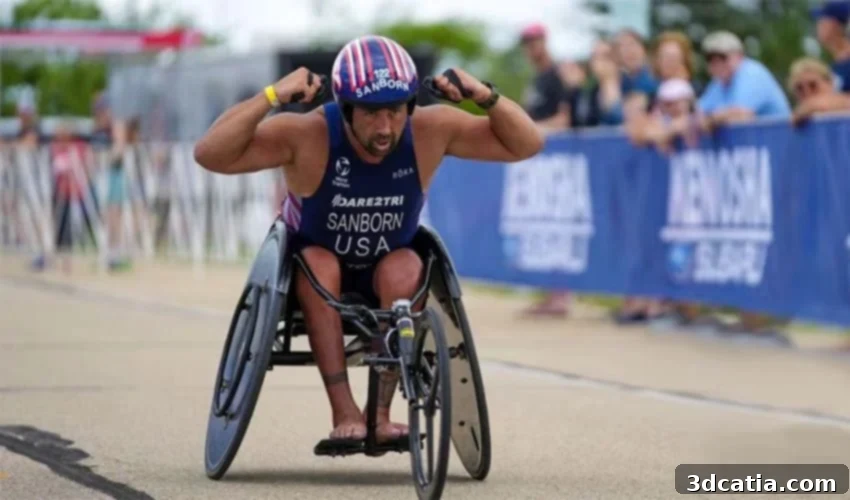
Empowering Paralympic Athletes: How 3D Printing Revolutionizes Adaptive Sports and Performance
Sport is a universal language, inherently designed to be accessible to everyone, irrespective of their individual circumstances or physical limitations. However, traditional perceptions often link sports solely with peak physical performance, erroneously assuming that physical integrity is a prerequisite for athletic excellence. The incredible athletes of the Paralympic Games resoundingly disprove this notion. Despite personal limitations, and often with the strategic integration of advanced technological aids—most notably 3D printing—these extraordinary individuals achieve unparalleled sporting feats, captivating audiences worldwide and demonstrating the true spirit of human endeavor.
The history of adaptive sports and organizations dedicated to athletes with disabilities stretches back over a century. A pivotal moment in the development of what we now celebrate as the Paralympic Games was the visionary work of Dr. Ludwig Guttmann. At Stoke Mandeville Hospital, he established a spinal injury center, where he pioneered the use of sports competitions as a transformative method for rehabilitating wounded soldiers. These pioneering “Stoke Mandeville Games” laid the essential groundwork for the modern Paralympic Games, which gained official recognition from the International Olympic Committee (IOC) in 1984. The term “Para” itself, derived from the Greek word for “beside,” beautifully signifies that the Olympic and Paralympic Games stand proudly side by side, celebrating athletic achievement in all its forms.
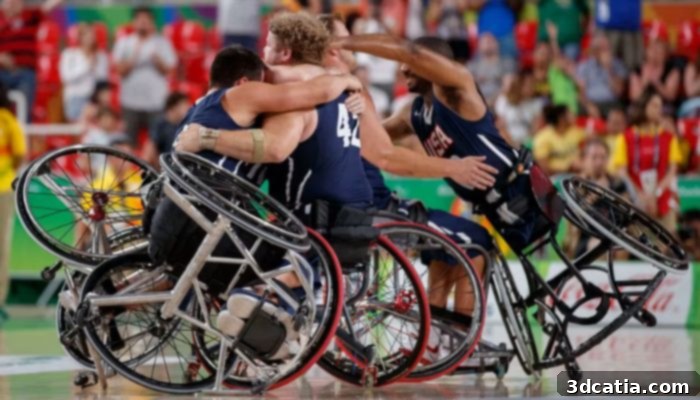
The Paralympic Games date back to the 20th century Stoke Mandeville Games (photo credits: Simon Bruty, OIS-IOC)
Since their inception, the Paralympics have welcomed athletes with a diverse range of physical and cognitive impairments. To ensure fair and equitable competition, athletes are categorized into various groups based on their specific type of disability. Furthermore, each sporting discipline implements rigorous classification systems. These systems are meticulously designed to ensure that athletes competing in the same category possess comparable functional abilities in critical areas such as movement, coordination, and balance. This careful classification guarantees that success is determined by athletic prowess and dedication, rather than by differences in impairment levels.
The Paris 2024 Paralympic Summer Games represent a landmark event, set to be the largest Paralympics to date. With an estimated 4,400 athletes converging to compete for medals across 22 distinct sports disciplines, the Games provide an unparalleled global stage for parasports. While the athletes themselves and their extraordinary achievements rightly command the spotlight, their silent partners—the sophisticated technological aids—play an equally crucial role. Modern technology is continuously driving innovation in parasports, introducing novel solutions that empower athletes to transcend perceived limitations and redefine the boundaries of human performance.

The Paralympic Games in Paris 2024 should be the biggest Paralympics yet (photo credits: Olympics.com)
The Transformative Power of 3D Printing in Paralympic Sports
Parasports, by their very nature, depend significantly on technological advancements. From specialized wheelchairs and high-performance prostheses to custom-designed sports equipment, technological progress serves as a vital enabler, helping athletes push past their physical limits and propelling the entire field of adaptive sports forward. Among these innovations, 3D printing stands out as a particularly game-changing technology.
Customization, Performance, and the Essence of Paralympic Competition
Heinrich Popow, a celebrated former German track and field athlete and multiple Paralympic medalist, eloquently states, “Sport is the best medicine.” At the same time, he underscores the indispensable role of technology in parasports, adding, “The use of aids is a sport in its own right.” This perspective leads Popow to advocate for a clear distinction between Olympic and Paralympic sports. He argues that Paralympic sports, with their reliance on sophisticated technological aids, inherently pursue their own unique performance limits and objectives. “That’s the beauty of Paralympic sport. You notice how the performance density is getting bigger and bigger because you’re doing performance-oriented sport,” Popow emphasizes, highlighting the continuous drive for innovation and improvement within the discipline.
Achieving peak performance often involves a synergistic combination of various technologies. For Paralympians, this integration opens up entirely new avenues in sports and unlocks unprecedented possibilities within their existing disciplines. 3D printing, especially when combined with other advanced techniques like 3D scanning and design optimization software, profoundly enhances ergonomics, mobility, and comfort. This synergy directly translates into optimal performance during both training and high-stakes competitions. Consequently, a growing number of elite athletes are embracing the profound benefits of additive manufacturing. Over the past few years, the Paralympic Games have witnessed a significant surge in the adoption of 3D printed aids, ranging from cutting-edge prosthetics and orthotics to specialized equipment such as ergonomic grips and custom gloves, particularly visible in cycling and wheelchair racing events.
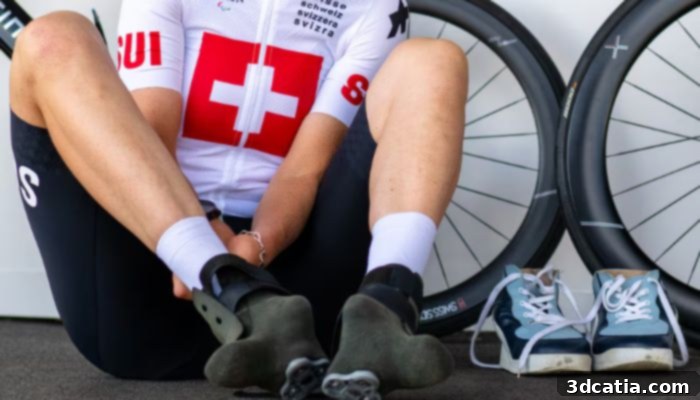
Switzerland’s Flurina Rigling is competing in the current Paralympic Games in Paris with 3D-printed shoes (photo credits: Tobias Lackner)
Swiss athlete Flurina Rigling, who clinched a bronze medal at the Paris 2024 Summer Paralympic Games while competing in cycling events with 3D-printed shoes, perfectly encapsulates the profound advantages of this technology. “This innovation helps me enormously,” Rigling explains. She elaborates on the practical improvements: “You have to imagine it: I used to have a single leather shoe. Once it was wet, I had to let it dry first. Now the 3D printer shoes are produced comparatively quickly and they are much lighter than the old ones. That makes a huge difference to me.” Her experience highlights not only the performance gains but also the significant improvements in practicality and athlete comfort.
The increasing ability to process a wide array of high-performance materials using 3D printing further elevates athlete comfort and performance. For instance, multi-material printing techniques enable the creation of components that seamlessly integrate both soft and hard elements, tailored precisely to specific functional requirements. Beyond material versatility, 3D printing’s core strengths lie in its unparalleled individualization and extensive customizability. Printed objects can be manufactured with exact measurements, ensuring a perfect fit for each athlete. Moreover, this technology allows for remarkably swift adaptations, which is crucial if an athlete’s needs evolve due to injury, rehabilitation, or a change in performance requirements.
Considering the vast diversity of assistive aids and specialized parts required by Paralympians, it’s no surprise that various 3D printing processes and materials are employed. In environments like the Repair Service Center, numerous technological resources are available on-site to facilitate these rapid customizations and repairs. Prominent among the additive manufacturing processes utilized are Fused Deposition Modeling (FDM), Selective Laser Sintering (SLS), and Multi Jet Fusion (MJF).
FDM 3D printing, known for its versatility and cost-effectiveness, is primarily utilized for rapid prototyping and the production of test parts. This ensures that crucial components like prosthetic sockets achieve a perfect fit, as even minor discrepancies—being too tight or too loose—can severely impede an athlete’s performance and comfort. For many end-use prostheses and orthotics that directly interact with the athletes, MJF 3D printing and SLS are highly favored. These powder-bed fusion technologies excel at creating high-performance, durable, and lightweight parts essential for the rigorous demands of parasports.
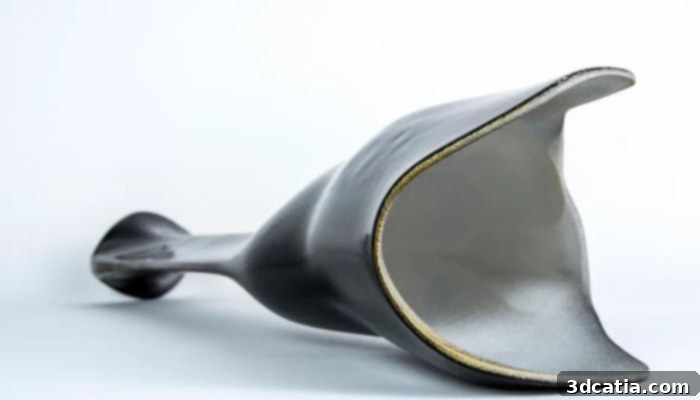
Prostheses now often come from 3D printers (photo credits: Autodesk)
The selection of materials is equally critical and varies significantly depending on the specific application and part requirements. While standard 3D printing materials such as nylon and ABS are suitable for prototypes and non-critical components, carbon fiber-reinforced materials are frequently chosen for demanding end-use parts. In the realm of composite materials, reinforcing fibers, including carbon fiber (CF) and glass fiber (GF), can be precisely embedded, either selectively or continuously, within a thermoplastic matrix. This precise placement allows for targeted adaptation of part stiffness and enables the creation of exceptionally lightweight yet robust structures. Furthermore, metal 3D printing has also found its place in parasports, with materials like titanium being used to produce personalized prostheses that offer significantly greater strength and durability compared to conventionally manufactured alternatives.
A compelling illustration of this material innovation is New Zealand Paralympian Anna Grimaldi, who leverages a 3D-printed titanium prosthesis to safely lift an impressive 50 kilograms. The choice of specific methods and materials is always tailored to the individual athlete’s needs, with a primary focus on maximizing performance and comfort. Often, the optimal solution emerges from a sophisticated combination of various manufacturing technologies, including CNC machining, injection molding, and 3D printing. This hybrid approach ensures that athletes receive the absolute best possible equipment. The numerous success stories from recent years unequivocally demonstrate that 3D printing is rapidly solidifying its crucial position at the Paralympic Games, continually expanding its reach and impact.
3D Printing for Immediate Support: The On-Site Repair Revolution
Beyond custom manufacturing, the critical role of on-site repairs cannot be overstated. All sports equipment is susceptible to wear, damage, and breakage due to intense forces, external impacts, falls, and general deterioration. 3D printing provides an invaluable solution for rapid repairs, often enabling fixes directly at the competition venue, depending on the extent of the damage. This immediacy is crucial for athletes whose performance depends on perfectly functioning equipment.
The Ottobock Technical Repair Service Center: A Paralympic Pit Stop
Recognizing this vital need, the Paralympic Games feature a dedicated repair hub: the Ottobock Technical Repair Service Center. Ottobock, a long-standing and committed partner of the International Paralympic Committee (IOC), has provided essential support to athletes at every Games since Seoul 1988. In Paris, an international team of 164 highly skilled professionals is on hand to assist. The impressive infrastructure includes a sprawling 720 square meter main workshop located within the Olympic Village, complemented by 14 smaller, strategically placed workshops at various sports facilities. The main workshop is equipped with a comprehensive range of capabilities, featuring a welding facility, a tailoring shop, a shoemaking shop, a specialized thermoplastics department, and, crucially, state-of-the-art 3D printers and 3D scanners.
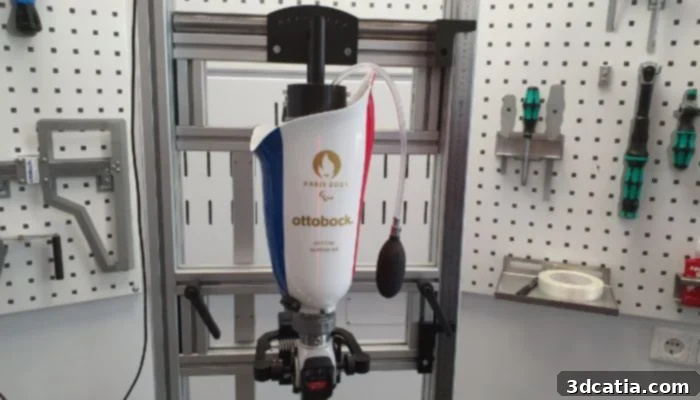
The Ottobock Repair Service Center carries out various repair work – including with 3D printers (photo credits: 3Dnatives)
Operating much like a Formula 1 pit stop, athletes bring their damaged equipment and concerns to the workshop, confident that the on-site team will swiftly address their issues, enabling them to compete on time with fully functional gear. Julian Napp, Technical Director of the Paris workshop and a master orthopaedic technician at Ottobock, emphasizes the profound importance of modern technologies: “The new digital possibilities help us to help the athletes faster. And time is a key factor for both the athletes and us technicians at the Paralympics. However, the success factor in the workshop remains the team’s expertise. Creativity, solution orientation and experience paired with the latest technology – that’s our support for the athletes.” This philosophy highlights that while technology is critical, it is the combination with human ingenuity and experience that truly makes the difference.
Ottobock began integrating 3D printers on-site at the Tokyo 2021 Games, as Peter Franzel, Head of Global Events, Exhibitions & Sport at Ottobock, detailed in a press conference. For the Paris Games, the team has expanded its capabilities, now utilizing 3D printers from Cosmyx and Markforged. These machines are crucial for producing test models and even final end-use parts directly at the venue, demonstrating the rapid evolution of this service from a single test machine in Tokyo to a full-fledged operational integration in Paris.
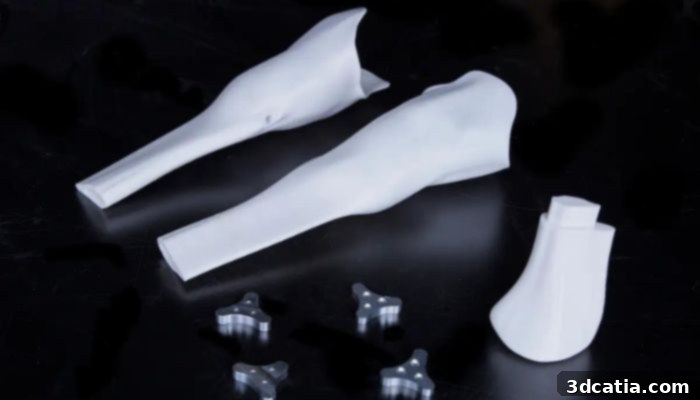
Franzel provides a specific application example of 3D printing in action: “We can print, scan and adapt a test socket (for a prosthesis) on site. The test socket can still be edited if, for example, growths, scars etc. need to be taken into account. The modeled socket is then scanned again for the final shape. The scan is then sent on to Grenoble (to the French Ottobock colleagues) and printed using the powder printing process.” This illustrates a streamlined digital workflow that ensures precision, speed, and personalized care, all while leveraging both on-site capabilities and remote advanced manufacturing facilities.
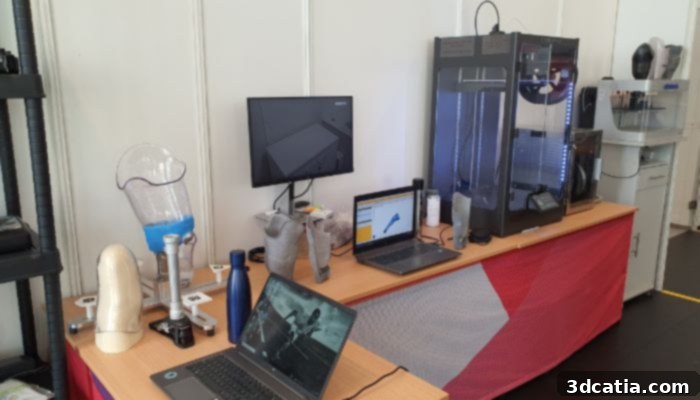
The Ottobock Repair Service Center has 3D printers and hand scanners on site. (photo credits: 3Dnatives)
Of the numerous repair orders received by Ottobock, approximately 56% are for wheelchairs, with prostheses and orthoses accounting for the remainder. In Tokyo, Ottobock recorded an impressive 2,200 repairs. At the Paris Paralympics, the Repair Center is on track to surpass this figure, demonstrating the ever-increasing demand and the critical nature of their services. The remarkable speed and comprehensive technological range offered by the Ottobock Repair Service Center are indispensable for athletes, ensuring they receive the best possible care for sudden equipment damage. This crucial support allows them to maintain focus entirely on their performance, free from equipment worries.
We cannot directly participate in the athletes’ performances with our 3D printing. But the fact that we can scan, model and manufacture quickly means that we can also supply the athletes quickly. Of course, this helps them to concentrate much better on their sport and to be able to complete their training sessions. This is in contrast to traditional methods where fitting athletes was very time-consuming, because you had to make a plaster cast and then have a fitting. That’s where I see the biggest impact of 3D printing. – Leon Fiolka, CPO at Ottobock
The versatility of 3D technologies, particularly on-site 3D printing, offers a multitude of practical advantages for athletes. Leon Fiolka, CPO at Ottobock, currently working in the repair center, shares a compelling anecdote: “Felix Streng came to our Repair Center and wanted a scan of his residual limb. He was really happy that we now have the opportunity to scan his residual limb here on site, because it saved him a flight to Germany.” This highlights the immense time and logistical savings. Fiolka provides another success story: “Another example of a success story is a small 3D-printed replacement part for a wheelchair that we designed so that the brakes worked again and the athlete was able to drive his everyday wheelchair safely through the streets again.” These examples underscore the tangible, immediate impact of additive manufacturing on athletes’ daily lives and competitive readiness.
Heinrich Popow himself attests to the invaluable support provided by the Repair Center. He recounts a personal anecdote about equipment damage just before a crucial competition: “My gold medal in London also has to do with the Ottobock Repair Service. If it hadn’t been for the Repair Service, I would never have won the gold medal!” Such powerful testimonials from elite athletes undeniably cement the critical role of innovative technological support and rapid repair services in achieving Paralympic success.
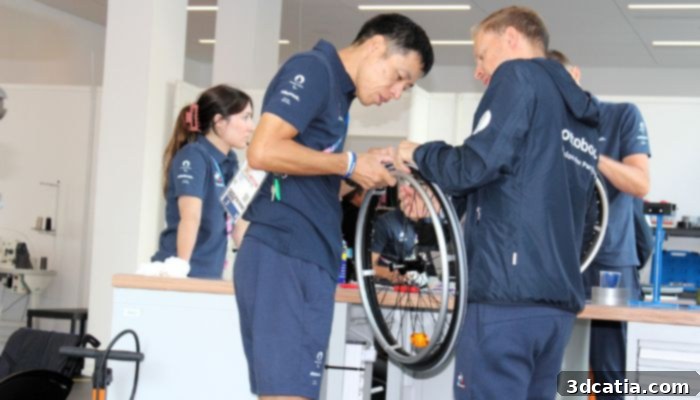
Wheelchairs account for a large proportion of repairs (photo credits: Ottobock)
Pioneering Applications of 3D Printing in Paralympic Competitions
It is now abundantly clear that 3D printing enables the realization of designs that would be either impossible or prohibitively expensive and slow to produce with conventional manufacturing techniques. Additive manufacturing offers rapid prototyping and cost-effective implementation of design iterations, allowing for continuous improvement. Furthermore, advanced design capabilities facilitated by 3D printing make it possible to produce exceptionally lightweight parts and optimize for superior aerodynamics, directly contributing to enhanced athletic performance.
Let’s delve deeper into concrete examples of how 3D printing has been strategically deployed within the Paralympic Games. Generally, 3D printing applications in parasports can be broadly categorized into two main areas: prostheses & orthoses, and specialized tools & equipment. The key distinction lies in their integration: prostheses and orthoses become extensions of the athlete’s body, while tools and equipment are external aids used in conjunction with the athlete’s physical activity.
3D Printed Prosthetics and Orthotics: Tailored for the Human Body
One of the earliest and most celebrated instances dates back to German cyclist Denise Schindler at the Rio 2016 Paralympic Games. Schindler embraced a 3D-printed prosthesis, developed in collaboration with Autodesk. Utilizing digital measuring techniques combined with additive manufacturing, her new prosthesis was 14% lighter than traditional carbon fiber parts, yet maintained equivalent strength. Critically, the production time was drastically reduced: while traditional methods could take up to 12 weeks, her additively manufactured prosthesis was printed in a mere 48 hours. This technological advantage propelled her to win both bronze and silver medals, earning her a place in the Guinness Book of Records for the first 3D-printed prosthetic used at the Paralympic Games.
Denise Schindler raced to bronze and silver in 2016 with the 3D-printed prosthesis (photo credits: Autodesk)
Another remarkable case is American athlete Mike Schultz, who transitioned to para-snowboarding after a leg amputation curtailed his career in motorcycling and extreme snowmobiling. His new sport demanded a uniquely robust prosthetic cover capable of withstanding the intense pressures of high-level athletic activity. This challenge was perfectly met by 3D printing. Stratasys collaborated with Schultz to create a prosthetic featuring two different joints, necessitated by his above-knee amputation, utilizing highly durable TPU 92A material. Beyond the final part, additive manufacturing facilitated rapid design iterations, ensuring the prosthetic met Schultz’s diverse and exacting requirements. Ultimately, Mike Schultz went on to win Paralympic Gold and Silver with his customized 3D-printed prosthetic.
Orthotics also play a crucial role in empowering athletes. Latvian wheelchair fencer Polina Rozkova faced significant design challenges in her quest for the Rio Paralympics. Stratasys stepped in to create a custom 3D-printed back brace, designed for both training and competition. 3D printing allowed for a perfectly custom-fitted brace specifically for her lower back, minimizing discomfort and strain during physical activity. Manufactured from Nylon 12, the brace was both lightweight and flexible, offering optimal support without hindrance.
Specialized Tools and Equipment: Enhancing Performance from the Outside In
What about specialized tools and equipment? These are components frequently integrated into the Paralympians’ gear, which, while not directly part of their bodies, significantly enhance their performance. This is an area where additive manufacturing is truly demonstrating its immense potential. For instance, in 2014, German biathlete Martin Fleig garnered considerable attention when he competed at the Paralympic Winter Games in Sochi using a groundbreaking 3D-printed “sled.” Fleig developed this custom sit-ski sled as part of the “Snowstorm” project, in collaboration with the Fraunhofer Institute for Mechanics of Materials. The racing device was meticulously adapted to Fleig’s unique body geometry using advanced 3D design and 3D printing techniques. The final 3D-printed racing device, constructed from PA12 with carefully embedded steel wires, helped Fleig achieve an impressive 9th place finish.
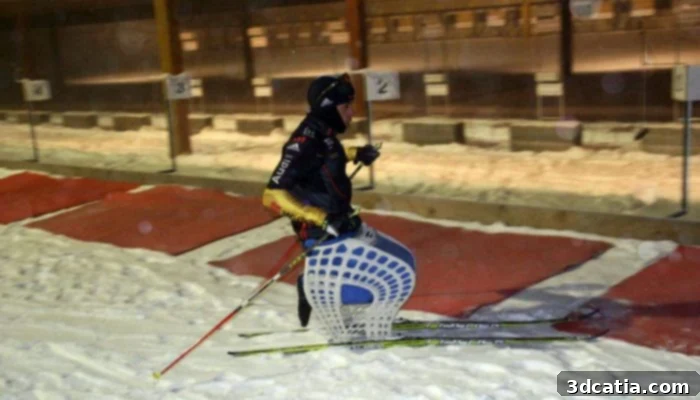
Martin Fleig on his 3D-printed “sled” (photo credits: Fraunhofer IWM)
Further examples abound: British Army veteran and Paralympic snowboarder Darren Swift benefited from 3D-printed snowboard bindings, developed by the Centre for Modelling & Simulation (CFMS). These bindings, made from glass-reinforced nylon, provided him with a crucial competitive edge at the China 2022 Games. British Paralympian Joe Townsend also utilized 3D printing for bespoke components on his adaptive racing bike, showcasing the technology’s versatility. Similarly, Paralympic paracanoe champion Emma Wiggs MBE leveraged 3D printing in 2020 to craft a paddle perfectly molded to her hands, which contributed to her securing a new Paralympic gold medal and setting a record time of 57.028 seconds at Tokyo 2020. These examples highlight the precision and performance gains achievable through customized additive manufacturing.
A growing trend in parasports is the adoption of 3D-printed gloves. Athletes such as Joe Townsend, Tatyana McFadden, and Arielle Rausin have all embraced 3D printing to create more durable gloves. These gloves can be precisely molded to each athlete’s hands and adapted to their specific needs, offering superior comfort and performance. They are particularly well-suited for the demanding sport of wheelchair racing, and Tatyana McFadden, a celebrated athlete, will notably be using her custom 3D-printed gloves at the Paris 2024 Paralympics, underscoring their proven effectiveness at the highest level of competition.
As we’ve explored, 3D printing is progressively transforming the landscape of parasports. It serves as an indispensable tool, empowering athletes to harness their bodies and technological aids to push beyond conventional limits, achieving feats that redefine human potential. With the Paris 2024 Games concluding, there has never been a more opportune moment to celebrate the profound impact and innovative spirit that additive manufacturing brings to the world of adaptive sports.
What are your thoughts on the integration and increasing use of 3D printing in the Paralympic Games? Share your insights and comments below, or connect with us on our LinkedIn, Facebook, and Twitter pages! Don’t forget to sign up for our free weekly newsletter here to receive the latest 3D printing news directly in your inbox! You can also discover all our compelling videos on our YouTube channel.
*Cover Photo Credit: Athlete Howie Sanbornd with his 3D-printed grips from Joe Townsend