
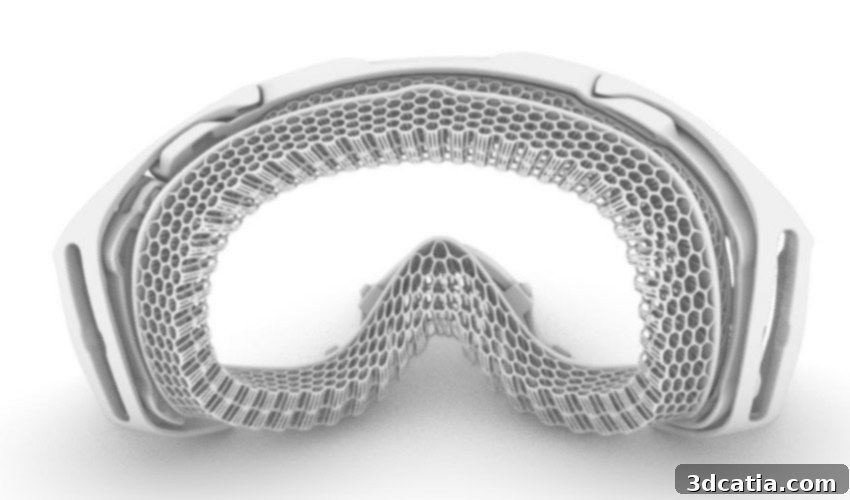
Revolutionizing Winter Sports: OECHSLER’s Breakthrough 3D Printed Ski Masks with TPU
The world of sports equipment is constantly evolving, driven by innovations that promise enhanced performance, comfort, and safety. In recent years, 3D printing has emerged as a game-changer across various sports, offering unprecedented design freedom and manufacturing efficiency. Among the pioneering companies leveraging this technology is the German specialist OECHSLER, renowned for its expertise in developing and manufacturing high-tech products and systems. OECHSLER has recently set its sights on transforming a crucial piece of winter sports gear: the ski mask. By integrating advanced additive manufacturing techniques, specifically 3D printing with Thermoplastic Polyurethane (TPU), the company has reimagined ski mask design and production, aiming to create a superior product that addresses long-standing user frustrations.
Traditional ski masks are often complex assemblies, typically comprising numerous individual components. OECHSLER’s initial analysis revealed that conventional masks could consist of as many as 13 distinct parts, each requiring separate manufacturing, assembly, and quality control. This multi-component approach inherently introduces potential points of failure, complicates the production process, and ultimately drives up costs. Recognizing these inefficiencies and limitations, OECHSLER’s innovation teams embarked on an ambitious project: to design and produce a ski mask as a single, integrated unit using 3D printing. This radical shift promises significantly increased strength, durability, and a streamlined manufacturing workflow.
As winter enthusiasts eagerly await the opening of ski lifts or recall past mountain adventures – whether skiing, snowboarding, or simply enjoying the crisp mountain air – they often remember the less-than-ideal aspects too. Who hasn’t experienced the frustration of a missing glove, a boot that pinches just right, or, perhaps most commonly, an ill-fitting or malfunctioning ski mask? Masks, in particular, are a frequent source of discomfort and operational issues. Over time, the foam padding can degrade and detach, lenses can fog up, and an improper fit can lead to poor visibility and reduced enjoyment. It is precisely these widespread problems that motivated the German group to fundamentally rethink the design of a ski mask, culminating in their groundbreaking 3D printed solution.
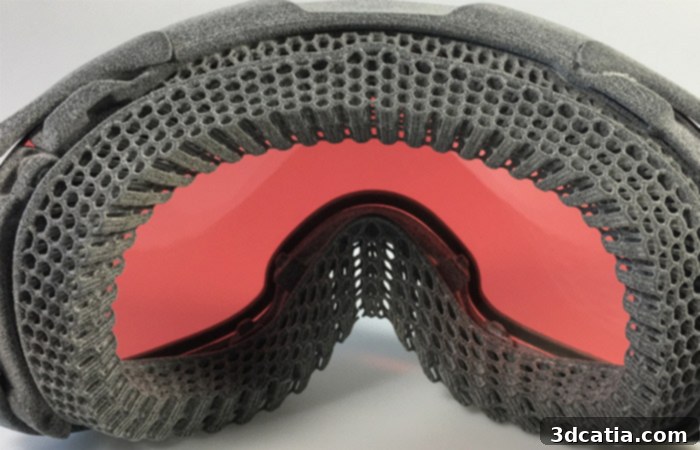
The number of ski mask parts has been considerably reduced through innovative 3D printing (photo credits: OECHSLER)
The Innovative Process Behind OECHSLER’s 3D Printed Ski Mask
One of the most significant advantages that additive manufacturing offers to product development is its ability to drastically reduce or even eliminate complex assembly phases. Instead of fabricating multiple discrete components and then joining them together, 3D printing allows for the creation of intricate parts in a single, continuous process. For OECHSLER’s ski mask project, this translated into a monumental simplification: moving from a product traditionally composed of 13 separate parts to a single, integrated unit. As OECHSLER aptly describes, the conventional multi-part approach “leads to a higher failure potential during production, higher risk of product failure, and ultimately higher costs.” By consolidating these components, OECHSLER aimed to mitigate these risks and enhance overall product integrity.
To achieve this remarkable reduction in complexity, the OECHSLER team embarked on a meticulous reverse-engineering process. They began by disassembling a traditional ski mask to gain a comprehensive understanding of its construction and the functions of each individual component. For instance, the outer frame of conventional masks typically incorporates multiple layers of internal foam, which are then painstakingly glued together. This labor-intensive and error-prone step was a prime target for innovation. The teams quickly identified an opportunity to eliminate this traditional production bottleneck entirely, replacing the cumbersome polyurethane foam with a sophisticated 3D printed lattice structure.
Within an impressively short timeframe – just one week – the company was able to conceptualize and develop a completely redesigned ski mask that integrated all 13 components into one cohesive structure. The detailed methodology involved utilizing advanced scanning technology. All the constituent components of a classic ski mask were first scanned using Computed Tomography (CT scan). This provided an incredibly precise digital blueprint, which was then reconstructed within specialized 3D design software. This digital model served as the foundation for generating a high-fidelity 3D printing file for the entire integrated structure, encompassing both the frame and the intricate lattice padding. Critical design considerations included ensuring the lattice structure was robust enough to maintain its integrity without being excessively bulky, thereby preserving the intended kinematics and functional requirements of the mask. The choice of material was equally crucial, and Thermoplastic Polyurethane (TPU) was selected for its exceptional flexibility and resilience, essential properties for replicating the comfort and adaptive fit traditionally provided by foam padding.
TPU: The Ideal Material for High-Performance Ski Masks
The selection of Thermoplastic Polyurethane (TPU) as the primary printing material was a deliberate and strategic decision, critical to the success of OECHSLER’s innovative ski mask. TPU is a versatile, high-performance elastomer known for its unique combination of properties, making it perfectly suited for demanding applications like sports equipment. Its inherent flexibility allows the mask to conform comfortably to various face shapes, providing a custom-like fit that traditional rigid frames struggle to achieve. This flexibility is also vital for impact absorption, offering superior cushioning in the event of a fall or collision – a common concern in high-speed winter sports. Unlike traditional foam, which can compress, degrade, and become less effective over time, TPU maintains its elastic properties, ensuring consistent performance throughout the mask’s lifespan.
Beyond flexibility and impact resistance, TPU also boasts excellent durability and abrasion resistance. Ski masks are subjected to harsh environmental conditions, including extreme cold, moisture from snow and sweat, and potential scratches or impacts from equipment. TPU’s robust chemical resistance and stability across a wide temperature range mean the 3D printed mask can withstand these challenges without compromising its structural integrity or comfort. Furthermore, TPU is often resistant to oils and grease, which can be beneficial for hygiene and longevity. The ability to print complex lattice structures with TPU allows OECHSLER to precisely control the material’s density and mechanical properties, creating zones of varying stiffness and cushioning to optimize comfort around the face and critical protection in impact-prone areas. This level of granular control is simply not feasible with conventional foam cutting and gluing methods, highlighting the transformative power of additive manufacturing in material application.
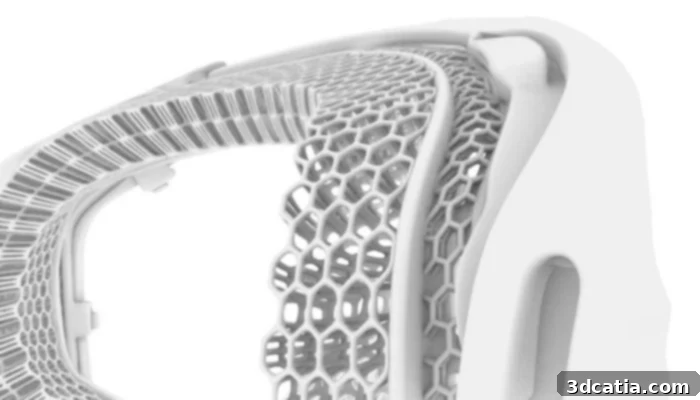
OECHSLER’s teams innovated by imagining a precisely engineered lattice structure to replace traditional foam padding (photo credits: OECHSLER)
Overcoming Design and Post-Processing Challenges
While 3D printing offers immense design freedom, bringing a complex product like a ski mask from concept to reality involves rigorous testing and iteration. The OECHSLER team candidly explains the challenges encountered during the development phase: “The first prints were too stiff so that the handles were not flexible enough.” This initial stiffness, contrary to their expectations, was not primarily caused by the 3D print file itself, but rather by the subsequent post-processing steps. Additive manufacturing often requires cleaning and curing processes to remove excess material or prepare the printed part for its final application. For the intricate lattice structures of the ski mask, these steps proved to be particularly critical.
The solution required a specialized and more intensive cleaning regimen for the lattice structures to effectively remove residual printing material. Achieving the desired level of flexibility and comfort demanded precise control over these post-processing parameters. OECHSLER notes, “Even though optimizing the print file has been quite fast, the adjustment of the post-processing to increase the flexibility of the lattice structure was challenging.” This highlights a crucial aspect of industrial 3D printing: the final properties of a part are not solely determined by the design and printing process but also heavily influenced by the post-processing workflow. The dedication to refining these steps underscores OECHSLER’s commitment to delivering a product that not only functions but also excels in user experience and comfort.
Unlocking Superior Comfort, Durability, and Manufacturing Efficiency
The culmination of OECHSLER’s innovative work is a 3D printed ski mask that promises a multitude of benefits, both for the end-user and for the manufacturing process itself. For skiers and snowboarders, the immediate advantages are clear: enhanced comfort and superior effectiveness in cushioning during potential impacts. The lattice structure, finely tuned through extensive testing and material optimization, can be engineered to provide targeted cushioning that adapts to facial contours, offering a snug yet gentle fit that mitigates pressure points. This bespoke level of comfort is a significant improvement over generic foam padding, which often fails to accommodate individual variations in face shape, leading to discomfort and reduced wearability over extended periods. Furthermore, the inherent durability and resilience of TPU, combined with the integrated, single-part design, mean the mask is built to last longer and withstand the rigors of mountain sports, reducing the likelihood of common failures like foam detachment or structural fatigue.
From a production standpoint, the German company emphasizes the substantial cost reductions achieved by eliminating multiple assembly steps. The transition from 13 separate components to a single 3D printed unit simplifies the entire supply chain, reduces inventory management complexities, and minimizes labor associated with manual assembly. This streamlined process not only lowers manufacturing costs but also significantly enhances production agility. Additive manufacturing empowers OECHSLER to rapidly iterate on designs, allowing for quick adjustments and improvements based on feedback or new requirements. This means products can be designed, prototyped, and brought to market in a fraction of the time compared to traditional methods. Such responsiveness is invaluable in the dynamic sports equipment market, enabling quicker adaptation to trends and consumer demands. Ultimately, this approach represents a paradigm shift, demonstrating how 3D printing can lead to more efficient, cost-effective, and environmentally conscious manufacturing without compromising product quality or performance. The potential for future customization, where masks could be tailored precisely to an individual’s facial geometry for ultimate comfort and fit, is also a tantalizing prospect enabled by this technology.
In any case, the prospect of experiencing this innovative 3D printed ski mask on the slopes is genuinely exciting. This development from OECHSLER is a testament to the transformative power of additive manufacturing, pushing the boundaries of what’s possible in sports equipment design and production. It’s a clear indication that the future of comfortable, durable, and high-performance gear lies in smart material science and advanced manufacturing techniques. Hopefully, it won’t be long until winter sports enthusiasts worldwide can test out this revolutionary gear. In the meantime, you can find more information about OECHSLER’s groundbreaking work and their commitment to setting new standards in the sporting goods market HERE.
What are your thoughts on this pioneering 3D printed ski mask and its potential impact on winter sports? We’d love to hear your opinions! Let us know in a comment below or join the conversation on our LinkedIn, Facebook, and Twitter pages! Don’t forget to sign up for our free weekly Newsletter here to get the latest 3D printing news delivered straight to your inbox. You can also explore all our videos and interviews on our YouTube channel for more insights into the world of additive manufacturing.