

Norsk Titanium Revolutionizes Boeing 787 Production with Advanced RPD Titanium Additive Manufacturing
Norsk Titanium US Inc., an American manufacturer widely recognized simply as Norsk, has achieved a significant milestone by commencing deliveries of vital components for the iconic Boeing 787 Dreamliner. These cutting-edge parts are destined for the Leonardo factory in Grottaglie, located in southern Italy. This development underscores Norsk’s position as a frontrunner in titanium additive manufacturing, a field critical for the aerospace industry’s continuous evolution. Karl Fossum, Director of Customer Programs for Norsk, expressed considerable satisfaction regarding this accomplishment, stating, “We are extremely pleased to solidify our role as a trusted supplier to Leonardo. This initial delivery represents a substantial increase in the volume of additively manufactured titanium parts being utilized, moving beyond those traditionally produced from titanium plate. More importantly, it marks a pivotal step forward in our overarching mission to offer a viable, superior alternative to traditional titanium forgings in high-demand aerospace applications.” Boeing, an industry giant that has embraced additive manufacturing for many years, is once again demonstrating its unwavering confidence in 3D printing technologies for the large-scale production of series parts, validating the technology’s readiness for mainstream aerospace integration.
The Groundbreaking Rapid Plasma Deposition (RPD) Technology
The advanced components now being delivered are meticulously crafted using Norsk’s proprietary Rapid Plasma Deposition (RPD) process. This innovative technology stands at the forefront of additive manufacturing, utilizing a method that involves precisely melting a titanium wire within a controlled cloud of inert argon gas. This unique environment is crucial for enhancing the intrinsic strength, structural integrity, and long-term durability of the final manufactured part, making it ideal for the rigorous demands of aerospace applications. Beyond its mechanical benefits, this sophisticated design methodology also significantly reduces the need for raw materials. By consuming less virgin material, the RPD process effectively limits the ecological footprint associated with the production of various aerospace components, aligning with global efforts towards more sustainable manufacturing practices. Furthermore, RPD technology excels in its ability to create parts with exceptionally complex geometries and intricate internal structures, all while consistently guaranteeing both remarkable lightness and uncompromised strength – a critical combination for optimizing aircraft performance and fuel efficiency. While RPD technology is a patented process exclusive to Norsk, it shares several fundamental principles and characteristics with the broader category of directed energy deposition processes, particularly concerning the controlled deposition of material under concentrated energy.
The innovation behind RPD is not just in its ability to create robust parts, but also in its efficiency. By precisely controlling the deposition of molten titanium, Norsk can achieve near-net-shape components. This means that the parts produced require significantly less post-machining compared to traditional methods or even other additive manufacturing techniques. The reduction in post-processing steps translates directly into shorter lead times, lower manufacturing costs, and a further decrease in material waste. This efficiency is a game-changer for the aerospace supply chain, where time and cost are paramount. The ability to produce complex, lightweight parts with high material utilization and minimal waste offers a compelling economic and environmental advantage that is increasingly sought after by aerospace primes like Boeing and their key suppliers such as Leonardo. The RPD process represents a strategic leap forward, moving titanium additive manufacturing from prototyping and specialized applications into high-volume, production-critical roles.
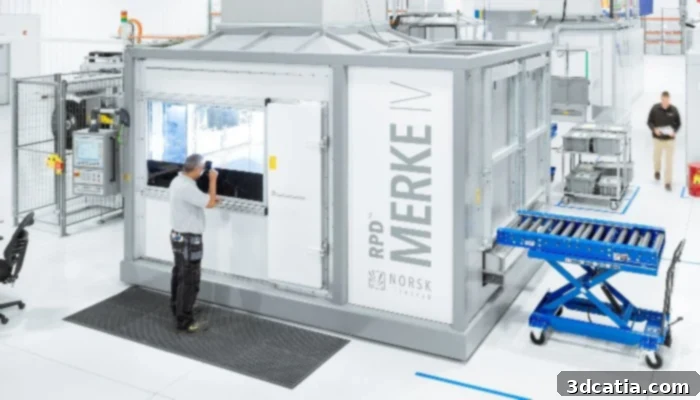
The Merke IV machine-tool, responsible for producing advanced titanium parts for the Boeing 787 Dreamliner. (Photo credit: Norsk Titanium)
RPD vs. Directed Energy Deposition (DED): A Deeper Dive
Directed Energy Deposition and Its Versatility
To fully appreciate the innovations of RPD, it’s beneficial to understand its relationship with other additive manufacturing techniques. Directed Energy Deposition (DED) is a well-established additive manufacturing process often employed for the repair, reinforcement, or consolidation of existing metal objects, as well as for creating new parts. DED utilizes a highly focused energy source—typically a laser beam, but sometimes an electron beam or plasma arc—to melt materials, usually in the form of powder or wire, as they are deposited. The specific nomenclature for DED technology can vary widely depending on the chosen application, the material feedstock, and the precise method of energy delivery. Consequently, DED is frequently encountered under various proprietary or descriptive names such as Electron Beam Additive Manufacturing (EBAM), Direct Metal Deposition (DMD), and Laser Engineered Net Shaping (LENS) or CLAD DIRECT. Like the RPD process, these DED variants often employ metals as their feedstock, either in fine powder form or as a continuous wire. The fundamental distinction between RPD and many DED technologies primarily lies in the specific means used to generate and focus the energy required to melt and fuse the material, and how this impacts the overall process speed, material properties, and suitability for different applications.
While many DED systems rely on lasers, the process patented and utilized by Norsk for its RPD technology ingeniously employs an electron beam as its primary energy source, rather than a laser. This crucial distinction provides several pronounced advantages, particularly in terms of manufacturing efficiency. An electron beam boasts the unique capability to heat and melt the deposited material in multiple locations simultaneously, a feat that is not achievable with a single-point laser focus. This multi-point heating capability dramatically speeds up the production of parts, allowing Norsk to achieve significantly higher deposition rates than many laser-based DED systems. This accelerated processing time is a critical factor for moving additive manufacturing from prototyping to series production, especially for large-scale aerospace components.
With its advanced RPD technology, Norsk efficiently transforms a simple titanium wire feedstock into structurally resistant and geometrically complex parts. This process not only achieves exceptional material properties but also does so while producing minimal waste, largely due to its near-net-shape capabilities. The controlled environment and precise deposition ensure that material is only placed where it is needed, drastically reducing the amount of scrap generated during manufacturing. Ultimately, one of the most compelling advantages of Norsk’s RPD process lies in its minimal to non-existent post-processing requirements. Unlike many additive manufacturing techniques that demand extensive and costly machining, heat treatment, or surface finishing after printing, RPD-produced parts often require very little, if any, additional work. This factor alone makes the entire manufacturing workflow considerably faster, more streamlined, and ultimately more cost-effective, offering a compelling case for its broader adoption in demanding industries like aerospace.
The Transformative Impact on Aerospace Manufacturing
The integration of Norsk Titanium’s RPD-manufactured parts into the Boeing 787 Dreamliner production line represents a paradigm shift in aerospace manufacturing. For the Boeing 787, an aircraft celebrated for its fuel efficiency and lightweight composite structure, every component’s weight and performance are meticulously scrutinized. RPD technology allows for the creation of components that are not only lighter due to optimized designs but also inherently stronger and more durable. This translates directly into enhanced operational performance, reduced fuel consumption over the aircraft’s lifespan, and potentially extended maintenance cycles, offering significant economic benefits to airlines. Furthermore, the ability to produce complex internal structures that improve load distribution and integrate multiple functions into a single part can simplify assembly processes and reduce the total number of parts required, further streamlining manufacturing and maintenance.
The long-term implications of this technology extend beyond individual part benefits. By providing a viable alternative to traditional titanium forgings – which are costly, time-consuming to produce, and generate substantial waste – RPD opens up new avenues for supply chain optimization. The reduced lead times for RPD parts mean that manufacturers like Leonardo can respond more flexibly to production demands and adapt more quickly to design iterations. This agility is vital in the fast-paced aerospace sector, where innovation cycles are constantly accelerating. Moreover, the enhanced design freedom offered by additive manufacturing allows engineers to rethink component designs from the ground up, moving away from the constraints of conventional manufacturing processes to unlock truly optimized, high-performance solutions previously unattainable.
Norsk Titanium’s Vision for the Future
Norsk Titanium is not just delivering parts; it is pioneering a vision for the future of industrial manufacturing. Their strategic focus on large-scale, high-performance titanium components for the aerospace industry positions them at the forefront of the advanced manufacturing revolution. The success with the Boeing 787 Dreamliner, one of the most technologically advanced commercial aircraft in service, serves as a powerful testament to the maturity and reliability of their RPD technology. This achievement is likely to pave the way for broader adoption of RPD across various aircraft platforms and potentially into other high-stakes sectors such as defense, automotive, and energy, where the demand for lightweight, strong, and efficiently produced metal parts is constantly growing. Norsk’s commitment to innovation, coupled with a strong emphasis on sustainability through reduced material waste and energy consumption, underscores their role as a leader driving positive change in manufacturing practices globally.
The partnership with Leonardo and the continued trust from Boeing are clear indicators that additive manufacturing, specifically Norsk’s RPD process, is transitioning from niche applications to becoming a cornerstone of industrial production. This evolution signifies a future where aerospace components are not only lighter and stronger but also produced with greater efficiency, less environmental impact, and unprecedented design flexibility. As Norsk continues to refine and scale its technology, we can anticipate even more transformative impacts on how complex metal parts are designed, manufactured, and utilized across critical industries worldwide, solidifying the place of titanium additive manufacturing as a cornerstone of modern engineering excellence.
What are your thoughts on Norsk Titanium’s Rapid Plasma Deposition process and its impact on aerospace? We encourage you to share your insights and comments below or engage with us on our Facebook and Twitter pages! Don’t miss out on the latest advancements in 3D printing; sign up for our free weekly Newsletter here, delivering the most current 3D printing news directly to your inbox!