
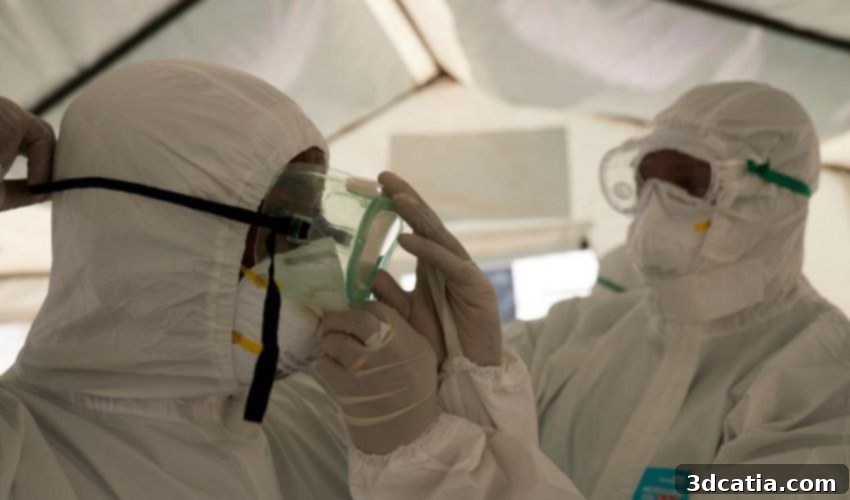
How 3D Printing and Open-Source Designs Addressed PPE Scarcity in Nigeria Amidst the Pandemic
The global COVID-19 pandemic presented unprecedented challenges to healthcare systems worldwide, particularly in the urgent demand for Personal Protective Equipment (PPE). Many nations struggled with critical shortages, but developing countries faced even more severe hurdles due to limited resources, strained supply chains, and economic vulnerabilities. A compelling academic paper has recently shed light on a remarkable initiative in Nigeria, where researchers from the University of Sussex in the UK and Olabisi Onabanjo University in Nigeria collaboratively turned to innovative solutions – specifically 3D printing and open-source designs – to tackle a dire PPE scarcity. This pioneering project, detailed in an article published in the esteemed scientific journal PLOS Biology, showcases the power of international cooperation and technological ingenuity in times of crisis. Dr. Andre Maia Chagas from the University of Sussex and Dr. Royhaan Folarin from Olabisi Onabanjo University spearheaded this effort, providing a blueprint for resilient local manufacturing.
The arrival of the COVID-19 pandemic struck the world with little to no warning, unleashing a cascade of disruptions that continue to resonate in our daily lives. As the world slowly begins its journey towards recovery and processing the profound shifts brought about by the health crisis, it becomes increasingly crucial to understand the diverse impacts across different regions of the globe. When the coronavirus reached African nations, including Nigeria, the situation rapidly escalated into a profound crisis. Nigeria, a country already grappling with significant economic challenges and a substantial portion of its population living in poverty, quickly experienced a severe shortage of essential Personal Protective Equipment for its dedicated medical staff. This scarcity posed an immediate and perilous threat, given the highly contagious nature of the virus and the critical role PPE plays in safeguarding frontline healthcare workers and preventing further transmission within communities.

Researchers Dr. André Maia Chagas and Dr. Royhaan Folarin (photo credits: Ralf Rebmann / scicomnigeria)
Leveraging Additive Manufacturing for Local Solutions
Faced with the escalating crisis, Dr. Andre Maia Chagas and Dr. Royhaan Folarin embarked on an urgent search for a viable and rapid solution to the acute PPE shortage. Their collaborative efforts quickly converged on additive manufacturing, more commonly known as 3D printing, as a promising pathway. This innovative technology offered a unique opportunity not only to produce urgently needed PPE swiftly but also to achieve this goal in a more cost-effective and sustainable manner compared to traditional manufacturing or relying on strained international supply chains. The team successfully sourced approved PPE designs through open-source platforms – a testament to the global collaboration facilitated by the open-source community during the pandemic. Without delay, they initiated the 3D printing process, fabricating essential equipment for the local Nigerian community. This approach proved remarkably efficient, with the cost of locally produced equipment being less than half of what conventional PPE would have cost, demonstrating significant economic advantages.
Dr. Andre Maia Chagas, a Research Bioengineer at the University of Sussex, eloquently articulated the profound impact of their project. He stated, “Through knowledge sharing, collaboration and technology, we were able to help support a community through a global health crisis. I’m really proud of the tangible difference we made at a critical time for this community.” Dr. Chagas further elaborated on the challenging environment they faced: “As PPE was in such high demand and stocks were low, prices for surgical masks, respirators and surgical gowns hiked, with issues arising around exports and international distribution. We quickly realized that alternative means of producing and distributing PPE were required. Free and open-source hardware (FOSH) and 3D printing quickly became a viable option.” His insights underscore the critical role of agile, decentralized manufacturing solutions when conventional supply chains falter under immense pressure. The ability to rapidly design, iterate, and produce essential medical equipment locally, bypassing bottlenecks and inflated prices, was truly transformative for the affected community.
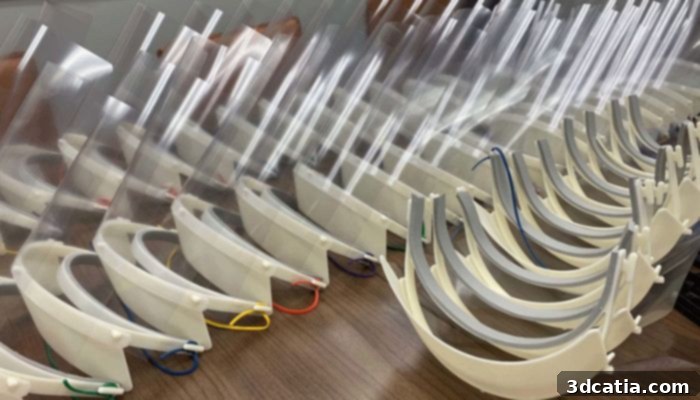
An example of 3D printed PPE (photo credits: America Makes)
The Role of International Collaboration and Charity Networks
Empowering Local Communities Through TReND in Africa
The genesis of this impactful collaboration between Dr. Chagas and Dr. Folarin can be traced back to a vital charity network known as TReND in Africa. This inspiring initiative, originally established and fostered by the University of Sussex, is dedicated to supporting and building scientific capacity within developing countries across the African continent. TReND in Africa creates a powerful bridge, enabling experts from the University of Sussex to work hand-in-hand with local researchers and medical professionals, facilitating the crucial exchange of knowledge in innovation, cutting-edge technology, and essential medical practices. This network proved to be an invaluable platform for identifying needs and mobilizing expertise during the pandemic.
Dr. Royhaan Folarin, a distinguished Neuroscientist and lecturer of anatomical sciences at Olabisi Onabanjo University in Nigeria, articulated his personal motivation and the synergy created by the TReND in Africa program. He explained: “During the pandemic, we saw the successful printing and donation of PPE in the Czech Republic by Prusa Research and it became a goal for me to use the training I had received in previous TReND in Africa workshops to help impact my immediate community in Nigeria.” Dr. Folarin’s statement highlights the ripple effect of global open-source movements and the critical importance of localized skill development. His prior training, facilitated by TReND in Africa, equipped him with the necessary understanding and confidence to adapt and implement 3D printing solutions effectively within his own community, directly addressing the urgent public health need.
Expanding Beyond Pilot Projects: The Future of Decentralized Production
The initial success of this pioneering project, which saw the production and distribution of approximately 400 pieces of vital PPE, served as a powerful proof-of-concept. While the 3D printer utilized by the team was not initially designed for large-scale serial manufacturing, the project’s demonstrable effectiveness sparked further interest and encouraged other professionals to test and optimize the innovative process. This critical initial phase laid the groundwork for significant advancements. Subsequently, the methodology was refined and scaled for industrial production, paving the way for companies worldwide to integrate 3D printing technologies into their manufacturing pipelines for PPE. This evolution enabled the efficient production and widespread distribution of essential equipment to regions in dire need, significantly strengthening global resilience against future health crises. The journey from a localized, academic initiative to influencing broader industrial adoption underscores the transformative potential of additive manufacturing.
The impact of this collaboration extends far beyond the immediate relief it provided during the COVID-19 pandemic. It serves as a compelling case study for the future of decentralized manufacturing, especially in regions with vulnerable supply chains or during emergencies. By demonstrating that high-quality, cost-effective PPE can be produced locally using accessible technologies and open-source designs, the project has opened doors for similar initiatives. This model empowers communities to become more self-reliant, reducing dependency on external markets and long-distance logistics that can easily falter under pressure. Furthermore, the collaboration between the University of Sussex and Olabisi Onabanjo University exemplifies the immense value of international academic partnerships in driving real-world solutions for global challenges. Such collaborations foster an environment of shared knowledge and technological transfer, ultimately benefiting underserved populations and building scientific capacity where it is needed most. This initiative underscores that innovation, combined with a spirit of altruism and collaboration, can overcome formidable obstacles, providing tangible relief and fostering sustainable development.
To delve deeper into the impactful work and mission of TReND in Africa, you can explore their official website HERE. Their continuous efforts in scientific capacity building are vital for empowering researchers and communities across the continent.
What are your thoughts on this groundbreaking 3D printing project in Nigeria and its implications for future global health crises? Share your insights in a comment below or join the conversation on our LinkedIn, Facebook, and Twitter pages! Don’t miss out on the latest advancements and news in additive manufacturing; remember to sign up for our free weekly Newsletter here, delivering the most current 3D printing developments straight to your inbox! You can also find all our engaging videos and exclusive interviews on our YouTube channel.
*Cover Photo Credits: WHO