

UILA: The 3D Printed Electric Cargo Bike & EV Hybrid Redefining Sustainable Urban Mobility
In a continuous stride towards innovative and sustainable solutions, the world of 3D printing has once again delivered a groundbreaking concept. This time, nFrontier, a forward-thinking innovation studio based in Berlin, has proudly unveiled UILA. This revolutionary vehicle stands as a pioneering hybrid, expertly blending the practicality and eco-friendliness of an electric cargo bike with the advanced features and protective capabilities of a small electric vehicle (EV). Positioned as a transformative answer to the urgent call for sustainable urban mobility, the UILA prototype represents a remarkable achievement, leveraging cutting-edge polymer solutions from Stratasys. Its grand reveal took place at the prestigious Formnext 2022 exhibition, captivating attendees at the Stratasys stand, specifically located in hall 12.1, booth D121. This introduction marks a pivotal moment, signaling a new direction for personal and cargo transportation in metropolitan areas, emphasizing both environmental responsibility and enhanced user experience.
The increasing global focus on sustainable solutions comes as no surprise, reflecting a growing awareness and urgency regarding environmental challenges. The past decade has been marked by some of the warmest temperatures on record, a stark reminder of climate change’s profound impact, prompting individuals and industries alike to critically re-evaluate their carbon footprints. The transportation sector, a significant contributor to global emissions, is at the forefront of this transformation. Current studies, highlighted in a press release from Stratasys, project an impressive surge, estimating that over 270 million electric two- and three-wheelers will traverse roads worldwide in the coming years. This forecast underscores a fundamental shift in how people commute and transport goods, driven by a confluence of factors including environmental consciousness, technological advancements, and economic pressures. Indeed, recent years have witnessed an undeniable boom in both electric bicycles and compact electric vehicles, a trend further accelerated by volatile and consistently rising gas prices, making greener alternatives not just an ethical choice but also an economically sensible one. The market is ripe for solutions that offer both efficiency and environmental benefits, and UILA is poised to meet this demand head-on, offering a compelling blend of utility, innovation, and sustainability for the evolving landscape of urban transportation.
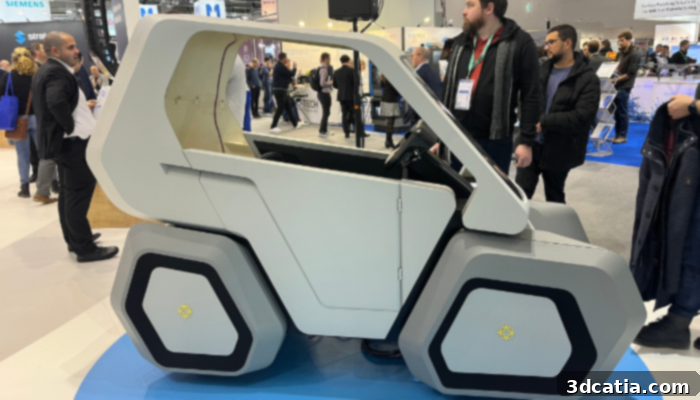
UILA at the Stratasys booth (photo credits: 3Dnatives)
UILA distinguishes itself by occupying a unique and highly advantageous position within the rapidly expanding realm of electric mobility, artfully blending the best attributes of an electric cargo bike with the sophisticated comforts and safety features typically associated with small electric vehicles. This innovative design means that users can enjoy the unparalleled freedom and accessibility of an e-bike – specifically, the ability to navigate bike lanes and the absence of a driver’s license requirement in many regions – while simultaneously benefiting from significantly enhanced protection. Unlike open-air bicycles, UILA’s fully covered format provides a robust enclosure, shielding occupants from adverse weather conditions and offering a vital layer of security against potential hazards on urban roads, making it a safer and more comfortable alternative for daily commutes and cargo deliveries. Beyond mere protection, UILA is ingeniously engineered to integrate a host of premium comforts and advanced technological functionalities, elevating the user experience far beyond conventional two-wheelers. These include, but are not limited to, a state-of-the-art modern infotainment system offering seamless smartphone integration, providing access to navigation, communication, and entertainment on the go. Furthermore, UILA boasts futuristic capabilities such as the ability to remotely summon the parked vehicle to your location or have it autonomously follow you, eliminating the need for a driver. This intelligent feature underscores nFrontier’s commitment to push the boundaries of smart mobility, offering convenience and efficiency that redefines urban travel. We delve deeper into these features to explore what discerning users can truly expect from this visionary vehicle.
A Closer Look at UILA: nFrontier’s Vision for Urban Mobility
UILA represents a meticulous fusion of innovative design and advanced manufacturing, conceived as a four-wheeled, two-seater vehicle that expertly balances compactness with utility. The visionary behind its aesthetics and functionality is nFrontier’s lead designer, Joschua Krnake, whose design philosophy centered on creating a vehicle that is not only sustainable but also highly practical for urban environments. The manufacturing process itself is a testament to the versatility and efficiency of additive manufacturing, specifically utilizing Stratasys’ diverse range of 3D printing technologies. Large-format body components, which demand structural integrity and robustness, were produced using Stratasys’ FDM (Fused Deposition Modeling) technology. This choice allowed for the rapid creation of strong, functional parts essential for the vehicle’s primary structure. For components requiring higher volume production, finer details, and superior surface finish, nFrontier turned to Stratasys’ powder-based SAF (Selective Absorption Fusion) and photopolymer-based P3 (Programmable PhotoPolymerization) systems. SAF technology is ideal for producing end-use parts with excellent mechanical properties and geometric accuracy, while P3 is renowned for its ability to create intricate, smooth parts suitable for various functional and aesthetic applications. This multi-technology approach showcases the power of 3D printing in optimizing production across different part requirements, demonstrating significant advantages over traditional manufacturing methods in terms of flexibility and speed.
Delving into UILA’s impressive specifications, the vehicle is engineered for both personal transport and light cargo duties within a bustling city landscape. A press release detailing its capabilities highlights a substantial cargo payload capacity of up to 250 kg, making it an ideal solution for urban deliveries, errands, or simply transporting groceries and personal belongings with ease. Its propulsion system allows it to accelerate to a top speed of 25 km/hr, a velocity perfectly suited for urban cycling lanes and congested city streets where speed limits are often lower and maneuverability is paramount. Furthermore, UILA offers an admirable range of 60-70 km on a single charge, providing ample autonomy for daily commutes and multiple short trips without the constant worry of recharging. In terms of physical dimensions, UILA maintains a sensible size that belies its cargo capacity; it measures 230 cm in length, stands 170 cm high, and is 90 cm wide. While significantly smaller and more agile than a conventional car, these dimensions still provide a comfortable and secure enclosure for its two occupants. Despite its robust construction and sophisticated features, the entire vehicle weighs in at a remarkably light 70 kg, further contributing to its efficiency and ease of handling. These meticulously engineered specifications underline UILA’s role as a practical, efficient, and user-friendly solution for navigating the complexities of modern urban life, setting a new benchmark for sustainable smart mobility.
3D Printing: The Core Catalyst for UILA’s Success and Sustainability
The integration of 3D printing technologies, or additive manufacturing (AM), was not merely a choice but a foundational pillar in the successful realization of UILA. Its pivotal role can be attributed to a multitude of strategic advantages that traditional manufacturing processes simply cannot match. Firstly, and perhaps most crucially for an innovative startup like nFrontier, employing diverse AM processes allowed for a significant reduction in the overall cost of producing the intricate and varied parts required for UILA. Compared to conventional methods that often entail expensive tooling and lengthy setup times, 3D printing offered unparalleled cost-effectiveness, especially for prototyping and small-batch production. Concurrently, this in-house production capability drastically shortened development cycles and saved invaluable time, enabling nFrontier to iterate designs rapidly and bring the UILA prototype to fruition with remarkable agility. This iterative process, facilitated by additive manufacturing, allowed for continuous optimization and refinement, ensuring the final product met the highest standards of design, functionality, and performance.
Beyond the immediate benefits of cost and time efficiency, 3D printing offered profound advantages in terms of sustainability, aligning perfectly with UILA’s core mission as an eco-friendly transport solution. While the environmental benefits of AM, primarily its ability to limit material waste through precise, on-demand fabrication, are widely acknowledged and were indeed a critical factor in UILA’s development, its capacity for localized production proved to be an equally significant boon. By manufacturing components closer to the point of assembly or even directly in Berlin, nFrontier was able to dramatically reduce supply chain challenges, minimizing the complex logistics often associated with globalized manufacturing. More importantly, this localized production strategy directly translated into a substantial reduction in transportation emissions. Fewer parts being shipped across continents means a smaller carbon footprint, making the entire production cycle of UILA inherently more environmentally responsible. Furthermore, 3D printing empowers designers with unparalleled freedom, allowing for the creation of complex geometries and lightweight structures that are often impossible with traditional methods. These optimized designs not only enhance the vehicle’s aesthetic appeal but also contribute to its overall energy efficiency by reducing its mass, further cementing UILA’s status as a beacon of sustainable innovation in urban mobility. This holistic approach, from design to production, underscores how additive manufacturing is not just a tool, but a strategic partner in forging a more sustainable future.
Daniel Buening, the visionary CEO of nFrontier, encapsulates the profound significance of UILA in his compelling statement: “UILA is our emphatic response to some of the most pressing challenges of our time, notably climate change and the pervasive energy crisis. More than just a new mode of transport, UILA is radically changing the way we are commuting, presenting a truly sustainable, game-changing mobility solution for urban environments. Simultaneously, it delivers an unparalleled feature set of digital functions and assets that far exceed current bicycle industry standards.” This declaration highlights UILA’s dual role as both an environmental answer and a technological marvel. nFrontier is not merely content with prototyping; the company is actively preparing UILA for serial production and traffic registration in Germany, with an ambitious timeline set for some point in 2024. This move signifies a confident step from concept to commercial reality, promising to introduce this innovative vehicle to the wider public in the near future. The integration of advanced digital functionalities, from intelligent infotainment to autonomous following capabilities, positions UILA not just as a vehicle, but as a smart companion for urban dwellers. It represents a paradigm shift, pushing the boundaries of what is expected from personal mobility solutions and setting new benchmarks for connectivity, convenience, and ecological responsibility. For a deeper dive into UILA’s features and its potential impact, you can find more detailed information and visual insights in the video provided below.
As we look towards the future of urban transportation, UILA emerges as a compelling example of how innovative design, driven by advanced 3D printing technologies, can address critical global challenges. It’s more than just a vehicle; it’s a statement about responsible commuting, sustainable urban living, and the limitless possibilities when creativity meets cutting-edge manufacturing. What are your thoughts on UILA? Do you envision yourself navigating city streets with this electric cargo bike and EV hybrid? We invite you to share your perspectives and feedback in a comment below or engage with us on our social media platforms: LinkedIn, Facebook, and Twitter! To stay abreast of the very latest developments and breakthroughs in the dynamic world of 3D printing, don’t forget to sign up for our free weekly Newsletter here, ensuring the freshest 3D printing news is delivered straight to your inbox! Additionally, you can explore all our insightful videos and in-depth content on our dedicated YouTube channel. Join the conversation and be part of the future of sustainable mobility!
*Cover Photo Credits: 3Dnatives