
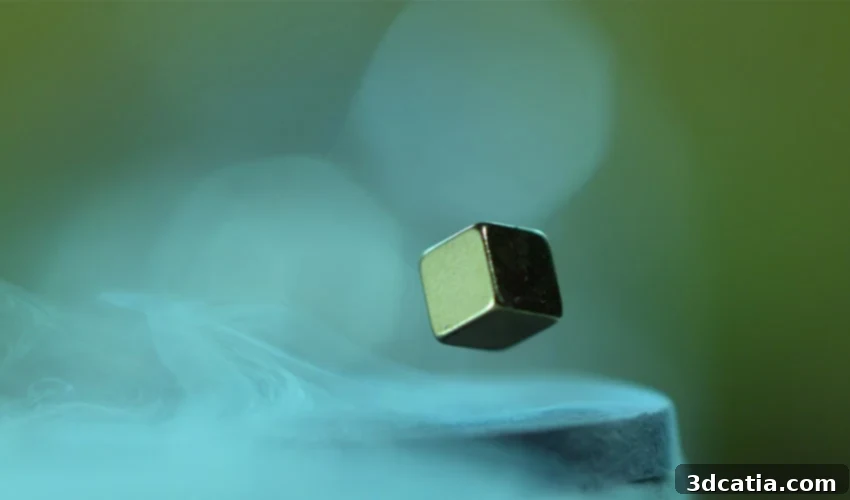
Revolutionizing Additive Manufacturing: The Breakthrough in Directly 3D Printing Permanent Magnets
A groundbreaking development from the esteemed **Jean Lamour Institute (IJL)**, the materials science research laboratory at the University of Lorraine, is set to redefine the landscape of additive manufacturing. Researchers there have successfully engineered a novel method for producing functional permanent magnets using a standard desktop FDM (Fused Deposition Modeling) 3D printer. This pioneering achievement means that, for the first time in the 3D printing sector, magnetic properties can be seamlessly integrated into various 3D printed parts without the need for a separate post-magnetization process. The secret lies in their innovative approach to utilizing and processing ferromagnetic materials, which are directly incorporated into the printing filament. This significant advancement not only pushes the boundaries of material science but also opens an entirely new realm of possibilities for creating sophisticated magneto-active objects, enabling unprecedented control over complex systems and components through precisely applied magnetic fields.
The rapid evolution of materials research in additive manufacturing continues to accelerate across diverse sectors, including polymers, metals, and composites. These continuous advancements are crucial, as they empower engineers and designers to produce parts for increasingly demanding industrial applications, meeting stringent performance requirements. Recent examples illustrating this trend include the high-resistance aluminum oxide developed by Austrian researchers, which exhibits exceptional resistance to corrosion and high temperatures, and the advent of extremely rigid liquid crystal polymer filaments. The overarching objective behind all these innovations is consistent: to achieve the ability to 3D print components that possess identical characteristics and properties to those manufactured using conventional methods such such as machining or molding. In the context of the University of Lorraine’s pioneering work, the focus has specifically been on magnetism, addressing the critical challenge of how to directly 3D print magnetized elements, thereby eliminating the often cumbersome and costly post-magnetization phase.
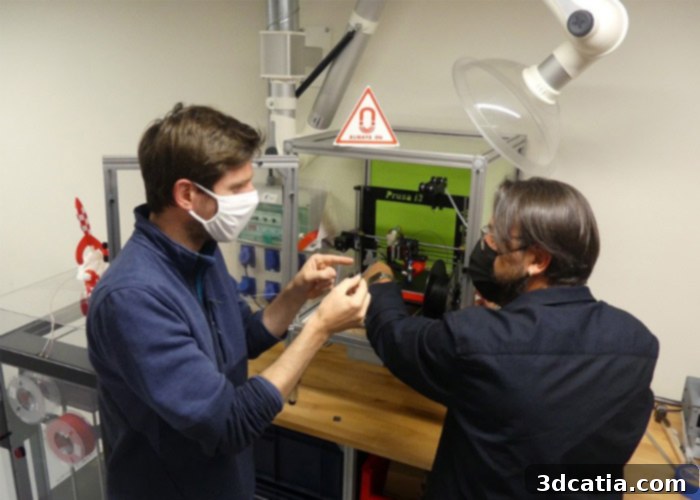
Researchers from the Jean Lamour Institute successfully used a modified Prusa i3 3D printer to create their innovative 3D printed magnet (photo credits: University of Lorraine)
Under the expert guidance of Samuel Kenzari, a distinguished CNRS research engineer, and Thomas Hauet, a respected lecturer at the University of Lorraine, the dedicated team embarked on a journey to design and implement a revolutionary 3D printing system. Their approach involved modifying a conventional desktop FDM solution to specifically handle a newly developed composite magnetic filament. While the precise details concerning the structural and functional modifications made to the FDM printer remain largely undisclosed, an initial commercial version of this innovative printer is anticipated to be available to the public as early as autumn 2021. The true marvel of this innovation, however, lies in the proprietary material developed by the researchers. They meticulously started with conventional ferromagnetic materials, which then underwent a specialized transformation process to render them suitable for extrusion-based 3D printing. This sophisticated conversion yielded a unique magnetic filament, the exact composition of which the researchers are understandably keeping discreet. Nevertheless, the significance of their achievement is unequivocally highlighted in their official press release, which states, “The parts produced by this printer have one or more permanent magnetic orientation(s) without requiring the application of a magnetic field a posteriori to magnetize them.” This capability represents a monumental leap forward, eliminating a critical bottleneck in the production of functional magnetic components.
The implications of this breakthrough extend far beyond simply producing magnets. Traditional magnet manufacturing often involves complex, multi-stage processes that are typically limited to simple geometries and require subsequent magnetization steps, which can be inefficient and costly. The ability to directly 3D print magnets with specific magnetic orientations opens up unparalleled design freedom. Engineers can now envision and create intricate magnetic structures, custom shapes, and complex geometries that were previously impossible or prohibitively expensive to produce. This direct integration streamlines the manufacturing process, reduces lead times, and offers significant cost savings, making customized magnetic components more accessible for a wider range of applications. Furthermore, the inherent precision of FDM technology allows for the creation of magnets with spatially varying magnetic fields, a feature that holds immense potential for advanced functionalities in various smart systems.
The scientific methodology behind the creation of this magnetic filament is as intriguing as the application itself. Ferromagnetic materials, by nature, are typically in powder form or bulk states. To make them suitable for FDM, they must be combined with a thermoplastic binder to create a printable filament. The critical challenge lies in ensuring that the magnetic particles are sufficiently aligned or oriented during the extrusion and deposition process to achieve permanent magnetism without an external field post-printing. This likely involves a sophisticated interplay of material composition, particle size and distribution, and precise control over the printing parameters, such as nozzle temperature and print speed, to maintain the magnetic integrity and desired orientation within the printed part. The University of Lorraine team’s success in this area underscores their deep expertise in materials science and additive manufacturing, paving the way for a new class of functional composite materials.
Looking ahead, the Jean Lamour Institute has ambitious plans to commercialize this innovative solution—encompassing both the specialized machine and its proprietary magnetic filament—by the end of the year. This strategic move aims to democratize the production of magnets, providing individuals and industries alike with the unprecedented capability to design and fabricate their own custom magnets directly from their homes or workshops. This concept essentially transforms a desktop FDM printer into a personal magnet factory, opening doors for rapid prototyping and on-demand production of highly specialized magnetic components. Beyond immediate commercial applications, this foundational research is also poised to significantly accelerate developments in the burgeoning field of 4D printing. In 4D printing, time is integrated as a fourth dimension alongside the traditional three spatial dimensions. This means that parts created through 4D printing are designed to undergo a predetermined transformation in shape or function when exposed to specific external stimuli, such as temperature fluctuations, vibrations, or even electrical signals. With the availability of directly 3D printed magnetic filaments, users could now design components whose shape, position, or other functionalities could be precisely controlled and modified over time via an external magnetic field, thereby unlocking a new paradigm in adaptive and responsive materials.
The potential applications for these directly 3D printed magnets are vast and transformative across numerous industries. In the medical field, they could enable the creation of customized, miniature magnetic implants or drug delivery systems that can be remotely guided and activated within the human body. For robotics, especially soft robotics, these magnets could lead to the development of highly flexible and adaptive actuators or grippers that respond dynamically to magnetic inputs, offering greater dexterity and control. The automotive and aerospace sectors could benefit from lightweight, custom-designed magnetic sensors or components for efficient motor designs and advanced navigation systems. In consumer electronics, the ability to embed intricate magnetic features directly into devices could lead to more compact, versatile, and innovative products. Furthermore, educational institutions and research facilities will gain an invaluable tool for exploring electromagnetism and material science in a hands-on, experimental manner. This technology truly represents a paradigm shift, enabling functions and forms previously unattainable with conventional manufacturing.
This breakthrough underscores the increasing interdisciplinary nature of modern scientific research, blending mechanical engineering, materials science, and digital fabrication to achieve novel outcomes. The ability to integrate permanent magnetic properties directly into 3D printed objects via FDM, a widely accessible and cost-effective additive manufacturing technology, is a game-changer. It not only simplifies the manufacturing process for magnetic components but also dramatically expands the design freedom available to engineers and product developers. The University of Lorraine’s contribution heralds a future where functional materials are not just parts of an assembly but are integral, active elements, tailor-made for specific tasks, responsive to their environment, and capable of adapting over time. This development moves us closer to a future where functional smart materials are commonplace, driving innovation in every sector imaginable.
What are your thoughts on these innovative 3D printed magnets and their potential impact on various industries? We invite you to share your insights in a comment below or join the conversation on our Facebook, Twitter, and LinkedIn pages! Don’t miss out on the latest advancements in additive manufacturing—sign up for our free weekly Newsletter here to receive all the breaking 3D printing news directly in your inbox!