
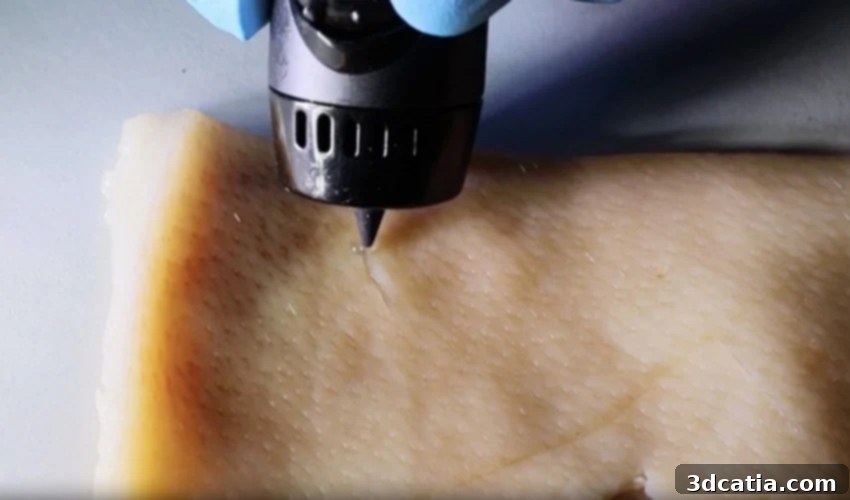
Revolutionizing Wound Healing: How 3D Printing and Bioactive PAINT Ink Accelerate Tissue Repair
The human body possesses an extraordinary capacity for self-repair. When the skin is cut or damaged, a complex cascade of biological processes immediately begins, encompassing hemostasis to stop bleeding, inflammation to clear debris and prevent infection, proliferation of new cells to rebuild tissue, and finally, remodeling to strengthen the repaired area. This intricate natural healing mechanism, supported by elements like clotting factors and white blood cells, is remarkably effective for minor injuries. However, for more extensive wounds—such as deep lacerations, severe burns, or chronic ulcers—the body’s inherent healing capabilities can be overwhelmed. In such cases, intervention becomes crucial to facilitate and enhance the repair process, preventing complications like persistent infection, excessive scarring, and delayed recovery. Traditional treatments often involve sutures or bandages to physically close wounds, alongside antibiotics to combat bacterial invaders. While these methods are widely practiced and effective to a degree, they sometimes fall short in significantly accelerating healing or preventing complications. A groundbreaking new technique, however, promises to fundamentally change how we approach wound care, harnessing the power of 3D printing technology combined with a novel, bioactive ink.
In a pivotal study recently published in the prestigious journal ACS Applied Materials & Interfaces, a team of pioneering researchers from Nanjing University—Dan Li, Xianguang Ding, and Lianhui Wang—unveiled a revolutionary wound-healing solution. They have engineered a sophisticated bio-material, aptly named portable bioactive ink for tissue healing, or PAINT, which is specifically designed to dramatically accelerate the body’s intrinsic healing processes. Unlike passive wound dressings, PAINT ink is an active biomaterial, formulated to tackle a broad spectrum of wounds. Its innovative composition features a synergistic blend of two key components: macrophage-derived vesicles (MDVs) and sodium alginate. These vesicles, which are nano-sized sacs secreted by specialized white blood cells known as macrophages, are critical orchestrators of the immune response and tissue regeneration. Within the healing cascade, MDVs play a vital role in stimulating the formation of new blood vessels, a process known as angiogenesis, which is essential for supplying oxygen and nutrients to the regenerating tissue. Furthermore, they are crucial in moderating the inflammatory response, preventing excessive inflammation that can impede healing. Complementing the vesicles, sodium alginate acts as a biocompatible scaffold, providing structural integrity and creating an optimal microenvironment for the MDVs to exert their therapeutic effects. Applied directly to the wound, this sophisticated ink forms a gel-like layer, creating an ideal interface for accelerated tissue repair.
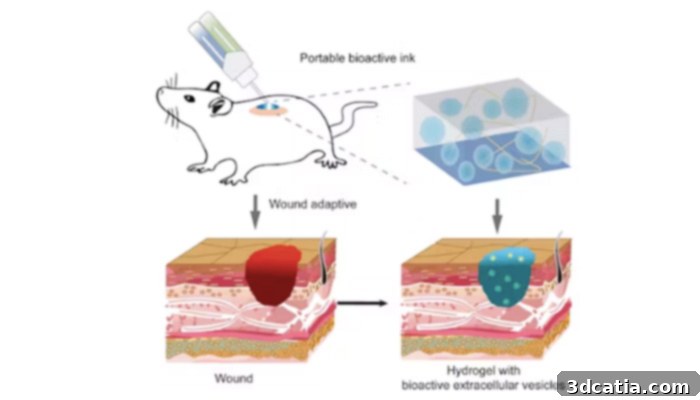
PAINT ink accelerates wound healing in both humans and animals (photo credits: Nanjing University)
PAINT Ink: Accelerating the Path to Full Recovery
The application method for PAINT ink is as innovative as its composition, leveraging the precision and accessibility of additive manufacturing. To deposit the bioactive ink onto the wound site, the researchers ingeniously utilized a 3D printing pen. This handheld device allows for precise, controlled extrusion of the bio-material, enabling direct and localized treatment. One of the most remarkable properties of PAINT ink is its rapid solidification: according to the scientists, the biomaterial transitions into a solid, protective layer within a mere three minutes of application. This swift gelation is crucial, as it immediately forms a robust barrier directly on the wound, protecting it from external contaminants while simultaneously retaining the therapeutic macrophage-derived vesicles. This immediate protective layer is a significant advantage, potentially reducing the risk of secondary infections and providing a stable environment for healing to commence. The versatility of PAINT ink also means it can be applied not just to open wounds, but also over existing sutures or bandages, seamlessly integrating with conventional wound care practices to supercharge the healing process. The preliminary results of their extensive research are profoundly promising, unequivocally demonstrating that PAINT ink actively promotes robust blood vessel formation—a critical step for tissue regeneration—and significantly reduces inflammatory markers, indicating a more controlled and effective healing response.
The efficacy of PAINT ink has been rigorously tested in preclinical trials, yielding compelling evidence of its wound-healing capabilities. Specifically, the bio-ink was applied to injured mice, and the outcomes were striking. Rodents treated with PAINT ink displayed almost complete healing of substantial wounds after just 12 days. This accelerated recovery was in stark contrast to control groups of mice, which, without the PAINT ink treatment, showed significantly less advanced healing at the same stage. This direct comparison highlights the powerful regenerative potential of the new bio-ink. As the research team aptly explains, “The treatment of skin wounds involving complex biological processes has become an important public health issue worldwide.” Indeed, chronic wounds, such as diabetic ulcers, pressure sores, and venous ulcers, affect millions globally, leading to substantial healthcare costs, prolonged suffering, and even limb amputations in severe cases. The ability of PAINT ink to promote faster and more effective healing represents a monumental leap forward in addressing this critical public health challenge, offering a potential solution for both minor injuries and more severe, hard-to-heal wounds. Moreover, the integration of a 3D printing pen for application underscores the convenience and precision this technology brings to medical professionals, once again showcasing the immense versatility and transformative potential of 3D printing technologies within the entire medical sector.
This innovative approach to wound care carries profound implications for the future of regenerative medicine. Beyond merely closing a wound, PAINT ink actively promotes a regenerative response, guiding the body to rebuild tissue more efficiently and with potentially less scarring. The use of macrophage-derived vesicles is particularly exciting, as it harnesses the body’s own powerful immune and healing agents in a targeted manner. This could lead to treatments that not only heal faster but also result in stronger, more functional tissue. The 3D printing pen facilitates on-demand, personalized treatment, allowing clinicians to precisely tailor the application to the specific shape and size of each wound, a level of customization largely unattainable with conventional dressings. This portable and versatile application method could be invaluable in diverse settings, from emergency rooms to remote clinics, potentially even for first responders. Furthermore, as 3D bioprinting continues to advance, we can envision a future where even more complex bio-inks or personalized tissue constructs are printed directly onto wounds, opening new avenues for treating everything from severe burns to congenital defects. The research into PAINT ink is a testament to the ongoing revolution in advanced materials and manufacturing, promising a new era of wound care characterized by rapid healing, reduced complications, and improved patient outcomes. To delve deeper into the scientific details and groundbreaking findings concerning PAINT ink, you can access the full study by clicking HERE.
What are your thoughts on the revolutionary PAINT ink and its potential to transform wound healing? Share your insights and comments below, or engage with us on our LinkedIn, Facebook, and Twitter pages! Don’t miss out on the latest advancements in additive manufacturing—be sure to sign up for our free weekly Newsletter here, delivering the most important 3D printing news directly to your inbox. You can also explore our extensive library of videos on our YouTube channel for more compelling content on the future of 3D technologies.
*Photo Credits: Nanjing University