

Revolutionizing Water Access: How 3D Printing Powers the ‘Water from Air’ Device
Access to clean drinking water remains a critical global challenge, affecting billions worldwide. The statistics are stark: over 2 billion people currently lack access to safe potable water, and tragically, diseases stemming from this scarcity claim approximately 14 lives every single day. In the face of this pressing humanitarian crisis, innovative solutions are desperately needed. This is precisely the ambition driving Louisa Graupe and Julika Schwarz, the visionary minds behind ‘Water from Air’ – a groundbreaking mobile device designed to extract drinking water directly from the atmosphere. Their solution leverages the fascinating properties of metal-organic frameworks (MOFs), advanced materials composed of metal ions that function much like highly efficient molecular sponges. What makes this particular innovation even more compelling is the pivotal role played by 3D printing in its development. The device’s casing, along with several other crucial components, has been meticulously 3D printed, enabling a custom-made, modular, and highly adaptable system that paves the way for a more sustainable future for water access.
The concept of atmospheric water recovery is not entirely new; existing technologies have long demonstrated its feasibility. However, these traditional systems often suffer from complexity, high technical requirements, and prohibitive costs, limiting their widespread adoption, especially in areas where they are needed most. Louisa and Julika’s core objective was to transcend these limitations by developing a significantly more accessible and user-friendly concept – one that could seamlessly integrate into any household, empowering individuals to produce their own drinking water. They articulate their profound vision: “Water from Air is conceived as a mobile water production and storage unit, engineered for flexible deployment within private households, irrespective of geographical location or socio-economic circumstances. It represents a practical solution and an accessible application option for communities across the globe. Initially, the concept facilitates the production of 6 liters of pristine drinking water per day, with inherent scalability designed for future expansion. A cornerstone of its development, the prototype was largely brought to life through the transformative capabilities of 3D printing.” This emphasis on mobility, ease of use, and scalability underscores their commitment to addressing the water crisis with a truly impactful and inclusive approach.
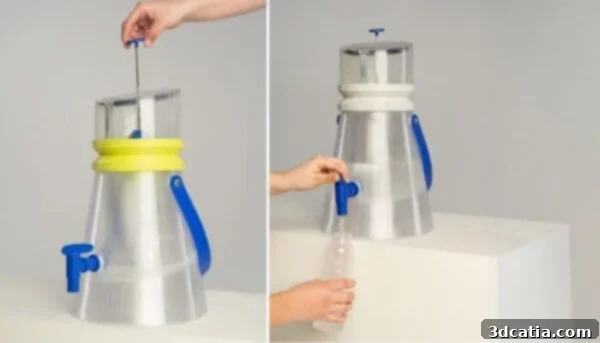
The Water from Air Device
Additive Manufacturing: The Backbone of the Water from Air Device
The ‘Water from Air’ device is ingeniously segmented into several distinct components, a significant number of which were brought to life using various 3D printing processes and an array of specialized materials. This strategic embrace of additive manufacturing allowed the designers unparalleled flexibility and precision. Let’s explore some of these key elements, starting from the device’s foundation. The water tank, strategically positioned at the base of the unit, was fabricated using Fused Deposition Modeling (FDM) – a robust and widely accessible 3D printing technology. For this crucial component, transparent PETG filament was selected. PETG offers excellent clarity, making it easy to monitor the water level, alongside superior durability and chemical resistance, crucial for holding potable water. Directly above the tank resides an intermediate part, also meticulously designed and produced with an FDM machine, again utilizing PETG for material consistency and structural integrity. This methodical approach ensures that the primary water-contacting components are made from reliable and safe materials.
The upper section of the device, which includes the intricately designed lid, required a different approach due to its functional complexity and aesthetic requirements. This part was expertly produced using an SLA (Stereolithography) 3D printer. SLA technology is renowned for its ability to create exceptionally smooth surfaces and intricate details, which were vital for the precise integration of the MOF materials and the overall aesthetic finish of the device. The lid itself was 3D printed in four distinct sections, a design choice that not only facilitated the intricate geometry but also allowed for easier post-processing steps such as curing, sanding, and assembly. The combination of FDM for larger, more structural components and SLA for precision parts highlights a thoughtful application of different additive manufacturing strengths, optimizing both functionality and production efficiency.
The Strategic Advantages of 3D Printing in Development and Future Vision
The selection of additive manufacturing as the primary prototyping and production method for ‘Water from Air’ was a deliberate and strategic decision, offering myriad benefits that traditional manufacturing simply couldn’t match. Firstly, 3D printing inherently enables rapid iteration and modification of designs. During the development phase, Louisa and Julika could swiftly test multiple design variations, optimize component shapes for efficiency, and refine the overall user experience without incurring significant costs or delays associated with conventional tooling. This agility was crucial in developing a custom-made, modular system that can be easily assembled, maintained, and potentially adapted for various environmental conditions. The ability to produce unique, tailored parts on demand significantly accelerated the product development cycle.
Beyond rapid prototyping, 3D printing plays a transformative role in the long-term vision for ‘Water from Air’. The overarching goal is not just to produce a few devices, but to facilitate the widespread availability of this innovative solution across the globe. By leveraging 3D printing, the team envisions a future where these devices can be quickly manufactured wherever they are needed, reducing logistical challenges and supply chain dependencies. Perhaps even more revolutionary is the ambition to offer the 3D design files for download. This open-source approach would democratize access to atmospheric water generation, empowering individuals, communities, and NGOs to produce devices directly at home or in local fabrication hubs. Such on-demand, localized production could significantly lower costs, foster self-sufficiency, and ensure that clean drinking water is accessible to anyone with a 3D printer and the necessary materials, creating a truly decentralized and sustainable solution to the global water crisis.
Unveiling the Ingenious Operation of the Water from Air Solution
Understanding the mechanics behind the ‘Water from Air’ solution reveals its elegant simplicity and profound effectiveness. At the heart of the device’s operation are Metal-Organic Frameworks (MOFs), which Louisa and Julika expertly integrated into their design. MOFs are a class of crystalline materials with incredibly high porosity and surface area, making them exceptionally efficient at adsorbing gases and molecules – in this case, water vapor from the ambient air. These microscopic structures act like molecular sieves, selectively capturing water molecules while largely ignoring other atmospheric pollutants. This intrinsic selectivity is a game-changer, as it inherently purifies the collected water, eliminating the need for complex and often costly external filtration systems. The ingenious design involves inserting these specialized MOF materials directly into the lid of the ‘Water from Air’ device, which serves as the primary interface for atmospheric interaction.
The operational cycle begins with the lid remaining open for approximately an hour. During this crucial absorption phase, the MOFs actively draw water molecules from the surrounding air, effectively ‘sponging’ them into their vast internal surface area. Thanks to their unique properties, the MOFs exhibit a remarkable affinity for water vapor, ensuring efficient collection even in relatively arid conditions. Once the absorption phase is complete, the lid is securely closed. This action seals the device, allowing the air trapped inside, now saturated with water, to naturally warm. This increase in temperature triggers a natural distillation process: as the air heats, the MOFs release the absorbed water molecules. These released molecules then cool and condense into liquid form on the cooler surfaces within the device, producing pure, fresh drinking water. This elegant condensation process also takes approximately one hour, mirroring the absorption phase.
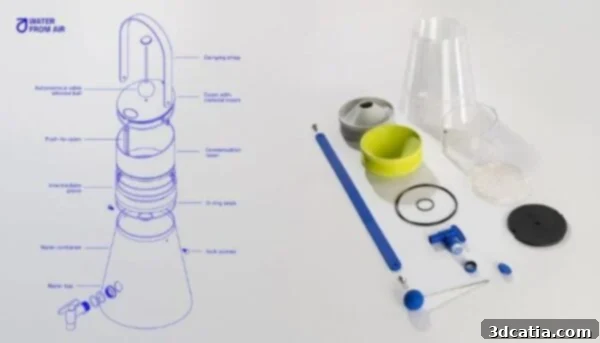
The different components of the system.
Following the condensation phase, the collected drinking water is ready for retrieval. A simple ball valve can then be opened to drain the freshly produced water into a container. For even quicker and more convenient access, a user-friendly tap is integrated into the device, allowing for immediate consumption. This entire two-hour cycle – one for absorption and one for condensation – enables the device to produce an impressive 6 liters of clean drinking water per day. Designed with portability in mind, the ‘Water from Air’ unit is equipped with a sturdy handle, making it incredibly easy to transport, ideal for use in various locations within a home, or for small-scale community applications. While the current prototype focuses on individual household needs, the long-term vision is to significantly scale up this innovative solution. The goal is to develop larger units capable of addressing more substantial requirements, such as providing a sustainable source of drinking water for entire communities, thus transforming lives on a broader scale. To delve deeper into the intricacies of this transformative project, we encourage you to explore further by clicking HERE.
The ‘Water from Air’ device stands as a testament to human ingenuity, merging cutting-edge material science with the versatility of 3D printing to tackle one of the world’s most critical challenges. Its potential to democratize access to clean drinking water, especially in underserved regions, is immense. This innovative blend of MOFs and additive manufacturing offers a beacon of hope for a future where clean water is a right, not a privilege. What are your thoughts on this revolutionary ‘Water from Air’ device and its potential impact? We invite you to share your perspectives in the comments section below or engage with us on our LinkedIn or Facebook pages! Furthermore, ensure you stay at the forefront of additive manufacturing news by signing up for our free weekly Newsletter, delivering the latest 3D printing innovations directly to your inbox. You can also discover more about emerging technologies and inspiring projects by visiting our YouTube channel for a wealth of informative videos.
*All Photo Credits: Louisa Graupe /Julika Schwarz