
BigRep NERA: Revolutionizing Electric Motorcycle Design with Advanced Large-Scale 3D Printing Technology
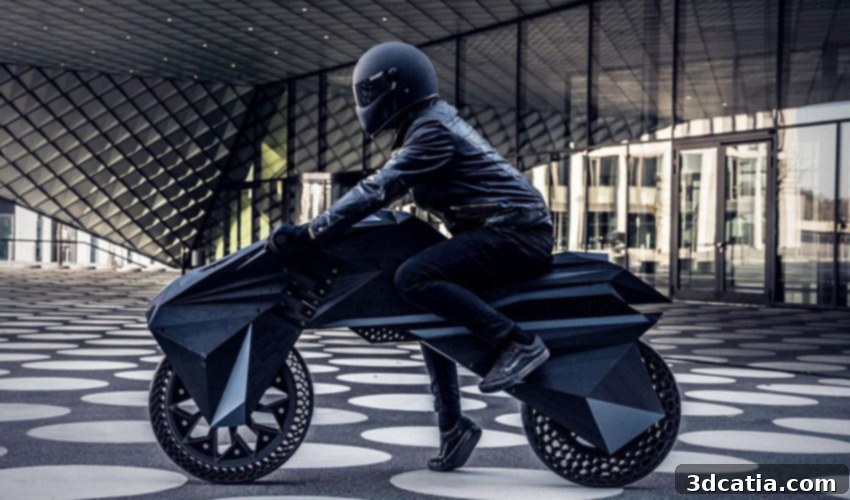
BigRep, a pioneering German manufacturer renowned for its expertise in large-format additive manufacturing, has consistently pushed the boundaries of what’s possible with 3D printing. Having previously garnered significant attention with its innovative 3D-printed, puncture-proof bike tire, the company once again captivated the industry by unveiling the NERA – a groundbreaking, fully 3D-printed electric motorcycle. This remarkable vehicle stands as a testament to the transformative power of additive manufacturing, with virtually every structural component, from its advanced tires and robust frame to its ergonomic seat, meticulously crafted using BigRep’s formidable FDM 3D printers. Only the essential electrical components were excluded from the 3D printing process, highlighting the depth of BigRep’s achievement. Conceived and designed by NOWlab, BigRep’s innovation lab, the NERA prototype made its public debut at the prestigious Formnext 2018 exhibition, signaling a new era for vehicle design and production.
The visionary behind the NERA’s distinctive structure is designer Marco Mattia Cristofori. A celebrated figure in the realm of 3D design, Cristofori was also instrumental in the creation of the acclaimed 3D printed organic rim. With the NERA project, his overarching goal was to vividly demonstrate how large-scale, or XXL, additive manufacturing can not only address complex industrial requirements but also unlock unprecedented levels of design freedom. This ethos allowed for organic shapes, intricate internal structures, and highly customized components that would be exceedingly difficult, if not impossible, to achieve with traditional manufacturing methods. Marco collaborated closely with Maximilian Sedlak from NOWlab to bring the NERA to life, ensuring that the innovative design met functional engineering principles. The resulting vehicle, impressive in both its form and function, measures 190 cm in length, 90 cm in height, and 55 cm in width, with a total weight of 60 kg. Its construction involved a carefully selected combination of BigRep’s high-performance filaments, including ProHT, ProFLEX, PETH, and PLA, each chosen for their specific mechanical properties and suitability for different parts of the motorcycle.
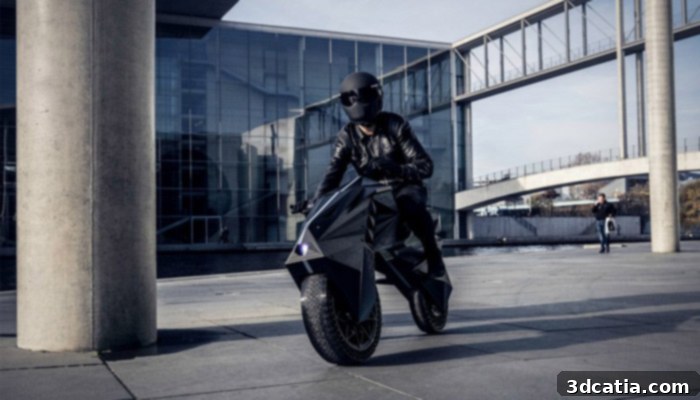
Daniel Büning of NOWlab eloquently captured the essence of the NERA, stating, “The Nera combines several innovations developed by Nowlab, such as the airless tire, functional integration and embedded sensor technology.” He further emphasized the broader impact of such projects: “This bike and our other prototypes push the limits of engineering creativity and will reshape Additive Manufacturing technology as we know it.” Büning’s remarks underscore that the NERA is more than just a motorcycle; it’s a showcase of advanced engineering, material science, and design methodology converging to redefine the capabilities and potential applications of large-format 3D printing. The innovations present in the NERA are not merely conceptual; they are tangible demonstrations of how 3D printing can lead to smarter, more integrated designs with enhanced functionality and performance characteristics that are difficult to achieve through conventional production techniques.
The World’s First of Its Kind: A Milestone in Additive Manufacturing
The NERA truly stands as a monumental achievement, distinguishing itself as the world’s first almost entirely 3D-printed electric motorcycle. This is a significant claim, especially in an automotive market where 3D printing is increasingly utilized for producing specific components and prototypes. While many modern motorcycles now incorporate individual parts designed or manufactured with additive technologies – from lightweight brackets to complex engine components – the NERA takes this concept to an unprecedented level. Its defining characteristic is the comprehensive application of 3D printing across its main structural elements, making it a unique pioneer in the realm of vehicle manufacturing.
A closer inspection of the NERA reveals the meticulous detail and innovative engineering that went into its creation. The tires, for instance, are not merely conventional tires with 3D-printed treads; they are entirely 3D-printed, airless structures. This eliminates the risk of punctures, reduces maintenance, and allows for unprecedented design flexibility in the tread patterns, which can be customized for various riding conditions or aesthetic preferences. This airless design is a direct evolution of BigRep’s earlier work on puncture-proof bicycle tires, scaled up and refined for motorcycle application. Beyond the tires, the NERA boasts striking diamond-shaped rims, which are also fully 3D printed, showcasing complex geometries that enhance both appearance and potentially structural integrity. The motorcycle’s robust frame, its critical fork assembly responsible for steering and stability, and even the rider’s seat, are all products of BigRep’s large-format FDM printers.
Another standout innovation of the NERA is its suspension system, which deviates significantly from traditional motorcycle designs. Instead of relying on conventional shock absorbers and springs, the NERA incorporates integrated flexible bumpers. These bumpers are 3D-printed as part of the frame structure, utilizing the elastic properties of specialized filaments like ProFLEX to absorb shocks and vibrations. This ingenious approach offers several advantages: it simplifies the overall mechanical design, reduces the number of individual parts, potentially lowers the vehicle’s weight, and allows for the integrated customization of damping characteristics. This feature not only demonstrates engineering creativity but also the potential for material and structural integration to replace complex mechanical assemblies.
In total, the NERA comprises 15 major components that were 3D printed, each representing a remarkable feat of large-scale additive manufacturing. The largest of these printed components measured an impressive 120 cm by 45 cm by 20 cm, pushing the practical limits of BigRep’s FDM machines. This scale of printing for functional, structural parts of a vehicle truly highlights the capabilities of industrial 3D printing and signifies a shift towards manufacturing larger, more integrated assemblies rather than just small, intricate prototypes. The meticulous design and execution of each of these 15 parts contribute to the NERA’s cohesive and highly innovative structure, setting a new benchmark for additive manufacturing in the automotive sector.
NERA: A Visionary Design Study for the Future of Mobility
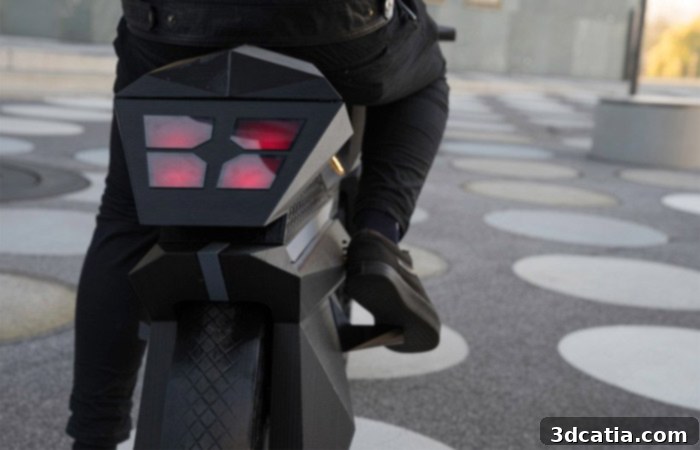
It is important to understand that the NERA, while fully functional in its prototype form, is fundamentally a design study rather than a commercial product destined for mass production and immediate street use. This distinction is crucial for appreciating its true value and purpose. The NERA was conceived as a platform to explore, demonstrate, and push the boundaries of large-scale additive manufacturing’s potential in the automotive industry. It serves as a tangible proof-of-concept, illustrating the immense design freedom, functional integration capabilities, and material versatility offered by BigRep’s advanced 3D printing technology.
This conceptual nature explains why specific details regarding its performance metrics—such as top speed, range per charge, precise transmission mechanisms, or detailed electrical specifications—are not extensively publicized. While these details are paramount for a consumer-ready vehicle, they are secondary for a design study focused on showcasing manufacturing innovation. The primary objective of the NERA is to inspire, to challenge conventional manufacturing paradigms, and to stimulate further research and development in the field of additive manufacturing for electric vehicles and other complex industrial applications. It demonstrates that complex, integrated structures can be efficiently produced, opening doors for customizability and on-demand manufacturing that could revolutionize niche markets and specialized vehicle development.
The NERA’s existence proves that a vehicle can be designed from the ground up to leverage the unique advantages of 3D printing, leading to innovations like integrated suspension systems and airless tires. This approach allows for fewer parts, simplified assembly, and potentially lighter, more efficient designs. It prompts engineers and designers to rethink how vehicles are constructed, moving beyond the constraints of traditional fabrication methods like welding, casting, and machining. The ability to rapidly iterate and produce large, complex parts locally can also significantly shorten development cycles and reduce manufacturing lead times, making custom vehicle production more feasible.
As a beacon of innovation, the NERA encourages us to imagine a future where personalized transportation is not just about choosing a color, but about fundamentally tailoring the vehicle’s structure and functionality to individual needs. This level of customization, once a distant dream, is brought closer to reality by the capabilities showcased in projects like the NERA. It underscores BigRep’s commitment to advancing the entire additive manufacturing ecosystem, from developing robust machines to creating high-performance materials and fostering groundbreaking applications. You can witness the NERA in action and explore more of its specificities and features by watching the video below and visiting the dedicated section on the BigRep website:
The BigRep NERA electric motorcycle is more than just a prototype; it’s a powerful statement about the future of manufacturing and design. It exemplifies how creativity, combined with cutting-edge technology, can lead to solutions that are not only innovative but also sustainable and efficient. The implications of this project extend beyond electric motorcycles, influencing fields from aerospace to construction, where large-scale 3D printing promises to redefine production possibilities. The project also highlights the importance of collaboration between designers, engineers, and material scientists in pushing the boundaries of what is achievable. What are your thoughts on this revolutionary 3D-printed electric motorcycle? We invite you to share your insights and comments below, or join the discussion on our Facebook and Twitter pages! Don’t miss out on the latest advancements and news in the world of additive manufacturing – sign up for our free weekly Newsletter to receive all the crucial updates directly in your inbox!