
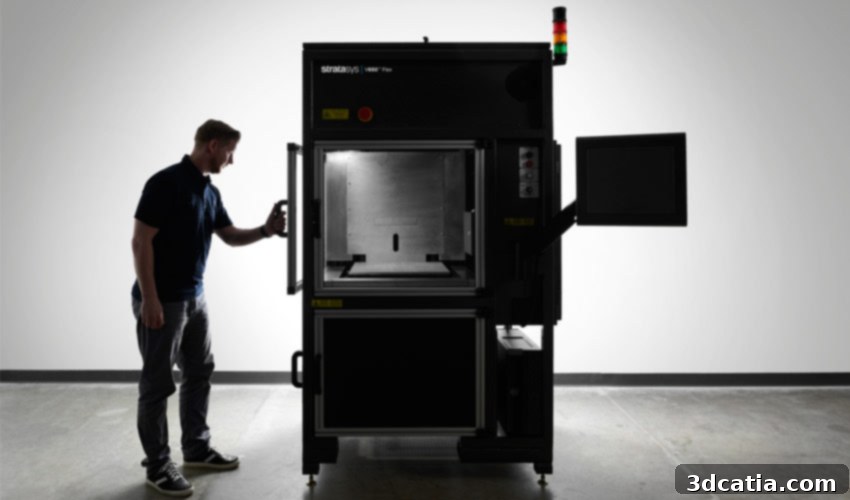
Stratasys Unveils Groundbreaking F120 FDM and V650 Flex SLA 3D Printers at AMUG 2019
The Additive Manufacturing Users Group (AMUG) 2019 conference, a premier event in the additive manufacturing calendar, opened its doors in Chicago yesterday, serving as a pivotal platform for industry leaders to showcase their latest innovations. Among the most anticipated announcements, the manufacturing giant Stratasys seized this opportunity to introduce two transformative 3D printing solutions to the global market. These new offerings, the F120 industrial FDM 3D printer and the V650 Flex stereolithography (SLA) machine, strategically broaden Stratasys’s extensive portfolio, catering to diverse industrial applications and user segments, from educational institutions to high-volume manufacturing operations.
The F120, a compact yet robust industrial FDM 3D printer, is meticulously engineered to make professional-grade additive manufacturing more accessible to engineers, designers, and educators. Its design emphasizes ease of use, reliability, and cost-effectiveness, bringing Stratasys’s renowned FDM technology to a wider audience. Simultaneously, the unveiling of the V650 Flex marks Stratasys’s official entry into the commercial SLA market with its own branded system. This move is particularly significant, as it positions the manufacturer in a new, high-precision market segment, diverging from previous discussions about venturing into metal additive manufacturing. While the company’s Stratasys Direct Manufacturing service has utilized SLA technology for years, bringing the V650 Flex to market demonstrates a strategic pivot to meet evolving industry demands for high-quality, large-format resin printing.
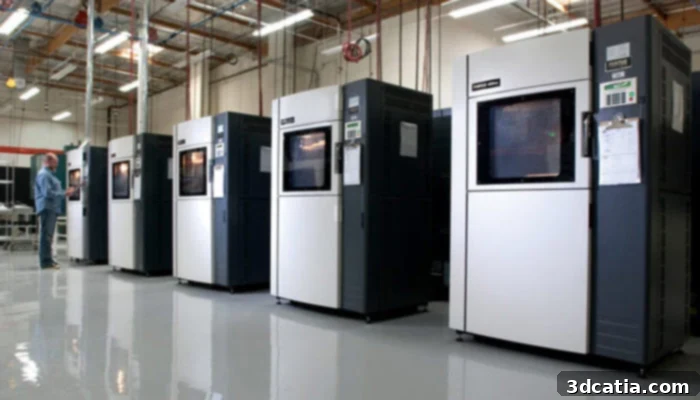
Stratasys Direct Manufacturing has been using SLA technology for some time now
The V650 Flex: Stratasys’s Foray into Industrial SLA
The V650 Flex SLA 3D printer is a testament to Stratasys’s commitment to industrial utility, prioritizing performance and functionality above all else. As one team member aptly explained, “Visually, it is not a pretty machine. But it is a great machine because it maximises build volume.” This statement encapsulates the ethos behind its design: a powerful, open-source system built for maximizing output and efficiency. The machine boasts an exceptionally generous build volume of 508 x 508 x 584 mm, providing ample space for large-scale prototypes and production parts. Furthermore, its innovative interchangeable resin trays offer unparalleled flexibility, allowing users to quickly switch between different materials and applications without significant downtime, thereby enhancing workflow efficiency in demanding industrial environments.
To ensure superior material performance, Stratasys forged a strategic partnership with DSM, a leading global science-based company, to develop specialized Somos resins tailored for the V650 Flex. This collaboration has already yielded four meticulously developed and rigorously tested resins, each designed to meet specific industrial requirements for strength, durability, and finish. The confidence in the V650 Flex’s reliability is further underscored by Stratasys’s internal testing, which has seen the machine successfully print over 150,000 parts, accumulating more than 75,000 hours of printing time. This extensive validation demonstrates the system’s robustness and readiness for demanding industrial production scenarios, assuring users of consistent and high-quality results.
Omer Krieger, Executive Vice President at Stratasys, elaborated on the motivation behind the V650 Flex: “While stereolithography is one of the original 3D printing processes – mainly used to create master patterns or large concept models quickly and accurately – customers have been challenged by restricted systems that can’t be configured and materials at a high cost-per-part. The V650 Flex is the result of customer demand around the world wanting a better solution – fully configurable to match the specific application and use-case. The solution is truly one of the first large-scale systems for creating reliable, high-quality parts across design concepts, validation, investment casting, tooling, and injection molding.” This statement highlights Stratasys’s intention to address long-standing industry pain points: the lack of configurability in traditional SLA systems and the prohibitive cost of proprietary materials. The V650 Flex aims to democratize high-performance SLA by offering an open, adaptable platform that empowers users to optimize their workflow and reduce operational expenses. Its versatility makes it ideal for a wide array of applications, from intricate design validation and rapid prototyping to producing master patterns for investment casting, creating durable tooling, and even manufacturing molds for injection molding processes.
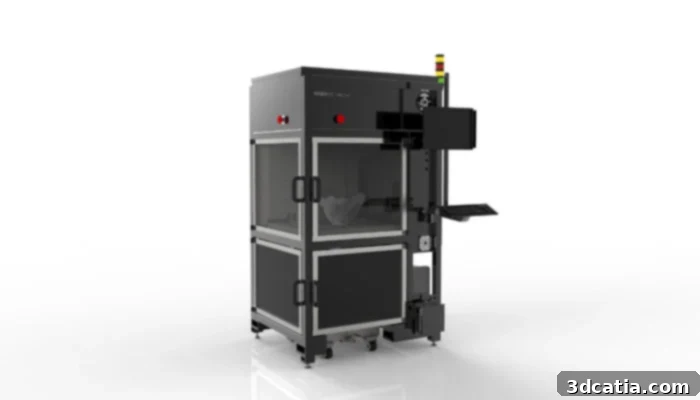
In essence, with the V650 Flex, Stratasys is not merely entering the stereolithography segment; it is aiming to redefine it. The company hopes to provide a faster, more efficient, and truly large-scale industrial solution, significantly reducing the cost associated with developing high-quality prototypes and functional 3D printed parts. This strategic move underscores Stratasys’s ambition to remain at the forefront of additive manufacturing by offering comprehensive solutions across various technologies, catering to the evolving and increasingly sophisticated demands of modern industrial production.
Expanding the F123 Series: Introducing the Accessible F120 FDM Printer
Concurrently with the V650 Flex, Stratasys leveraged the AMUG event to unveil its second groundbreaking machine: the F120, an integral addition to its acclaimed F123 series, based on the highly popular FDM (Fused Deposition Modeling) technology. This compact machine is specifically designed to democratize industrial 3D printing, making professional-grade capabilities accessible to a broader audience. The F120 is perfectly suited for designers, engineers, and educators who require reliable, accurate, and robust 3D printing for various applications, from concept modeling to functional prototyping and end-use parts. Gina Scala, Marketing Director, Global Education at Stratasys, emphasized the F120’s educational impact: “We designed it to prepare the future workforce so that it has all the keys in hand to adapt to the job market. It is an ideal solution for all schools and universities and to stimulate our engineers and designers.” This highlights the machine’s role in bridging the skills gap in additive manufacturing, equipping students with practical experience on industrial-grade equipment, and fostering innovation in educational settings. The question then arises: what truly differentiates the F120 from the multitude of FDM 3D printers already saturating the market?
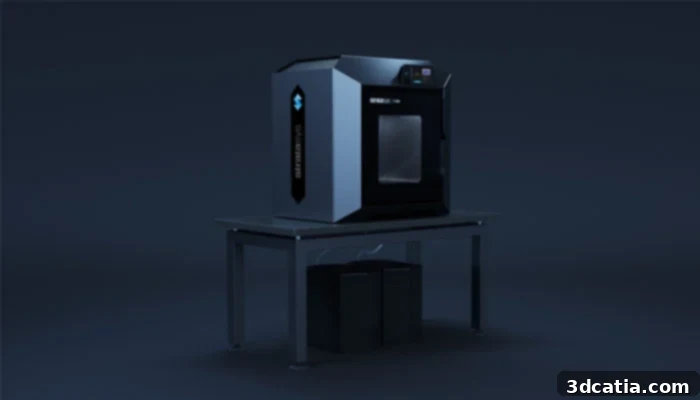
The F120 distinguishes itself with several key features that enhance productivity, reliability, and ease of use. First and foremost, it boasts a printing speed up to three times faster than many competing solutions in its class, dramatically reducing turnaround times for prototypes and parts. This speed is complemented by the inclusion of large-capacity filament boxes, enabling the F120 to print continuously for up to 250 hours without requiring material changes. This feature significantly minimizes user intervention, preventing print interruptions and reducing the operational burden of frequently changing reels, which is a common frustration with smaller, less industrial machines. Furthermore, Stratasys stands by the F120’s exceptional quality and robustness, citing extensive testing that involved over 1,200 hours of continuous operation, including rigorous validation with leading CAD software. This comprehensive testing ensures not only the mechanical integrity of the printer but also seamless integration into existing design workflows. The F120 offers material versatility, compatible with industrial-grade ABS, ASA, and SR30 filaments, which are widely recognized for their durability and performance in various engineering applications.
Omer Krieger, EVP Products, Stratasys, reiterated the company’s legacy and the F120’s strategic importance: “For more than three decades, Stratasys has set the standard for performance, reliability and accuracy in industrial-level 3D printing technology. Some of the largest names in automotive, aerospace, and healthcare count on us to deliver repeatable and accurate 3D prints for both prototypes and end-use parts. The F120 3D printer introduces this cutting-edge technology to even the most basic users, transcending many entry-level machines. Never before has it been this easy to put 3D printing to work for everyone – from students preparing for industry to the smallest design studio, through full-scale prototyping departments putting tools at designers’ fingertips.” This statement underscores the F120’s role in democratizing Stratasys’s industrial expertise, making advanced 3D printing capabilities accessible to a broader spectrum of users. It effectively bridges the gap between consumer-grade desktop printers and high-end industrial systems, offering robust features and proven reliability at an approachable price point.
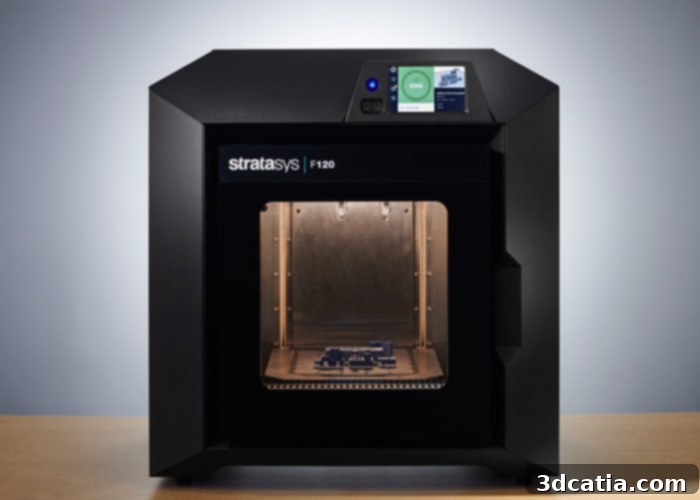
Further enhancing its user-friendliness and modern appeal, the F120 incorporates an intuitive touch control screen, simplifying operation and navigation, along with a sophisticated remote monitoring system. These features provide users with greater control and flexibility, allowing them to manage print jobs and monitor progress from virtually anywhere, significantly improving workflow efficiency. The F120 seamlessly integrates into the established F123 series, known for its industrial-grade performance and reliability. Priced competitively at $11,999, the F120 offers an exceptional value proposition for an industrial-grade FDM solution. Stratasys anticipates that the first orders for this groundbreaking machine will begin shipping in July, marking a new chapter in accessible industrial additive manufacturing.
The introduction of both the V650 Flex and the F120 signifies Stratasys’s dual strategy: on one hand, expanding into new high-precision segments like SLA with an open and configurable system, and on the other hand, reinforcing its FDM dominance by making industrial capabilities more affordable and accessible. These launches collectively strengthen Stratasys’s position as a comprehensive provider of additive manufacturing solutions, capable of addressing a wide range of needs from rapid prototyping and educational applications to sophisticated industrial production across various industries.
You can find more information on Stratasys’ website HERE.
What are your thoughts on Stratasys’s latest innovations, the V650 Flex and F120 3D printers? How do you envision these machines impacting the landscape of industrial additive manufacturing and education? Let us know what you think in a comment below or join the conversation on our Facebook and Twitter pages! Don’t forget to sign up for our free weekly Newsletter to receive all the latest news in 3D printing delivered straight to your inbox, keeping you at the forefront of this rapidly evolving industry!