
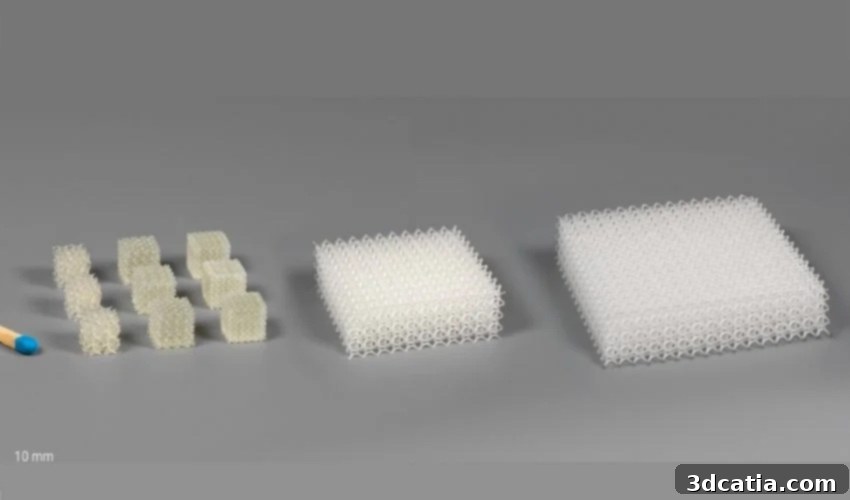
Nanoscribe Unveils XLF Print Set: Revolutionizing High-Precision Centimeter-Scale 3D Printing
The landscape of additive manufacturing is continuously evolving, with innovations pushing boundaries across various scales. While significant strides are often highlighted in large-format industrial printing, the equally critical domain of microfabrication – the art and science of creating structures with micro-sized dimensions, often referred to as microscale 3D printing – is a vibrant hotbed of research and development. At the forefront of this specialized field is the German company Nanoscribe. For several years, Nanoscribe has cemented its reputation as a pioneer, particularly through its expertise in two-photon polymerization (2PP) technology.
Two-photon polymerization is an advanced additive manufacturing process renowned for its ability to produce parts with astonishing nanoscopic and microscopic precision. It enables the creation of highly intricate and complex three-dimensional geometries that are simply unattainable with conventional manufacturing methods. However, the very nature of this high-resolution technique has traditionally come with inherent limitations. While exceptional for extremely fine details, 2PP typically restricts the size of manufactured parts, making the production of objects on the order of a centimeter impractical or exceedingly time-consuming. This constraint has presented a challenge for researchers and industries looking to leverage 2PP’s precision on a slightly larger, yet still microscopic, scale. Recognizing this crucial gap, Nanoscribe has engineered an groundbreaking solution: the Extra Large Features (XLF) Print Set.
The XLF Print Set is specifically designed to augment the capabilities of Nanoscribe’s flagship Quantum X Shape 3D printer. This innovative addition is set to unlock a new realm of possibilities for the machine, bridging the gap between ultra-high resolution microfabrication and more substantial component sizes. Prior to the XLF Print Set, the Quantum X Shape was already celebrated for its superior accuracy, far surpassing that of conventional stereolithography (SLA) and digital light processing (DLP) technologies in terms of feature resolution and detail. However, its operational envelope was somewhat bounded by limitations in both maximum print size and overall print speed when producing larger volumes. The introduction of the XLF Print Set represents a significant leap forward, engineered to push back these very limitations and expand the utility of the Quantum X Shape dramatically. Dr. Michael Thiel, Chief Science Officer and co-founder of Nanoscribe, encapsulates the transformative potential of this development, stating, “The XLF Print Set brings a whole new world of opportunities to the Quantum X Shape. First and foremost, you gain a tremendous speed up in manufacturing large print quantities of voluminous objects in one batch.” This statement underscores the dual impact of XLF: not only does it enable larger features, but it does so with unparalleled efficiency, making high-precision, millimeter-to-centimeter scale additive manufacturing a more viable reality.

The Quantum X Shape 3D printer, now enhanced by the XLF Print Set (photo credits: Nanoscribe)
Benefits of the Extra Large Features (XLF) Print Set: Elevating Micro-Additive Manufacturing
The introduction of the XLF Print Set marks a pivotal moment for advanced additive manufacturing, particularly for applications requiring both exquisite detail and increased part dimensions. Nanoscribe highlights that the XLF Print Set empowers the Quantum X Shape to fabricate parts several millimeters, and even up to centimeter scale, while maintaining the signature Nanoscribe precision. This includes the ability to reproduce complex geometries and integrate extremely fine details that are critical for high-performance micro-components. The synergy created by combining the XLF Print Set with Nanoscribe’s highly sensitive photopolymer resins and the inherent capabilities of the Quantum X Shape is truly transformative. These inherent properties include a remarkably high scanning speed and the flexibility of adjustable voxel sizes, allowing for optimized material deposition and feature resolution across different scales.
Together, these elements form a comprehensive solution for high-precision 3D printing, adept at operating across a wide range of scales—from the sub-micron (thousandth of a millimeter) to the centimeter. This capability opens doors to new research avenues and industrial applications where the trade-off between resolution and size was previously a significant hurdle. For instance, creating intricate scaffolding for tissue engineering that requires both fine cellular interfaces and a macroscopic structural integrity, or designing advanced micro-optical components with specific focal lengths and complex lens arrays, becomes vastly more achievable. The XLF Print Set effectively scales up the unique advantages of two-photon polymerization, making it relevant for a broader spectrum of challenges without compromising on the technology’s core strength: unparalleled precision at the micro and nano levels.
The potential applications of the XLF Print Set, in conjunction with the Quantum X Shape, are extensive and diverse, spanning numerous high-tech industries. Nanoscribe emphasizes that this integrated solution is not merely suited for early-stage prototyping and academic research; it is also robust enough for the production of functional final parts. This represents a critical shift, as it enables the transition of groundbreaking micro-designs from the laboratory bench to tangible, market-ready products. For example, the German company highlights the machine’s capability to design and manufacture complex mechanical parts, such as precision millimeter-sized connectors and intricately detailed housings for miniature electronic devices. These components often demand exceptionally tight tolerances and feature resolution that conventional machining struggles to achieve efficiently at such small scales.
Furthermore, the XLF Print Set excels in creating sophisticated microfluidic structures, which are vital for developing advanced lab-on-a-chip devices, diagnostic tools, and precise drug delivery systems. The ability to craft complex internal channels and reaction chambers with high accuracy and reproducibility is paramount in these fields. In biomedical research and development, the Quantum X Shape with XLF Print Set proves invaluable for fabricating intricate scaffolding for tissue engineering and regenerative medicine. These scaffolds mimic natural biological environments at a cellular level, guiding cell growth and tissue formation, and require a precise three-dimensional architecture that spans from micro-features to overall millimeter dimensions. Beyond these, the technology also promises significant advancements in micro-optics, photonics, and sensor development, where custom, high-performance miniature optical elements and precise sensor components can be rapidly iterated and produced. The capacity to bridge the gap between microscopic detail and macroscopic size positions Nanoscribe’s XLF Print Set as a transformative tool for a new generation of high-performance micro-devices across various scientific and industrial disciplines. For more comprehensive details on the XLF Print Set and its extensive capabilities, interested parties can explore further HERE.
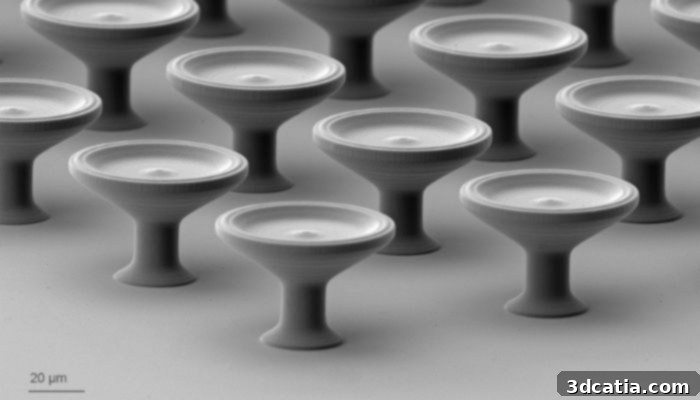
Examples of high-precision micro-parts fabricated with Nanoscribe’s technology (Photo Credits: Nanoscribe)
Nanoscribe’s XLF Print Set represents a significant leap forward in the field of micro-additive manufacturing, empowering researchers and engineers to push the boundaries of design and application. This solution not only enhances the capabilities of the Quantum X Shape but also broadens the horizons for high-precision 3D printing across multiple scales. We invite your thoughts on this exciting development from Nanoscribe. Share your insights in a comment below or engage with us on our Linkedin, Facebook, and Twitter pages! For the latest updates and breaking news in the world of 3D printing, don’t forget to sign up for our free weekly Newsletter here. Additionally, you can find all our engaging videos and in-depth discussions on our YouTube channel.