
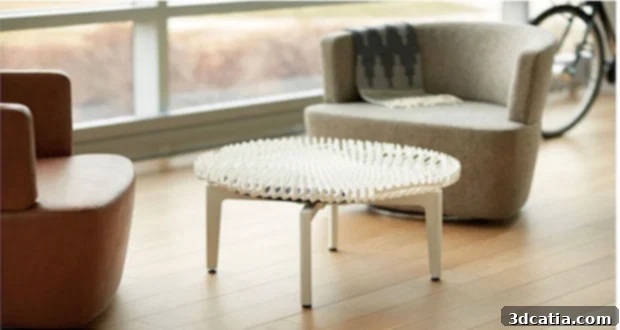
Rapid Liquid Printing: Revolutionizing Furniture Design with Steelcase and MIT’s Self-Assembly Lab
In the dynamic world of manufacturing, innovation is the cornerstone of progress. Steelcase, the world’s largest office furniture company, has long been a vanguard in integrating advanced technologies, including 3D printing, into the very fabric of their designs. This commitment to pushing creative boundaries has consistently brought their imaginative concepts to life. Now, their pursuit of innovation reaches new heights through a groundbreaking partnership with MIT’s Self-Assembly Lab. Together, they are pioneering a revolutionary technique that promises to fundamentally reshape the future of furniture design and creation.
For years, the widespread adoption of 3D printing in industrial manufacturing has faced significant hurdles. Many manufacturers have hesitated to fully embrace additive manufacturing due to limitations primarily related to printing time, material quality, and the extensive post-processing often required. Traditional 3D printing methods, while excellent for prototyping and intricate small-scale production, can be notoriously slow for larger components, often resulting in visible layer lines and anisotropic properties where the material is weaker along the Z-axis. This has led to a cautious approach from industries requiring high-volume, robust, and aesthetically flawless products. However, the researchers at MIT’s Self-Assembly Lab believe they have discovered a profound solution to these long-standing challenges, a technique that is surprisingly elegant in its simplicity: “Rapid Liquid Printing.” This innovative approach, developed in collaboration with Steelcase, aims to deliver products with superior refinement and significantly faster creation times than any conventional 3D printing or manufacturing process available today.
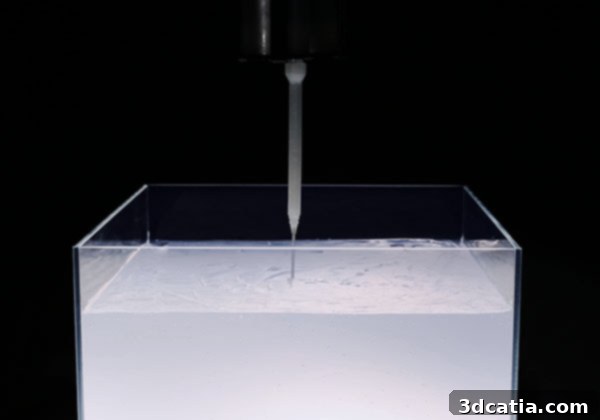
The process uses a gel with a long tube to print objects.
Rapid Liquid Printing fundamentally redefines how three-dimensional objects are formed. Unlike traditional 3D printing, which builds objects layer by layer from the bottom up in an open-air environment, this novel technique involves injecting liquid industrial materials directly into a tank of viscous gel. This specialized gel serves as a dynamic support medium, suspending and stabilizing the material as it is continuously extruded and solidifies within the three-dimensional space. The process circumvents the need for discrete layers, eliminating the common issues of stair-stepping and weak layer adhesion inherent in many additive manufacturing methods. By continuously printing in this supportive gel, the method allows for the creation of intricate and highly complex geometries that would otherwise require cumbersome and often difficult-to-remove support structures. The beauty of Rapid Liquid Printing lies in its ability to produce complete, robust pieces of furniture and other products in a matter of minutes, using a diverse range of industrial liquid materials such as rubber, foam, various plastics, and even composites.
One of the most compelling advantages of Rapid Liquid Printing is its dramatic reduction in post-processing requirements. In conventional 3D printing, a significant amount of time and effort is often spent on removing support structures, sanding rough surfaces, and curing parts. With this new method, because the object is supported by the gel throughout the entire printing process, there is no need for temporary, break-away supports. This means that once the printing is complete, the final stage is remarkably simple: the printed part is gently removed from the gel medium and then easily rinsed with water to clean off any residual gel. This streamlined workflow not only accelerates production timelines but also significantly lowers labor costs and reduces material waste, making it an economically attractive and environmentally friendlier alternative for industrial-scale manufacturing. The resulting prints boast incredibly smooth, seamless surfaces and exhibit isotropic mechanical properties, meaning their strength and integrity are uniform in all directions, a crucial factor for durable furniture and high-performance industrial components.
The collaboration between Steelcase and MIT’s Self-Assembly Lab is a potent synergy, combining deep academic research with vast industrial application expertise. MIT’s Self-Assembly Lab, renowned for its innovative work in programmable materials and self-assembly, provides the scientific bedrock and inventive spirit behind Rapid Liquid Printing. Their cutting-edge research pushes the boundaries of material science and digital fabrication. Steelcase, on the other hand, brings unparalleled industry knowledge, design acumen, and a profound understanding of the demands of commercial furniture production. Their involvement ensures that this pioneering technology is developed with practical applications in mind, addressing real-world needs for scalability, durability, aesthetics, and user experience. This partnership is not merely about creating a new printing method; it is about strategically deploying it to revolutionize how furniture is conceived, manufactured, and utilized, making customized and complex designs more accessible and efficient than ever before.
The implications of Rapid Liquid Printing for furniture design and manufacturing are truly transformative. Imagine a future where furniture can be customized on demand, perfectly tailored to an individual’s ergonomic requirements or specific aesthetic preferences, and produced locally within hours. This technology has the potential to dramatically shorten supply chains, reduce lead times, and facilitate rapid prototyping and iterative design cycles. Furthermore, the ability to create complex internal geometries, impossible with traditional methods, could lead to furniture that is not only lighter and stronger but also incorporates integrated functionalities like hidden wiring channels or optimized airflow. From a sustainability perspective, Rapid Liquid Printing offers significant advantages, including minimized material waste due to the absence of support structures, and the potential for utilizing recycled or bio-based liquid materials. This innovative approach moves us closer to a future of distributed, highly efficient, and environmentally conscious manufacturing, where a chair or a desk can be printed precisely when and where it’s needed, drastically reducing inventory and transportation costs.
While the promise of Rapid Liquid Printing is immense, it’s important to acknowledge that the technology is still in its nascent stages of commercial development. We might not see entire ranges of 3D printed furniture created with this specific process hitting retail stores immediately. The journey from a groundbreaking lab concept to widespread industrial adoption involves further refinement of materials, scaling up of printer dimensions and throughput, and rigorous testing for long-term durability and safety. However, the foundational breakthroughs achieved by Steelcase and MIT’s Self-Assembly Lab provide a clear and exciting glimpse into the near future. This technology represents a pivotal moment in additive manufacturing, pushing the boundaries of what is possible and setting a new benchmark for speed, quality, and design freedom. The ongoing research and development efforts are focused on expanding the material palette, enhancing printing precision, and developing larger-scale machines capable of meeting industrial production demands. We anticipate witnessing remarkable advancements in the coming years as this innovative method matures, promising a new era of agile and highly customized furniture manufacturing.
The potential impact extends far beyond the furniture industry. Rapid Liquid Printing could find applications in automotive interiors, aerospace components, medical devices, consumer goods, and architectural elements, wherever rapid production of complex, high-quality parts from liquid industrial materials is beneficial. The ability to produce isotropic parts without layer lines opens up possibilities for structural components that require uniform strength in multiple directions, an inherent limitation of many current 3D printing technologies. This universal adaptability and the distinct advantages it offers in speed and material efficiency truly position Rapid Liquid Printing as a game-changer across numerous sectors, fostering an environment where intricate designs and custom solutions can be brought to fruition with unprecedented ease and speed. We are incredibly excited to observe all the future developments and widespread applications that will undoubtedly emerge thanks to the pioneering work of Steelcase and MIT’s Self-Assembly Lab.
To truly grasp the innovative nature of Rapid Liquid Printing, we encourage you to watch the process in action. Witnessing the fluid mechanics and the instantaneous solidification within the gel vividly illustrates the elegance and efficiency of this groundbreaking technique. Check out the video below to see how this revolutionary printing method operates:
For those interested in delving deeper into the organizations driving this innovation, you can find more information about Steelcase and MIT’s Self-Assembly Lab by visiting their respective websites. Explore the extensive portfolio of Steelcase’s innovative furniture solutions here, and discover the groundbreaking research and projects undertaken by the Self-Assembly Lab at MIT here.
What are your thoughts on this revolutionary 3D printing process? Do you envision a future where your home or office is furnished with custom 3D printed pieces? We invite you to share your insights and predictions in a comment below, or join the conversation on our Facebook or Twitter page. Your perspective helps shape the discussion around the future of manufacturing and design!