
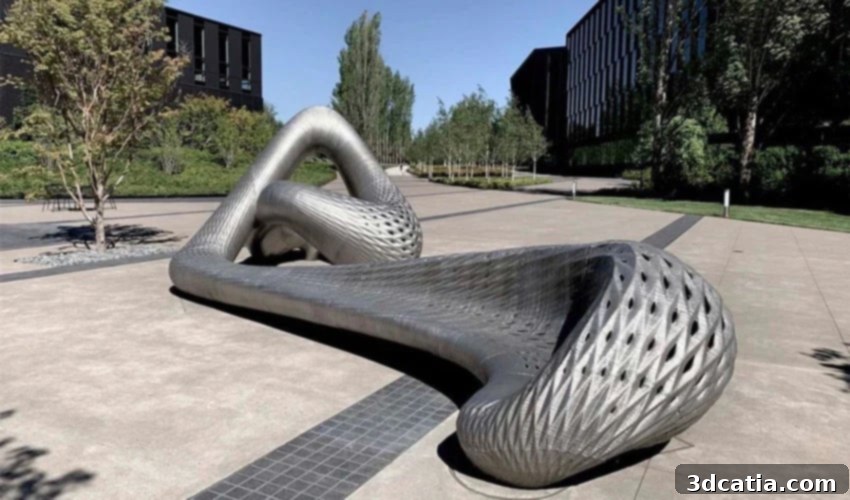
MX3D’s Oregon Dragon Bench: Revolutionizing Public Art with WAAM 3D Printing at Nike World Headquarters
In a remarkable blend of artistic vision, advanced engineering, and cutting-edge technology, MX3D, a recognized leader in Wire Arc Additive Manufacturing (WAAM), has once again unveiled a groundbreaking construction project. Their latest masterpiece, the “Oregon Dragon Bench,” transcends the conventional definition of public seating, emerging as a monumental metal sculpture distinguished by its unique open-loop design. This innovative structure has found a fitting and prominent home: it is proudly installed directly in front of the LeBron James Building, the vibrant innovation center nestled within the expansive Nike World Headquarters in Beaverton, Oregon. Measuring an impressive 10 meters (approximately 33 feet) in length, 3 meters (10 feet) in width, and 2.5 meters (8 feet) in height, this magnificent 3D printed bench was brought to life using MX3D’s state-of-the-art robotic 3D printer, showcasing the unparalleled potential of metal additive manufacturing in creating large-scale, intricate public installations.
The Genesis of a Design Icon: Joris Laarman’s Vision for the Oregon Dragon Bench
The “Oregon Dragon Bench” stands as a powerful testament to the harmonious collaboration between a visionary designer and revolutionary fabrication technology. The creative genius behind its captivating concept is none other than the celebrated Dutch designer and entrepreneur, Joris Laarman. Widely acclaimed for his pioneering work that seamlessly integrates art with emerging technologies, Laarman has consistently delivered pieces that challenge and redefine conventional design and manufacturing methodologies. The bench’s evocative name, “Oregon Dragon Bench,” is not arbitrary; it conjures images of fluid power, intricate patterns, and a majestic presence, all of which are embodied in its dynamic, almost organic, shape.
Laarman’s design philosophy often revolves around pushing the boundaries of digital craftsmanship, and this project serves as a quintessential example. The bench’s distinctive form factor, reminiscent of an unfolding ribbon, a swirling vortex, or a mythical creature in graceful motion, immediately captivates onlookers and invites interaction. The deliberate choice of location at Nike’s cutting-edge innovation hub is profoundly significant. It underscores Nike’s enduring commitment to forward-thinking design, embracing advanced technology, and fostering an environment of continuous creativity. The bench acts as a daily source of inspiration for the innovators, employees, and visitors who pass by, symbolizing the relentless evolution of materials and manufacturing processes in achieving previously unimaginable artistic and functional forms.
MX3D’s WAAM Technology: Reshaping the Landscape of Large-Scale Metal 3D Printing
For anyone following the remarkable advancements in metal additive manufacturing, the name MX3D is synonymous with groundbreaking achievements and innovative applications. The company first achieved widespread international recognition for its iconic 3D printed metal bridge, which was successfully installed over a picturesque canal in the historic heart of Amsterdam. That colossal structure, measuring an impressive 12.2 meters (approximately 40 feet) in length, 6.3 meters (20.7 feet) in width, and 2.1 meters (6.9 feet) in height, demanded an astounding 6 tons of stainless steel for its fabrication. The Amsterdam bridge project was a monumental undertaking, pushing the absolute limits of design, material science, and robotic fabrication, and its resounding success firmly established MX3D’s reputation at the forefront of large-scale metal 3D printing applications.
The “Oregon Dragon Bench” seamlessly builds upon this legacy of innovation, further demonstrating the incredible versatility, scalability, and artistic potential of MX3D’s core technological expertise: Wire Arc Additive Manufacturing (WAAM). WAAM is a sophisticated direct energy deposition process that ingeniously utilizes an electric arc to melt metal wire, precisely building objects layer by layer. Unlike many powder-based additive manufacturing methods, WAAM is exceptionally well-suited for the production of large-scale metal parts. It offers significantly higher deposition rates and the flexibility to work with a broad spectrum of commercially available metal alloys, making it an ideal choice for challenging projects like architectural components, robust industrial parts, and impressive public installations such as the Dragon Bench and the pioneering Amsterdam Bridge.
A key advantage of MX3D’s approach lies in its integration of robotic arms. This robotic flexibility grants unparalleled design freedom, enabling the creation of extraordinarily complex geometries that often require minimal or no temporary support structures during the printing process. This capability was absolutely crucial in fabricating the intricate, interlocking shapes that define the Oregon Dragon Bench – forms that would be exceedingly difficult, if not utterly impossible, to achieve using traditional manufacturing techniques or even many other forms of additive manufacturing. The combination of speed, efficiency, and precision inherent in MX3D’s WAAM process is a critical factor in transforming ambitious artistic visions into tangible realities, especially when confronted with projects of such formidable scale and complexity.
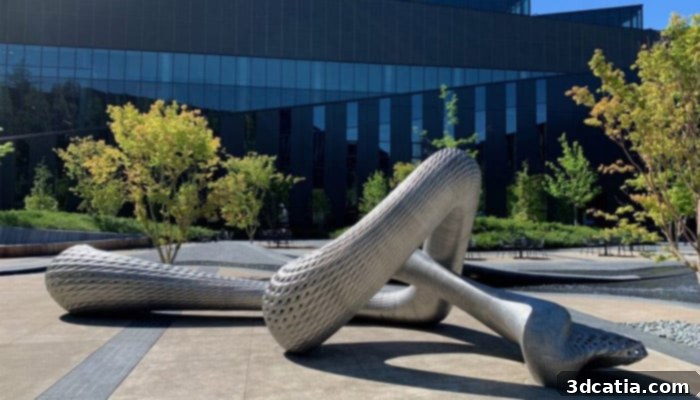
Photo Credits: Joris Laarman
Structural Ingenuity and Material Efficiency: The Power of Topological Optimization
Beyond its undeniably captivating visual presence, the “Oregon Dragon Bench” represents a triumph of advanced structural engineering. Joris Laarman meticulously integrated a sophisticated structural gradient into its design, a cutting-edge technique that guarantees optimal stability and robust structural integrity while simultaneously minimizing the overall weight of the bench. This highly sophisticated approach was achieved through the intelligent application of topological optimization – a powerful computational design methodology that intelligently identifies the most efficient and effective distribution of material within a predefined design space, based on anticipated load conditions.
In essence, topological optimization allowed Laarman and his dedicated team to perform comprehensive simulations under various load scenarios, pinpointing with absolute precision exactly where material was indispensable to maintain structural integrity. This iterative process systematically helps to eliminate superfluous material from areas that experience minimal stress, resulting in a significantly lighter, more resource-efficient, and inherently sustainable structure. For the Oregon Dragon Bench, this meant crafting a design where strength is strategically concentrated in critical load-bearing zones, while other areas are gracefully sculpted with a more open, almost skeletal, and airy aesthetic. The ultimate result is a piece that is both remarkably robust and exquisitely elegant, utilizing material judiciously and aligning perfectly with the core principles of sustainable design and advanced engineering.
The thoughtful integration of topological optimization contributes far more than just structural efficiency; it plays a pivotal role in defining the bench’s unique and compelling visual language. The organic, almost biomimetic patterns and flowing lines that emerge as a direct consequence of this optimization process bestow upon the bench its distinctive texture and dynamic form. This profound synergy between sophisticated analytical tools and unparalleled artistic expression is what truly elevates the Oregon Dragon Bench, demonstrating how complex computational methods can lead to both superior functional performance and breathtaking aesthetic beauty. It serves as a prime example of how digital design tools can liberate designers from the rigid constraints of traditional manufacturing, empowering them to create forms that are simultaneously structurally sound, aesthetically revolutionary, and environmentally conscious.
Unprecedented Efficiency in Fabrication: Surpassing Traditional Manufacturing Methods
The strategic implementation of MX3D’s groundbreaking 3D printing technology was instrumental in enabling Joris Laarman to fully realize the intricate, complex, and visually interwoven shapes that give the Oregon Dragon Bench its truly unique “loop-like” appearance. The benefits derived from this advanced manufacturing approach extended far beyond mere aesthetic possibilities. Laarman himself highlighted the significant reductions achieved in both manufacturing time and the associated production costs when compared to conventional fabrication methods. Traditional techniques, which often involve extensive manual welding, precise cutting, and laborious assembly of numerous individual components, would have been prohibitively time-consuming, immensely expensive, and technically challenging for such a complex, non-standard, and bespoke form.
Furthermore, the WAAM process demonstrated clear advantages over certain powder-based additive manufacturing techniques, particularly when it comes to the production of large-scale metal structures. While powder-bed fusion excels in producing extremely fine details and intricate internal geometries, WAAM offers vastly superior deposition rates and proves to be significantly more cost-effective for larger parts. This efficiency directly contributes to minimizing the overall production timeline and substantially reducing material waste. Although the precise weight and the exact production time for the Oregon Dragon Bench have not been publicly disclosed, the very existence of such a sophisticated and large-scale object, fabricated with remarkable speed and precision, speaks volumes about the outstanding accomplishments made possible by advanced robotic additive manufacturing.
This project serves as a compelling and undeniable case study for the burgeoning industrial applications of large-format 3D printing. It powerfully demonstrates how the intelligent integration of design innovation with manufacturing efficiency can lead to the creation of superior products that are simultaneously cost-effective, aesthetically captivating, and environmentally conscious due to meticulously optimized material utilization. The inherent ability to iterate on designs rapidly and to produce bespoke, architecturally significant pieces without the extensive and costly tooling traditionally associated with mass production opens up entirely new avenues for creators, engineers, and architects alike. It unequivocally underscores a fundamental paradigm shift in how large-scale metal structures can be conceived, intricately designed, and ultimately brought to life, strongly hinting at a future where customized, complex forms are not the exception, but rather the anticipated norm.
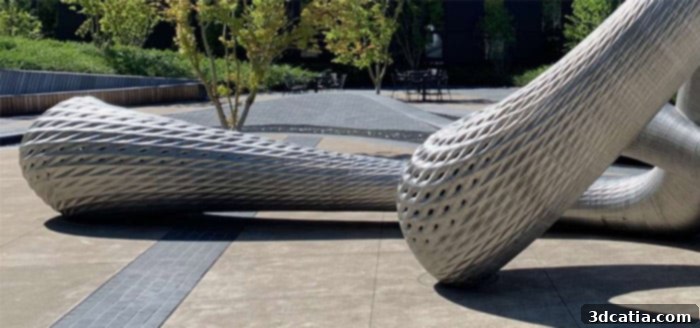
Photo Credits: Joris Laarman
The Broader Impact: Additive Manufacturing’s Role in Shaping Public Spaces and Sustainable Futures
The “Oregon Dragon Bench” represents much more than merely a sophisticated piece of street furniture; it makes a profound statement about the rapidly evolving landscape of design and fabrication. It powerfully exemplifies how additive manufacturing, particularly large-scale metal 3D printing, is fundamentally transforming public spaces and revolutionizing architectural design. Projects of this caliber, alongside MX3D’s globally recognized Amsterdam bridge, demonstrate an extraordinary capability to create structures that are not only highly functional but also serve as iconic artistic landmarks and stimulating conversation starters. They actively invite interaction, foster contemplation, and encourage a deeper, more meaningful connection between people and their surrounding urban environment.
The strategic deployment of such sophisticated and technologically advanced designs in prominent public areas, such as the prestigious Nike World Headquarters, signals a growing acceptance, enthusiastic adoption, and profound appreciation for cutting-edge technology within mainstream architecture and urban planning. It powerfully highlights the immense potential for bespoke, context-specific designs that are meticulously tailored to reflect and enhance the unique identity and character of a specific location, moving beyond the reliance on generic, mass-produced elements. This innovative approach not only significantly enriches the aesthetic quality and experiential value of public spaces but also prominently showcases the unwavering commitment of forward-thinking institutions like Nike to innovation, sustainability, and artistic expression.
Moreover, these pioneering projects contribute significantly to the ongoing and critical discourse about sustainable construction practices. By meticulously optimizing material use through advanced methodologies like topological optimization and dramatically minimizing the waste inherent in additive processes, MX3D and Joris Laarman are setting new, ambitious benchmarks for environmentally responsible and resource-efficient manufacturing. The ability to create durable, long-lasting metal structures with significantly reduced material input has profound and far-reaching implications for the future of urban infrastructure and public art worldwide, paving the way for a future filled with more eco-friendly, aesthetically captivating, and structurally innovative designs on a global scale.
Explore Further: Delving into the Innovative Worlds of Joris Laarman and MX3D
To truly appreciate the immense depth, intricate complexity, and expansive breadth of this groundbreaking project, we wholeheartedly encourage you to delve deeper into the extraordinary creative genius of Joris Laarman. His diverse body of work consistently explores and challenges the traditional boundaries at the intersection of art, science, and technology, continuously reshaping our perceptions of what is possible in design and manufacturing. Visiting the artist’s official website offers a comprehensive and enlightening look at his remarkable and varied portfolio, providing invaluable insights into how 3D printing and advanced design methodologies can be seamlessly and harmoniously combined to produce truly transformative and thought-provoking pieces.
In parallel, MX3D continues to stand as a formidable driving force in the dynamic realm of Wire Arc Additive Manufacturing, consistently demonstrating its impressive capabilities and broad applicability across a multitude of diverse industries, ranging from innovative construction and critical infrastructure development to specialized applications in the demanding oil and gas sectors. Their projects are far more than mere feats of engineering prowess; they are compelling visions of a future where complex, customized designs can be brought to fruition with unprecedented levels of efficiency, freedom, and precision.
The Oregon Dragon Bench stands as a powerful and enduring symbol of visionary collaboration, relentless innovation, and the virtually endless possibilities that emerge when forward-thinking design seamlessly converges with advanced manufacturing technology. It serves as a compelling invitation to fundamentally reconsider what public art can truly be and how transformative technology can effectively shape and enhance our built environment for a brighter, more innovative future.
What are your thoughts on the extraordinary Oregon Dragon Bench? We are genuinely eager to hear your unique perspective and insights on this remarkable fusion of art and technology. Please feel free to share your valuable comments below, or alternatively, engage with us and join the conversation on our vibrant social media platforms: LinkedIn, Facebook, and Twitter. For the very latest updates, breaking news, and fascinating developments in the ever-evolving world of 3D printing, don’t forget to subscribe to our completely free weekly Newsletter here, conveniently delivered straight to your inbox! You can also explore our extensive library of insightful videos and captivating content on our dedicated YouTube channel.
*Cover Photo Credits: Joris Laarman