
Nanofabrica’s Breakthrough: Redefining Precision Micro-3D Printing with Micron-Level Resolution
In the rapidly evolving landscape of additive manufacturing, achieving ultra-high precision at microscopic scales has long been a significant challenge. However, a pioneering Israeli company, Nanofabrica, has emerged as a game-changer, recently unveiling its revolutionary micron-level resolution industrial 3D printers: the Workshop System and the Industrial System. These cutting-edge machines are poised to transform the precision engineering sector by offering unprecedented accuracy and efficiency in micro-manufacturing. Nanofabrica’s patented process, which forms the core of these systems, masterfully integrates a sophisticated Digital Light Processing (DLP) engine with advanced Adaptive Optics (AO) technology, a technique traditionally employed to correct image distortions in high-power optical devices like telescopes, now repurposed to perfect print fidelity.
The flagship Industrial System machine stands out by boasting an astonishing one-micron resolution, a feat that sets a new benchmark in the additive manufacturing industry. This level of precision, combined with a robust 50 x 50 x 100 mm build volume, empowers manufacturers to produce thousands of intricately detailed micro-parts in a single, efficient build. Jon Donner, CEO of Nanofabrica, emphasizes the critical market shift driving this innovation: “There is an inexorable shift towards miniaturisation, with many applications demanding extremely exacting levels of micron and sub-micron precision on macro and micro parts, and there is huge potential for an AM platform that can service this trend.” His statement underscores the growing global demand for smaller, more complex components across numerous industries, a demand that conventional manufacturing methods often struggle to meet with the required precision and cost-effectiveness.
The Technology Behind Unprecedented Precision: DLP and Adaptive Optics
Nanofabrica’s technological prowess lies in its intelligent fusion of established DLP technology with advanced Adaptive Optics. DLP-based 3D printing works by projecting an entire layer of an object at once, curing a photosensitive resin with UV light. While efficient, achieving sub-micron resolution with standard DLP often introduces optical distortions that limit accuracy. This is where Adaptive Optics comes into play. Originating from astronomical telescopes where it corrects atmospheric distortions to produce sharper images, AO actively deforms a mirror or lens to compensate for aberrations in the optical path. In Nanofabrica’s system, this means dynamically adjusting the projected light to ensure each voxel (3D pixel) is perfectly formed, eliminating optical errors that would otherwise degrade resolution and part accuracy. This synergistic approach allows for precise control over the light polymerization process, enabling the creation of features previously thought impossible with additive manufacturing, revolutionizing the realm of high-resolution 3D printing.

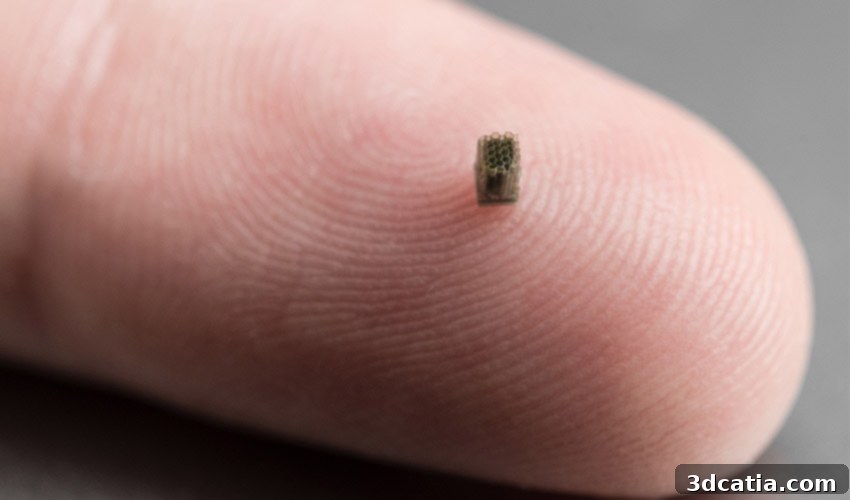
A meticulously crafted micro gear made from ABS material. This part measures 1.3 x 1.3 x 0.4mm, demonstrating Nanofabrica’s ability to produce intricate micro-components with exceptional precision and detail. | Image source: Nanofabrica
Addressing the Micro-Manufacturing Gap Since 2016
Founded in 2016, Nanofabrica has dedicated years to meticulous research and development, striving to bridge a critical gap in the manufacturing market. The company’s core mission has been to equip manufacturers with a technology capable of producing parts with exceptional levels of accuracy—specifically, at micron and sub-micron resolutions. This commitment stems from the recognition that traditional manufacturing processes, such as injection molding or CNC machining, often face severe limitations when attempting to create features below certain thresholds, or do so at exorbitant costs and with significant material waste. Nanofabrica’s approach offers a viable and scalable solution, enabling direct digital manufacturing of ultra-precise components that were once prohibitively expensive or technically unachievable. This makes complex micro-parts more accessible for various industries.
Diverse Applications Across Critical Industries
The implications of Nanofabrica’s micro-3D printing technology are vast and transformative, impacting a wide array of high-tech industries. For instance, in the realm of microelectronics, this technology is ideal for fabricating intricate casings, connectors, and tiny structural components that are essential for next-generation devices. As electronic devices continue to shrink while increasing in functionality, the demand for incredibly precise, bespoke micro-parts becomes paramount. Beyond protective casings, Nanofabrica’s printers can produce sophisticated micro springs, micro actuators, and micro sensors, which are vital for developing advanced robotics, complex optical systems, and highly sensitive detection equipment. These components require not just small size, but also exacting material properties and geometric accuracy to function reliably in demanding environments.
Furthermore, the medical field stands to gain immensely from this breakthrough. The ability to 3D print micron-level resolution parts opens up new possibilities for critical medical devices. This includes the manufacturing of highly precise micro valves for fluidic control in diagnostic equipment, miniaturized micro syringes for targeted drug delivery systems, and intricate micro implantable or surgical devices that require biocompatibility and exact anatomical fit. Such advancements can lead to less invasive procedures, improved patient outcomes, and entirely new therapeutic approaches. The customization potential of 3D printing also allows for patient-specific implants and tools, a significant leap forward in personalized medicine, fostering innovation in medical micro-devices.
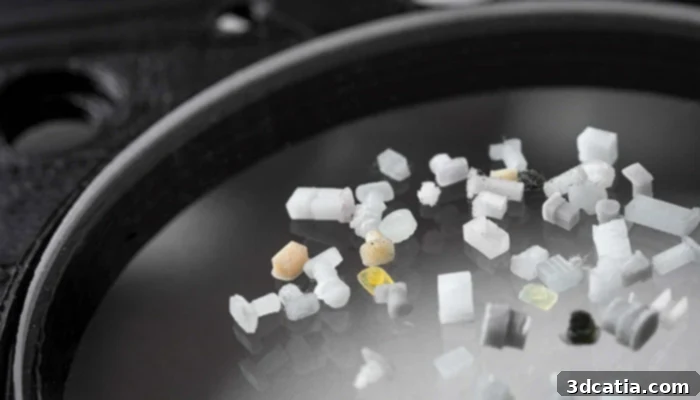
An impressive array of 3D printed parts, showcasing a variety of materials including three grades of ABS, three different grades of PP, and advanced ceramic-loaded compositions. This highlights Nanofabrica’s material versatility for diverse applications. | Image source: Nanofabrica
Overcoming Industry Limitations in Micro-Additive Manufacturing
Prior to Nanofabrica’s innovations, the additive manufacturing industry faced considerable hurdles in achieving truly fine resolutions. Jon Donner elaborates on these challenges: “To date, key AM platform developers have struggled to achieve a resolution under 50 microns, and the few micro-manufacturing AM technologies that exist are either extremely expensive in terms of machine and per-part costs, extremely slow, or have rigid size limitations.” This statement highlights the significant void Nanofabrica is filling. Traditional micro-AM techniques often involve trade-offs: high resolution typically comes at the expense of speed, cost, or part size. For example, some micro-SLA (Stereolithography) or two-photon polymerization systems offer high resolution but are extremely slow and limited to tiny build volumes, making mass production economically unfeasible. Nanofabrica’s systems aim to shatter these limitations, providing a platform that is not only precise but also scalable for industrial applications, thereby democratizing access to high-resolution micro-parts and fostering broader adoption of additive manufacturing.
Pioneering Advanced Materials for Precision 3D Printing
Beyond its groundbreaking hardware, Nanofabrica also recognizes that material innovation is paramount for unlocking the full potential of micro-3D printing. The company actively develops its own proprietary materials, specifically formulating them to optimize performance at micron-level resolutions. Their initial focus has been on commonly used engineering plastics such as ABS (Acrylonitrile Butadiene Styrene) and polypropylene (PP). These materials are crucial due to their excellent mechanical properties, chemical resistance, and widespread industrial adoption. ABS is valued for its strength, rigidity, and temperature resistance, making it suitable for functional prototypes and end-use parts. PP, on the other hand, offers flexibility, chemical inertness, and impact resistance, ideal for medical applications or living hinges. By controlling the material at a fundamental level, Nanofabrica ensures optimal flow, curing, and structural integrity for minuscule features.
Pushing the boundaries further, Nanofabrica has already demonstrated successful printing of parts with up to 80% ceramic-loaded materials. This is a significant achievement, as ceramic 3D printing at high resolutions presents unique challenges, including shrinkage control and debinding processes. The company is actively working towards achieving 100% ceramic materials with the same remarkable one-micron resolution. The ability to print pure ceramics with such precision would unlock applications in extreme environments, such as aerospace components requiring high heat resistance, biocompatible medical implants, or advanced electronic insulation, further expanding the versatility and impact of their additive manufacturing platform. This dual focus on both hardware and material science positions Nanofabrica as a comprehensive solution provider for the intricate demands of micro-manufacturing, including highly specialized advanced materials.
The Future of Miniaturization and Additive Manufacturing
Nanofabrica’s introduction of the Workshop System and Industrial System marks a pivotal moment in the evolution of additive manufacturing. By successfully achieving and commercializing micron-level resolution 3D printing, the company is not just creating new tools; it is enabling entirely new product categories and functionalities across various sectors. The capacity to rapidly prototype and mass-produce ultra-small, complex parts with unparalleled accuracy promises to accelerate innovation in fields ranging from consumer electronics to advanced biomedical engineering. This technology will allow designers and engineers to push the boundaries of miniaturization without compromising on performance or design freedom. The vision of smart, interconnected devices, sophisticated medical instruments, and high-performance micro-robotics moves closer to reality with every micron of precision gained.
This breakthrough underscores the potential of additive manufacturing to move beyond traditional prototyping and niche production into mainstream industrial applications, particularly where size and precision are critical. As industries continue to strive for greater efficiency, customization, and reduced material waste, Nanofabrica’s solutions offer a compelling answer. The ability to produce thousands of high-resolution parts in a single build cycle significantly lowers per-part costs and increases throughput, making advanced micro-manufacturing economically viable for a broader range of enterprises. This positions Nanofabrica at the forefront of the industrial 3D printing revolution.
To delve deeper into Nanofabrica’s innovative micro-3D printing solutions and explore their full potential for your precision engineering needs, please visit their official website HERE.
Stay connected and share your thoughts on this remarkable advancement! Let us know in a comment below or join the conversation on our Facebook and Twitter pages. For all the latest news and insights in the world of 3D printing, don’t forget to sign up for our free weekly Newsletter, delivered straight to your inbox!