

Pioneering Women in 3D Printing: Shaping the Future of Diverse Industries
In an era defined by rapid technological advancement, additive manufacturing, commonly known as 3D printing, has emerged as a transformative force across countless industries. From revolutionizing production processes to enabling unprecedented levels of customization and innovation, 3D printing is at the forefront of the next industrial revolution. Significantly, women are increasingly at the helm of this transformation, not only mastering these complex technologies but also spearheading their practical application in daily activities across all sectors. As we acknowledge the remarkable contributions of women in STEM and industry, this article shines a spotlight on some of the trailblazing women who are making profound impacts in key markets utilizing additive manufacturing. We delve into their diverse projects and the pivotal roles they play, often fueled by an unwavering passion for cutting-edge technologies, showcasing their leadership in fields such as aerospace, automotive, medical, construction, design, education, and oil & gas.
Aerospace
The aerospace sector demands unparalleled precision, reliability, and innovation, making it a critical area where additive manufacturing is redefining possibilities. Women engineers and leaders are essential in driving these advancements, pushing the boundaries of what is achievable in aircraft and spacecraft design and production.
Lucía Bayona, Air Systems and R&D Engineer at Airbus
Airbus stands as one of the global giants in aerospace, dedicated to the intricate design, meticulous manufacture, and strategic sale of airplanes and advanced aircraft. The company has been a pioneer in integrating additive manufacturing into its operations for several years, leveraging its potential for lighter, stronger, and more efficient components. In Spain, Lucía Bayona has distinguished herself as a leading figure in this specialized field. As both a systems engineer and an R&D professional, she focuses on metal additive manufacturing at Airbus. Her academic foundation, an Industrial Engineering program with a major in Mechanical Engineering from the prestigious Polytechnic University of Madrid, provided her with a robust understanding of complex mechanical systems. Lucía’s journey into 3D printing began at HiETA Technologies in London, where she gained invaluable knowledge and practical experience that she now expertly applies and further develops at Airbus. Her work involves optimizing air systems through advanced manufacturing techniques, ensuring both performance and safety critical to aerospace applications. Lucía’s significant contributions to Airbus and her involvement in groundbreaking additive manufacturing projects within aeronautics have rightfully earned her recognition as a prominent woman in the advanced manufacturing industry, inspiring future generations of engineers.
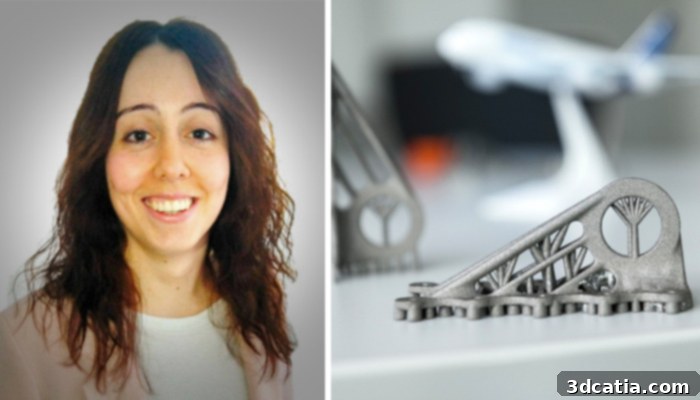
Photo Credits: Airbus
Dr. Melissa Orme, Vice President of Boeing Additive Manufacturing
Dr. Melissa Orme possesses an impressive track record, having been a pivotal figure in both the additive manufacturing and aerospace industries for many years. Her expertise and strategic vision led her to join Boeing in 2019 as Vice President of Additive Manufacturing. In this influential role, Dr. Orme has been instrumental in charting the growth and scaling of Boeing’s additive manufacturing capabilities. Her responsibilities include overseeing the significant increase in the production of 3D printed end-use parts, a testament to the technology’s evolving maturity and reliability in critical aerospace applications. A notable milestone under her leadership occurred in 2022, when Dr. Orme played a key role in the official opening of Boeing’s new Center of Additive Manufacturing Excellence (CoAME) in Auburn, Washington. Although technically operational since 2020, the formal inauguration was delayed until November 2022 due to pandemic-related restrictions. The CoAME is now a central hub responsible for the advanced design and manufacturing of a wide array of tools and parts for commercial aircraft, helicopters, spacecraft, and satellites, all leveraging the power of additive manufacturing. Dr. Orme’s work not only drives innovation but also reinforces Boeing’s commitment to cutting-edge production methods, ensuring components meet the highest standards of performance and safety in the demanding aerospace environment.
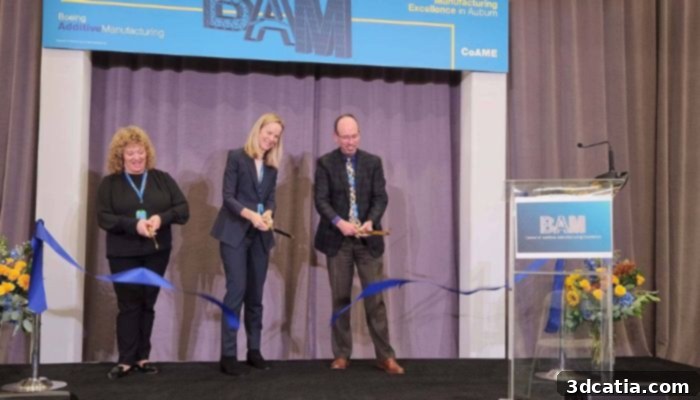
Dr. Melissa Orme (center) at the official opening of the Boeing Additive Manufacturing Facility (photo credits: Boeing/Hanneke Weitering)
Automotive
The automotive industry is rapidly adopting 3D printing to accelerate prototyping, reduce lead times, and create lightweight, complex parts. Women professionals are at the forefront of this revolution, integrating additive manufacturing into vehicle development and production pipelines.
Malini Dusey, Additive Manufacturing: Polymer Process Lead at General Motors
General Motors has been a proactive adopter of 3D printing, integrating the technology into various stages of its manufacturing processes, from rapid prototyping to the creation of functional end-use parts. Central to these advancements is Malini Dusey, a chief engineer and polymer process leader in additive manufacturing at General Motors. Since her tenure with the company, Malini has proven to be an indispensable member of the team, playing a crucial role in GM’s emergence as a leader in 3D printed automotive tooling. Her expertise is particularly significant in an industry historically dominated by men, where her experience and profound knowledge are enabling GM to implement sophisticated additive manufacturing processes. These processes are vital for producing innovative automotive components that are then seamlessly integrated into the company’s extensive network of assembly plants. Malini’s leadership in polymer additive manufacturing not only enhances GM’s operational efficiency and product innovation but also serves as a powerful testament to the impact and critical contributions of women in engineering and advanced manufacturing.
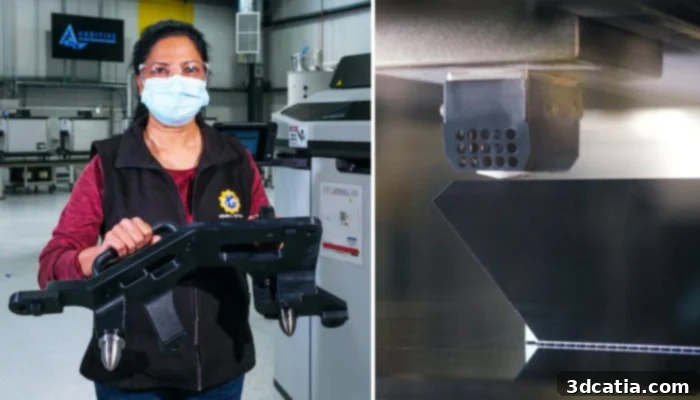
Photo Credits: GM
Dr. Ellen Lee, Technical Leader Additive Manufacturing Research at Ford
Dr. Ellen Lee stands as another highly influential figure in the realm of additive manufacturing within the automotive industry. As the Technical Leader for Additive Manufacturing Research at Ford Motor Company, she brings over 24 years of diverse experience within the company to her current role. Dr. Lee is unequivocally a pivotal force at Ford, where she has been instrumental in conceptualizing and developing the company’s comprehensive additive manufacturing strategy. Her strategic guidance has shaped numerous key projects, most notably establishing Ford’s dedicated AM research program back in 2014. This initiative significantly accelerated the adoption of 3D printing across Ford’s operations, extending its use to critical end-use parts. Beyond manufacturing innovation, Dr. Lee has also championed sustainability within the industry. A prime example of this commitment is a groundbreaking project where Ford collaborated with HP to recycle 3D printed waste materials. This recycled waste was then ingeniously repurposed to create automotive parts for Ford’s robust Super Duty F-250 trucks, demonstrating a circular economy approach in additive manufacturing. Dr. Lee’s work underscores the immense potential of 3D printing not just for performance enhancement, but also for fostering environmentally responsible manufacturing practices in the automotive sector.

Dr. Ellen Lee (left) with other members of the Ford Additive Manufacturing Research team (photo credits: Ford)
Construction
3D printing in construction offers revolutionary potential for faster, more sustainable, and cost-effective building processes. Women entrepreneurs and visionaries are leading this frontier, from large-scale housing projects to humanitarian initiatives.
Anna Cheniuntai, CEO and Founder of Apis Cor
Anna Cheniuntai embarked on an extraordinary entrepreneurial journey after graduating with a bachelor’s degree in Space Physics in 2014. Driven by a vision to transform the construction industry, she founded Apis Cor, a pioneering company specializing in robotic 3D printers for the construction sector. Headquartered in the United States, Apis Cor has rapidly ascended to become one of the industry’s leaders, consistently impressing with its innovative 3D printing technologies and advanced material applications. A monumental achievement for the company, under Anna’s guidance, was the construction of the world’s largest 3D-printed building in Dubai in 2019, a feat that garnered an entry in the prestigious Guinness Book of World Records. This project showcased not only the scalability but also the structural integrity and aesthetic potential of 3D printed construction. Looking ahead, Anna Cheniuntai’s ambitious vision extends beyond Earth; she aims to make 3D-printed house construction a reality not only on our planet but also on the Moon and Mars, pushing the boundaries of what is possible in extraterrestrial habitat development. Her work at Apis Cor is a testament to how innovative thinking can disrupt traditional industries and open doors to unprecedented future possibilities.
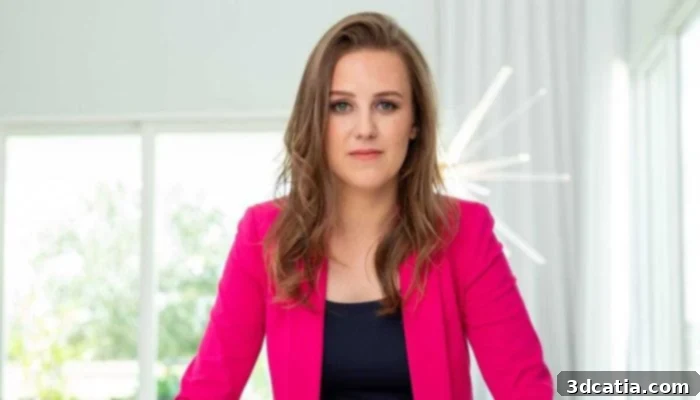
Photo Credits: Medium
Maggie Grout, the Young Visionary Behind Thinking Huts
Maggie Grout is the inspiring founder and CEO of Thinking Huts, a non-profit organization that ingeniously merges the capabilities of 3D printed construction with the vital mission of expanding access to education. Through her innovative company, Grout aims to address the global challenge of educational inequality by leveraging humanitarian-driven technology solutions. Thinking Huts utilizes additive manufacturing to build 3D printed schools in underserved communities where educational infrastructure is desperately needed. A significant milestone for the organization was the successful completion of its pilot project: a fully functional 3D printed school in Fianarantsoa, Madagascar. This achievement not only demonstrated the viability of 3D printed schools but also highlighted their potential to provide safe and modern learning environments quickly and efficiently. Maggie Grout, alongside her dedicated team, is far from finished. They have ambitious plans for constructing even more 3D printed schools across Madagascar and other regions. Grout continues to advocate for and implement the use of 3D printed construction, striving to create schools that are not only rapidly built but also utilize locally-sourced materials, thereby increasing educational opportunities for all and fostering community empowerment.
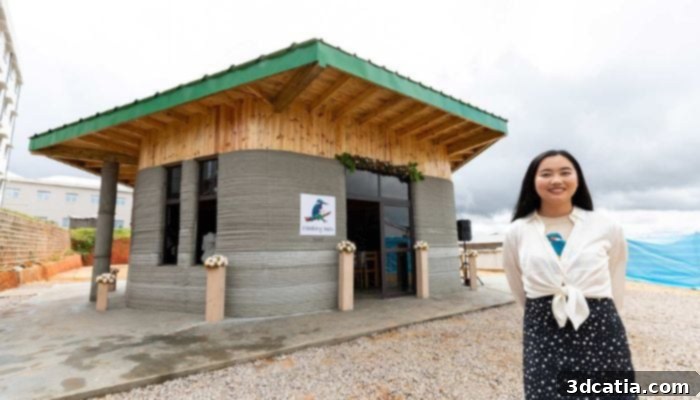
Photo Credits: Thinking Huts/Geoffrey Gaspard and Mattea LinAe
Design/Fashion
In the realms of design and fashion, 3D printing offers unprecedented creative freedom, enabling designers to produce intricate geometries, custom fits, and innovative textures that were once impossible. Women designers are leading this artistic and technological fusion.
Anouk Wipprecht, a FashionTech Designer
Anouk Wipprecht is renowned for her groundbreaking work as a FashionTech designer, consistently integrating cutting-edge technologies into her captivating creations. She is a pioneer in combining 3D printing with artificial intelligence (AI) and robotics to produce truly interactive and futuristic garments. Her designs transcend traditional fashion, blurring the lines between clothing, technology, and art. In a recent high-profile project, the visionary Dutch designer unveiled a collection of her futuristic 3D printed dresses at an event in New York. These remarkable pieces, reminiscent of sentient robots, were crafted in collaboration with Shapeways, utilizing advanced techniques such as Selective Laser Sintering (SLS) and Multi Jet Fusion (MJF) to achieve intricate details and complex forms. Anouk’s past innovations include a 3D printed dress capable of extracting data from the wearer’s brain, visually reflecting their thoughts and emotions, and a unique 3D printed proximity dress designed to facilitate social distancing through embedded sensors. Her work continually challenges perceptions of what clothing can be, positioning her at the forefront of fashion innovation and demonstrating the immense potential of additive manufacturing in creative expression.
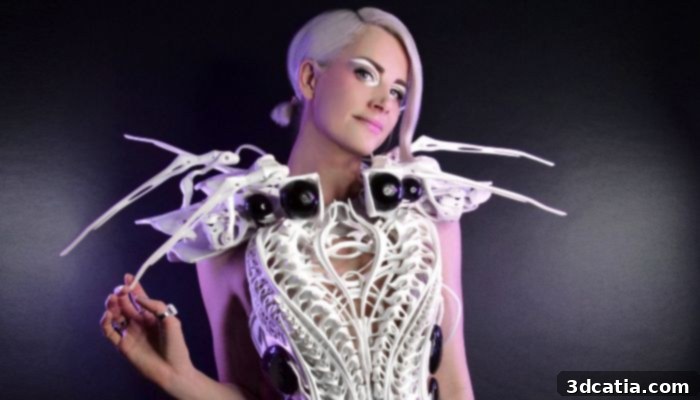
Anouk Wipprecht in a dress containing microcontrollers that was at least partly made using 3D printing (photo credits: Anouk Wipprecht)
The Designer Sophy Wong
Sophy Wong is a highly innovative and multidisciplinary designer who masterfully specializes in the intricate intersections of the garment industry and digital manufacturing. Her approach is characterized by a deep engagement with cutting-edge techniques, consistently focusing on projects that push the boundaries of conventional design towards the futuristic. Sophy’s work often explores how technology can enhance aesthetics and functionality in fashion. Recently, she designed an extraordinary dress that was entirely 3D printed from PLA, a versatile and biodegradable polymer. This remarkable garment was composed of two primary pieces, meticulously constructed from individual 3D printed panels. Demonstrating a thoughtful blend of digital fabrication and traditional craftsmanship, the dress was elegantly lined with silk and featured two transparent zippers at the back, adding both practicality and a modern aesthetic. Sophy Wong’s creations exemplify the transformative power of 3D printing in fashion, allowing for unparalleled geometric complexity, bespoke textures, and personalized design, making her a compelling voice in the evolving narrative of digital couture.
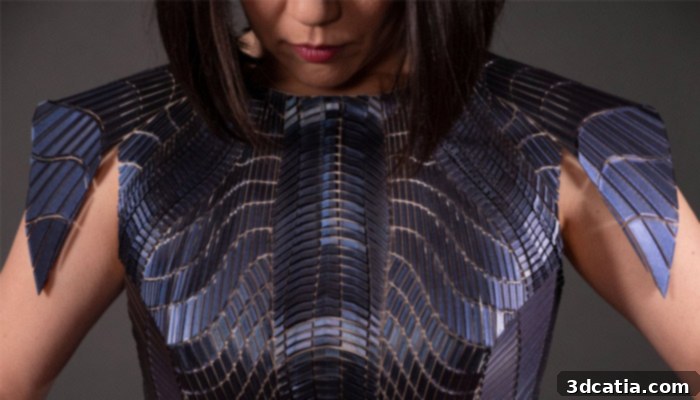
Sophy Wong and her 3D printed dress (photo credits: Sophy Wong)
Education/Research
In education and research, 3D printing serves as an invaluable tool for hands-on learning, complex visualization, and experimental fabrication. Women researchers and educators are utilizing this technology to inspire, innovate, and make abstract concepts tangible.
Amy Elliott, 3D Printing Scientist at Oak Ridge National Laboratory
Dr. Amy Elliott, a distinguished 3D printing scientist, earned her PhD at Virginia Tech, where she notably managed the DreamVendor, a pioneering initiative recognized as the world’s first 3D printing vending machine. This early project showcased her innovative spirit and deep understanding of additive manufacturing’s accessibility potential. Currently, Dr. Elliott is a vital member of the R&D staff at Oak Ridge National Laboratory (ORNL), a premier research institution where additive manufacturing plays a significant role in scientific advancements. At ORNL, her research focuses intensely on inkjet-based metal and ceramic 3D printing, exploring novel materials and processes that can revolutionize various industrial applications. Beyond her laboratory work, Amy is also a prominent science figure on the popular television show “Outrageous Acts of Science,” where she adeptly deciphers viral videos, explaining the underlying engineering and scientific principles behind seemingly impossible feats. Last year, Dr. Elliott received widespread recognition for her dedicated efforts in advancing STEM education. Her contributions were further celebrated when she was selected as one of 120 women to have a 3D printed statute featured in the groundbreaking IfThenSheCan exhibit at the Smithsonian, cementing her legacy as an inspiring role model in science and technology.
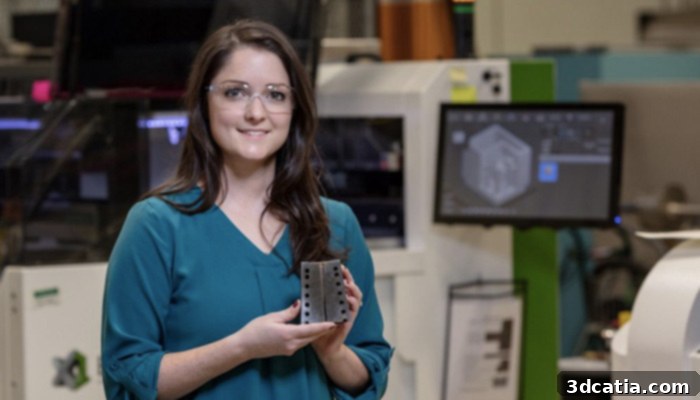
Photo Credits: ORNL
Dr. Alex Pillen, Associate Professor of Anthropology of Language at UCL
One particularly insightful application of 3D printing lies in its ability to transform abstract or elusive concepts into clear, tangible models, making complex subjects more accessible and easier to comprehend. Dr. Alex Pillen, an Associate Professor in the Anthropology of Language at University College London (UCL), has brilliantly utilized this capability in her research. Collaborating with Emma-Kate Matthews from the Archaeological School at the same university, Dr. Pillen embarked on an innovative project to create 3D printed language models of endangered languages. The duo meticulously designed and produced physical 3D models representing four distinct minority languages. These models effectively mapped and highlighted the unique grammatical features of each language, providing a physical representation of their linguistic singularity. This pioneering approach allows individuals to establish a more profound and tangible connection with these threatened tongues, fostering greater understanding and appreciation. For the creation of these intricate models, Dr. Pillen and her team employed sophisticated design software such as Grasshopper and Rhino3D. The initial prototypes were printed using PA12 material through the Selective Laser Sintering (SLS) process, ensuring precision and durability for these unique educational tools.
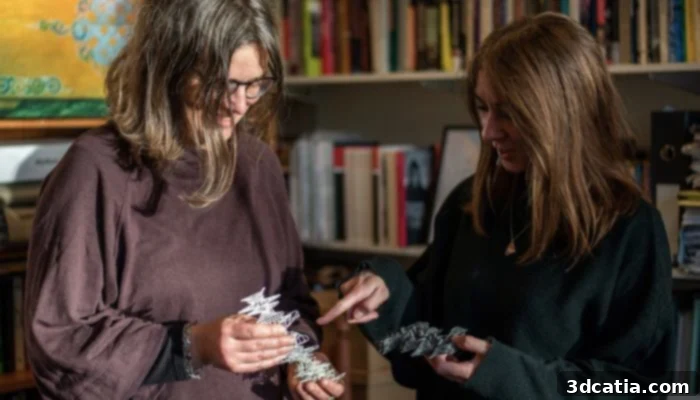
Dr. Pillen (left) and Emma-Kate Matthews holding their language models (photo credits: Mike Lucibella/UCL)
Medical
In the medical field, 3D printing is transforming patient care through personalized prosthetics, anatomical models for surgical planning, and innovative medical devices. Women in healthcare and engineering are driving these life-changing applications.
Dr. Teresa Flaxman, Senior Clinical Research Associate at the Ottawa Hospital Research Institute
Dr. Teresa Flaxman, a distinguished Senior Clinical Research Associate at the Ottawa Hospital Research Institute, made a groundbreaking contribution to medical science in 2021 by pioneering the use of 3D models for gynecologic surgery. Her innovative work involved a close collaboration with the Institute’s dedicated 3D Printing Lab team. Together, they created a precise physical 3D model of the uterus of a woman preparing for surgery. This highly accurate model provided the surgical team with an unprecedented visual and tactile understanding of the organ’s intricate anatomy, allowing for meticulous pre-operative planning. Crucially, this advanced planning enabled the patient to avoid a major surgical procedure, specifically the complete removal of the uterus, opting instead for a minimally invasive approach. The 3D printing process for this complex model took approximately 14 hours, a testament to the detail and accuracy required. Driven by the success of this pioneering case, Dr. Flaxman and her team are committed to expanding their work with the 3D Printing Lab. Their goal is to offer similar minimally invasive gynecological surgical options to more women, significantly improving patient outcomes, reducing recovery times, and enhancing the quality of healthcare through personalized, cutting-edge technology.
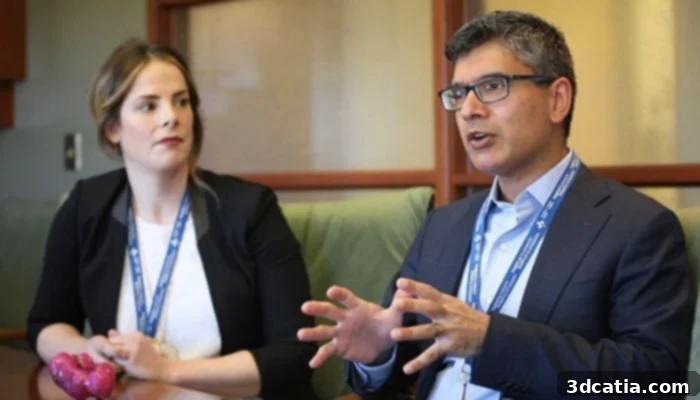
Dr Flaxman (left) worked with Dr Sony Singh on the project (photo credits: The Ottawa Hospital Foundation)
Maureen Mulvihill, CEO of Actuated Medical
Maureen Mulvihill is the visionary CEO of Actuated Medical, a dynamic company dedicated to creating personalized medical devices that significantly enhance patient care. Her leadership is currently focused on an exciting 3D printing project, collaborating with an all-women team of brilliant researchers from the University of Texas and Penn State. This groundbreaking initiative aims to develop advanced pediatric ventilation devices, alongside other innovative medical instruments that possess the remarkable capability to alter their shape according to specific clinical needs. The immense potential of their work was recognized with a substantial $2 million grant from the National Science Foundation (NSF)’s Leading Engineering for America’s Prosperity, Health and Infrastructure (LEAP-HI) program. This critical funding allows the team to significantly expand the capabilities of their 3D printing project, pushing the boundaries of what personalized medical devices can achieve. This builds upon Actuated Medical’s impressive track record, which includes previous grants awarded for their successful development of 3D printed patient-specific masks and face shields. Maureen Mulvihill’s work at Actuated Medical underscores the profound impact of women in biotech and engineering, particularly in addressing critical healthcare needs through innovative additive manufacturing solutions.
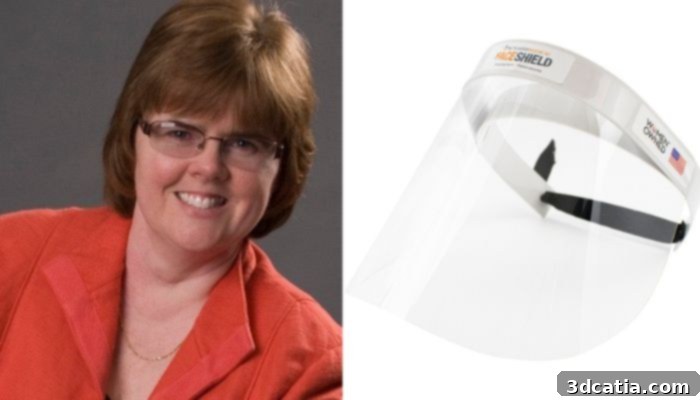
Maureen Mulvihill and Acutated Medical have previously made 3D printed patient-specific masks and nasal prongs (photo credits: Actuated Medical)
Oil & Gas
The oil & gas sector, traditionally conservative, is embracing 3D printing for rapid prototyping of complex components, on-demand part production for remote sites, and innovative solutions for sustainability. Women leaders are helping drive this critical shift towards efficiency and modernization.
Lisa Kieft-Leenders, Team Leader of 3D Printing at Shell
In industries such as oil and gas, women have historically been significantly underrepresented. This makes the contributions of figures like Lisa Kieft-Leenders particularly noteworthy and inspiring. After successfully completing her Master’s degree in Product Development in the Netherlands, Lisa began her professional journey as a 3D printing engineer. Her innate talent and dedication quickly propelled her upwards, leading her to assume team leader roles at various prominent 3D printing manufacturers. Today, Lisa is a key asset at Shell, a global energy and petrochemical company based in Amsterdam. In her multifaceted role, she is not only responsible for overseeing mechanical workshops but also serves as the dynamic team leader for additive manufacturing. Her leadership is crucial in integrating 3D printing technologies into Shell’s operations, enhancing efficiency, and fostering innovation. Furthermore, Lisa Kieft-Leenders is actively involved with her colleagues in pioneering initiatives aimed at leveraging 3D printing to make the energy industry more sustainable. Her work demonstrates how advanced manufacturing can contribute to environmental responsibility, proving that women are not only breaking barriers in traditionally male-dominated sectors but are also steering them towards a more innovative and sustainable future.
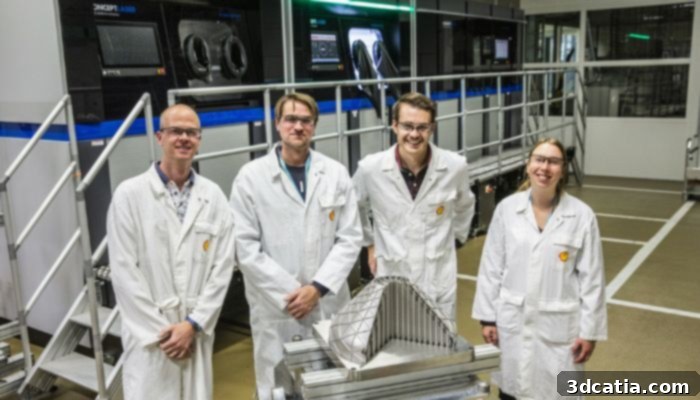
Lisa Kieft-Leenders with her colleagues at the Energy Transition Campus Amsterdam (photo credits: Shell)
Valeria Tirelli, President and CEO of AIDRO
Continuing within the vital oil & gas sector, Valeria Tirelli has emerged as a prominent and influential figure, particularly recognized across Europe. As the President and CEO of AIDRO, a specialized company in fluid power, Valeria has steered the company towards pioneering additive manufacturing of complex metal parts. These advanced components cater not only to the demanding oil & gas sector but also extend to hydraulics, aerospace, and general energy applications, showcasing the versatility and high performance of AIDRO’s offerings. Inheriting the leadership of the company from her father in 2012, Valeria has been the driving force behind AIDRO’s continuous growth and strategic development. Her unwavering commitment to additive manufacturing was further solidified when AIDRO joined Desktop Metal in 2021, a move that significantly bolstered the company’s capabilities and market presence in advanced manufacturing. Beyond her corporate leadership, Valeria is also the impactful Area Manager Italy for Women in 3D Printing (Wi3DP), the world’s largest organization dedicated to promoting and supporting the presence of women in the additive manufacturing industry. In this crucial capacity, she consistently champions the cause, actively organizing events, fostering networking opportunities, and sharing invaluable insights to boost the growth and visibility of the Italian female AM community, making her a true leader and advocate.
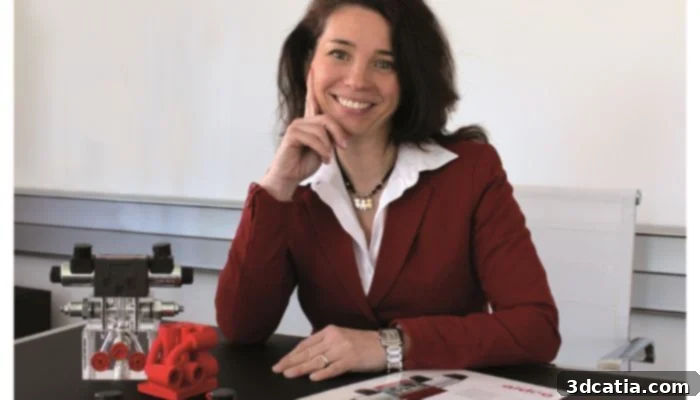
Photo Credits: Valeria Tirelli
The remarkable women highlighted in this article exemplify the profound impact and invaluable contributions of female leaders in the rapidly evolving world of additive manufacturing. From the precision demands of aerospace to the creative frontiers of fashion, and from life-saving medical innovations to sustainable solutions in oil & gas, these women are not just adapting to new technologies; they are actively shaping the future of their respective industries. Their passion, expertise, and dedication are driving innovation, breaking down barriers, and inspiring countless others to pursue careers in STEM and advanced manufacturing. Their stories underscore a powerful narrative of diversity fostering excellence and ingenuity. We hope their work encourages dialogue and further recognition of women’s pivotal roles in crucial sectors. What do you think of these trailblazing women who are leading the adoption of 3D printing? Have you seen their inspiring work before? Let us know in a comment below or connect with us on our LinkedIn, Facebook, and Twitter pages! Don’t forget to sign up for our free weekly Newsletter here to receive the latest 3D printing news straight to your inbox! You can also find all our engaging videos on our YouTube channel, offering more insights into the world of additive manufacturing.