
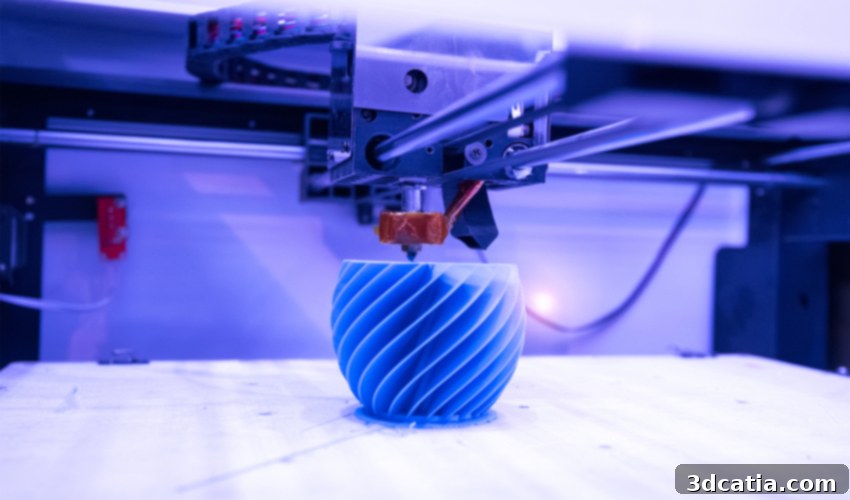
MIT Breakthrough: Laser-Assisted FDM 3D Printer Achieves 10x Faster Speeds, Revolutionizing Additive Manufacturing
Engineers at the renowned Massachusetts Institute of Technology (MIT) have unveiled a groundbreaking innovation in additive manufacturing: a new FDM 3D printer that operates with unprecedented speed. Leveraging the power of laser technology, this advanced machine prints an astonishing 10 times faster than conventional office-grade FDM printers. While incorporating a laser, the core process remains fundamentally a fused deposition modeling technique, pushing the boundaries of what was previously thought possible within this widely adopted 3D printing method. This development signifies a monumental leap, especially considering recent advancements that merely aimed to double printer speed; MIT’s achievement is truly in another league. The secret lies in a meticulously designed print head that integrates both a sophisticated laser and an innovative screw mechanism, synergistically boosting the machine’s operational velocity and efficiency.
The cornerstone of this revolutionary 3D printer is its meticulously engineered extruder, a testament to the ingenuity of two brilliant MIT students. Unlike traditional FDM systems that rely solely on resistive heating elements, this new design incorporates a laser for melting the filament. This integration of laser technology is reminiscent of processes found in other high-precision additive manufacturing techniques such as stereolithography (SLA) or The quest for faster 3D printing has long been a driving force in additive manufacturing research. Traditional FDM printers, while affordable and versatile, are often hampered by inherent speed limitations primarily stemming from the rate at which filament can be heated, melted, and precisely extruded. The MIT team, building on a foundation of deep academic inquiry—as evidenced by MIT’s recent offering of a3D printing university course—approached this challenge by reimagining the extrusion process itself. Instead of relying on conventional resistive heaters and simple push mechanisms, their FDM printer employs an extruder featuring a laser-assisted screw mechanism. This sophisticated setup functions by rapidly feeding the plastic filament into the nozzle while the laser concurrently and instantly heats and melts the material. This simultaneous action of mechanical feeding and precise laser heating is critical to unlocking the printer’s extraordinary speed capabilities.
The Mechanics Behind the Speed: Laser and Screw Mechanism Explained
At the heart of this innovation is the synergy between the laser and the novel screw mechanism. In standard FDM, the print head heats up a small section of the filament, relying on thermal conduction to melt the plastic before it’s pushed through the nozzle. This process is inherently slow due to the time required for heat transfer. The MIT approach bypasses this bottleneck by having the laser directly and almost instantaneously melt the filament just before it exits the nozzle. This targeted, rapid heating ensures that the material is at the optimal temperature for extrusion without waiting for a large thermal mass to heat up. Furthermore, the innovative screw mechanism takes the place of the traditional pushing systems found in most FDM print heads. These traditional mechanisms often struggle to maintain consistent and strong extrusion force at high speeds, leading to issues like filament skipping, inconsistent flow, or loss of layer adhesion. The screw mechanism, akin to an industrial extruder, provides a continuous, powerful, and precise feed, allowing for much higher volumetric melt rates without degradation in performance.
To further optimize this high-speed process, the MIT team also developed a specially formulated filament. This material is designed to work in conjunction with the laser and screw mechanism, featuring enhanced adhesion properties that are crucial for rapid layering and robust part creation. The improved adhesion ensures that even at significantly increased print speeds, the successive layers bind together effectively, maintaining the structural integrity and quality of the final print. The rapid and efficient heating by the laser, combined with the powerful and consistent feeding of the screw mechanism, fundamentally transforms the FDM process. The laser heats and melts the filament instantaneously as it approaches the nozzle, ensuring that a perfectly molten and controlled stream of material is always available for deposition, eliminating the lag and inconsistencies common in high-speed traditional FDM operations.
This MIT-developed 3D printer is poised to significantly accelerate manufacturing and prototyping processes.
Solving Critical FDM Printer Problems: A Holistic Approach
The traditional limitations of FDM technology have often confined it to prototyping and hobbyist applications, primarily due to its relatively slow printing speeds and challenges in scaling for industrial production. John Hart, an MIT student and one of the brilliant minds behind this printer’s creation, firmly believes that this innovation could fundamentally transform FDM into a far more viable and competitive production technique. Imagine a scenario where a complex part that once took an hour to print can now be completed in a mere six minutes. This dramatic reduction in print time opens up a vast array of new opportunities across various industries, from enabling rapid iteration in product development to facilitating on-demand manufacturing in factories. Companies could more easily and quickly print essential spare parts, minimizing downtime and streamlining supply chains. Beyond industrial applications, Hart also highlights the potential of this high-speed FDM 3D printer as a critical solution in urgent scenarios, such as medical emergencies, where rapid custom part fabrication could be life-saving.
The creators of this advanced system meticulously designed it to address three long-standing and interconnected problems commonly associated with FDM technology: inherently slow speeds, inadequate extrusion force, and inefficient heat transfer within the print head. John Hart elaborated on their methodical approach, stating, “Given our understanding of what limits these three variables, we wondered how we could design a printer ourselves that would improve all three in one system. We developed it and it works pretty well.” This holistic design philosophy means that the laser-assisted screw mechanism isn’t just a band-aid solution; it’s a fundamental re-engineering of the FDM process. The laser ensures rapid and efficient heat transfer directly to the filament, solving the slow heating problem. The powerful screw mechanism provides a consistent and high extrusion force, overcoming the limitations of traditional push systems. And the combination of these two elements, supported by specially developed materials, directly leads to the exponential increase in printing speed. This integrated solution promises to elevate FDM from a prototyping tool to a robust and rapid manufacturing technology.
Transformative Applications and Future Outlook of High-Speed FDM
The implications of a 10x speed increase in FDM 3D printing are profound and far-reaching. In industrial settings, this technology could revolutionize production workflows. Rapid prototyping, which is already a strength of 3D printing, becomes even faster, allowing designers and engineers to iterate through more designs in a fraction of the time, accelerating product development cycles. Furthermore, the ability to print complex parts quickly could enable on-demand manufacturing for end-use components, reducing the need for large inventories and extensive tooling. Imagine a factory that can print critical spare parts on-site, immediately addressing equipment failures and minimizing costly downtime. This localized, rapid production capability also has significant economic advantages, potentially lowering manufacturing costs, optimizing supply chains, and fostering localized production.
In the medical field, the impact could be truly transformative. During medical emergencies, custom prosthetics, surgical guides, or even anatomical models for pre-surgical planning could be fabricated within minutes rather than hours. This speed is critical when patient outcomes depend on immediate intervention and highly personalized solutions. For instance, a custom implant needed for an urgent surgery could be designed, printed, and prepared while the patient is being prepped, significantly improving response times and patient care. Beyond emergencies, this rapid manufacturing capability could also democratize access to customized medical devices, making personalized healthcare more efficient and affordable.
The MIT innovation also underscores the ongoing commitment of leading academic institutions to advancing additive manufacturing. By pushing the boundaries of FDM, this research inspires further innovation in materials science, mechanical engineering, and control systems for 3D printing. As this technology matures, we can anticipate more efficient and powerful desktop 3D printers, making high-speed, high-quality additive manufacturing accessible to a broader audience, from small businesses to educational institutions. While the immediate focus is on speed, future research might explore expanded material compatibility, even finer resolution at high speeds, and further automation to integrate these printers into fully autonomous manufacturing lines. This laser-assisted FDM printer represents not just a faster way to print, but a significant step towards fully realizing the potential of additive manufacturing for widespread industrial and societal benefit.
To truly appreciate the operational efficiency and speed of this innovative 3D printer, observe its capabilities in action:
For those interested in a deeper dive into the scientific specifics of this new 3D printer and its underlying principles, you can access the comprehensive study here. Furthermore, to explore and compare a diverse range of FDM 3D printers, including those offering advanced features, you can utilize our dedicated Comparator here.
We value your insights and opinions on the current state and future of 3D printing technology, particularly regarding innovations like MIT’s laser-assisted FDM. Please share your thoughts in a comment below or engage with our community on our Facebook and Twitter pages! Don’t miss out on the latest advancements and breaking news in the additive manufacturing world; make sure to sign up for our free Newsletter, delivering all the essential updates straight to your inbox!