
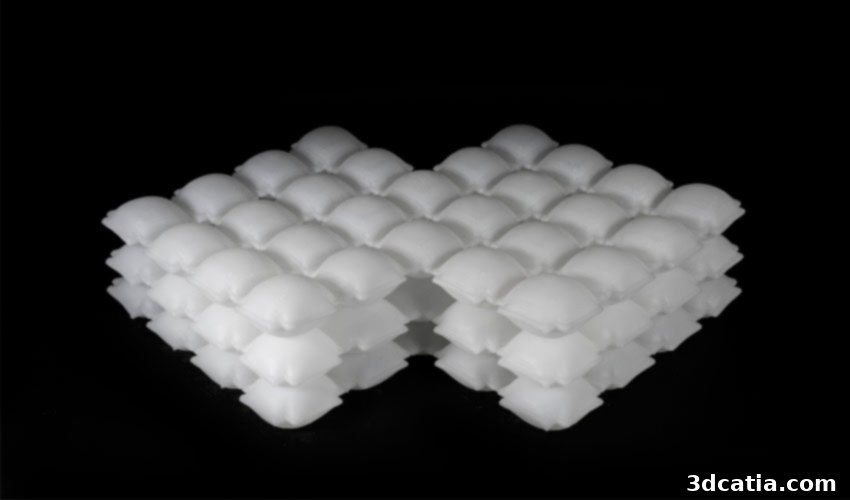
Revolutionizing Automotive Design: BMW and MIT Unveil Inflatable Liquid 3D Printing Material
The world of additive manufacturing continues to push the boundaries of what’s possible, and a groundbreaking collaboration between automotive giant BMW and the innovative MIT Self-Assembly Lab has once again demonstrated this limitless potential. Together, they have revealed an ambitious project centered around an “inflatable liquid material” designed for 3D printing, a development that promises to redefine how structures can transform in both shape and size. This cutting-edge research has culminated in what both partners proudly claim to be the first liquid and pneumatic 3D printing material, presenting immense potential, particularly within the automotive sector and beyond.
This pioneering work represents a significant leap forward in smart materials and adaptive design. Unlike traditional manufacturing methods that yield static forms, this novel approach enables dynamic, responsive objects capable of on-demand changes. Imagine vehicle interiors that adapt to passenger needs, or components that can alter their aerodynamic profile. The implications of such a material are vast, signaling a new era for programmable matter and highlighting the synergistic power of combining industrial innovation with academic research excellence.
The past few years have witnessed a surge in research dedicated to advanced 3D printing materials, exploring possibilities ranging from medical implants to acoustic metamaterials. For instance, recent advancements include 3D printed liquid silicone, which offers biocompatibility and elasticity for various applications, and metamaterials designed to precisely control sound and vibrations, opening doors for noise reduction and innovative sensor technologies. MIT, a well-established leader in additive manufacturing research, has a rich history of contributing to this field, with previous projects often focusing on groundbreaking substances like graphene. However, in this latest endeavor, the prestigious institution has partnered with BMW, shifting their focus specifically to the intricacies and transformative power of liquid materials. This collaboration, built on two years of intensive studies and rigorous experimentation, has finally borne fruit, with the partners now ready to unveil their remarkable results to the global scientific and industrial communities.
The collaborative spirit between BMW, renowned for its engineering prowess and forward-thinking automotive design, and MIT’s Self-Assembly Lab, celebrated for its pioneering work in programmable materials and self-transforming systems, provided fertile ground for this innovation. Their shared vision of creating truly adaptive and responsive physical structures led them down the path of liquid-based additive manufacturing. This long-term commitment underscores the complexity of developing such a novel material and validates the meticulous approach taken to ensure its viability and potential for real-world application, especially in demanding environments like the automotive industry where safety, performance, and comfort are paramount.
Photo Credits: BMW
Liquid Materials Pave the Way for Dynamically Inflatable Structures
At the heart of this innovation lies the ingenious method for creating these 3D printed pneumatic structures. The process involves depositing successive layers of liquefied materials—such as specialized rubber, foam, or plastic compounds—into a carefully controlled vat of gel. This support gel plays a crucial role, acting as a temporary scaffolding that precisely holds the liquid material in place as it is extruded. This innovative technique, often referred to as Direct Ink Writing (DIW) within a support bath, is essential for overcoming the challenges associated with printing with low-viscosity or non-self-supporting liquid polymers. By providing buoyancy and stability, the gel allows researchers to build highly intricate and complex objects with internal voids and chambers, which would otherwise collapse under their own weight during the printing phase. The liquid material gradually solidifies, or cures, within the gel bath, eventually retaining its programmed shape once removed and hardened. This approach is fundamental to achieving the desired flexibility and structural integrity required for the dynamic inflation mechanism.
The careful selection of materials and the precise control over the deposition process are critical for the functionality of these smart structures. The chosen liquefied compounds must possess specific properties, including tunable viscosity during printing, controlled curing mechanisms (e.g., UV-light, heat, or chemical reaction), and desirable mechanical properties in their solidified state, such as elasticity, durability, and airtightness. These characteristics are paramount for ensuring that the printed structures can withstand repeated inflation and deflation cycles without material fatigue or degradation, making them suitable for long-term applications.
Programmable Pneumatics: Shaping the Future with Air
To bring these inflatable structures to life, the researchers primarily utilized a specialized silicone rubber. This material was carefully chosen for its inherent flexibility, resilience, and excellent airtight properties, which are essential for creating durable pneumatic systems. The 3D printing process allows for the intricate design of internal air chambers and pathways within the structure. These precisely engineered air chambers are the key to the material’s transformative capabilities. By selectively introducing or releasing air pressure into these chambers, the structures can inflate, deform, and reconfigure, taking on a multitude of different forms and adjusting their levels of firmness or stiffness. This dynamic response enables a new paradigm in material functionality, moving beyond static objects to truly adaptive components.
Skylar Tibbits, the visionary co-director and founder of the MIT Self-Assembly Lab, eloquently describes this innovative concept as “programming it with air. Instead of zeros and ones, you’re sending different pulses of air.” This analogy beautifully encapsulates the essence of programmable pneumatics. It highlights how air pressure, when precisely controlled and directed into specific chambers, acts as a form of digital input, triggering complex physical transformations. This level of granular control allows for intricate changes, from subtle shifts in surface texture to significant alterations in overall shape and volume. For instance, a single object could be programmed to bend, twist, expand, or stiffen on demand, driven purely by modulated air pressure. This remarkable development underscores the profound commitment of both MIT and BMW to continuously push the technological boundaries of additive manufacturing, exploring new frontiers in responsive design and intelligent materials.
The potential applications for this inflatable liquid 3D printing material are truly expansive. In the automotive industry, where BMW’s interest lies, this could lead to revolutionary adaptive vehicle interiors, seats that dynamically adjust for comfort and safety, customizable dashboards, or even exterior body panels that change aerodynamic properties based on driving conditions. Beyond automotive, the technology holds promise for medical devices, enabling patient-specific prosthetics or orthotics that can adapt to swelling or changes in body shape. Soft robotics could benefit immensely from these pneumatic capabilities, creating more compliant and safe robots for human interaction. Consumer products, aerospace components, and even architectural elements could leverage this technology to create objects that are not only functional but also dynamically interactive and energy-efficient. The journey from laboratory breakthrough to widespread adoption will undoubtedly involve further research into material longevity, scalability of production, and sophisticated control systems, but the foundational innovation has been firmly established.
You can find more in-depth information and captivating visuals on the MIT Self-Assembly Lab’s official website, exploring the specifics of their liquid printed pneumatics project.
Photo Credits: MIT Self-Assembly Lab
What are your thoughts on this incredible 3D printed inflatable structure and its potential to transform various industries? We eagerly anticipate your insights! Share your perspective in a comment below or join the conversation on our Facebook and Twitter pages. Don’t miss out on the latest advancements and breaking news in additive manufacturing—be sure to sign up for our free weekly Newsletter, delivered straight to your inbox!