
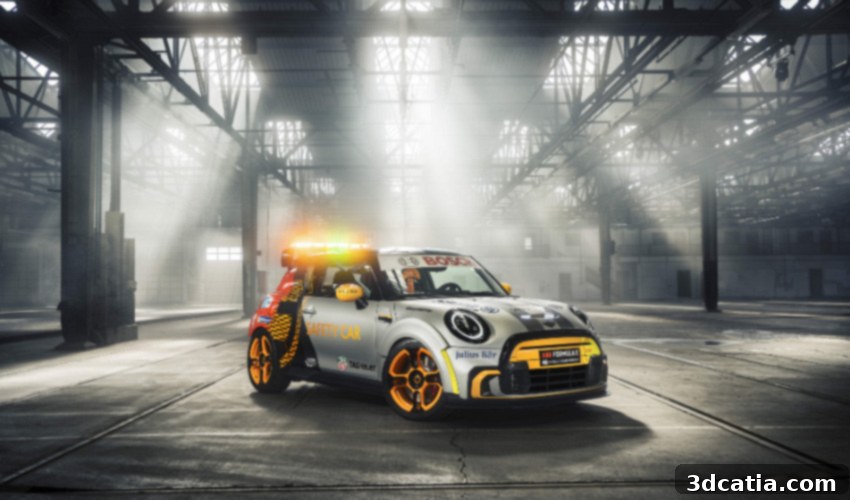
MINI Electric Pacesetter: Formula E’s 3D Printed Safety Car Driving the Future of Electrification
The automotive world is undergoing a significant transformation, with electric mobility and advanced manufacturing technologies at its forefront. Embodying this exciting shift, the MINI Electric Pacesetter, a high-performance safety car inspired by the John Cooper Works (JCW) MINI Cooper, has proudly taken its place as the official safety vehicle for the ABB FIA Formula E World Championship races. This innovative vehicle is more than just a pace-setter on the track; it’s a powerful statement of MINI’s strategic commitment to becoming a fully electric brand in the coming years. What makes this car particularly remarkable is its pioneering integration of 3D printing technology, featuring custom-made pads for its racing seats and other critical components, showcasing the immense potential of additive manufacturing in the automotive sector. The MINI Electric Pacesetter is a testament to collaborative innovation, born from a partnership between BMW, MINI Design, Motorsport, the FIA, and Formula E, drawing significant inspiration from the new MINI Cooper SE and pushing the boundaries of what electric performance can achieve.
The Formula E World Championship, a global stage for electric vehicle innovation, demands not only cutting-edge racing technology but also equally advanced support vehicles. The introduction of the MINI Electric Pacesetter marks a significant milestone as the first all-electric safety car for the series. The fundamental role of a safety car in motorsport is paramount: in instances of accidents, debris on the track, or adverse weather conditions, it intervenes by entering the circuit and positioning itself in front of the leading car. This action effectively slows down the pack, neutralizes the race, and provides crucial time for marshals to address on-track hazards safely. For an all-electric series like Formula E, an electric safety car not only aligns with the championship’s ethos but also demonstrates the capabilities and reliability of electric performance under demanding race conditions.
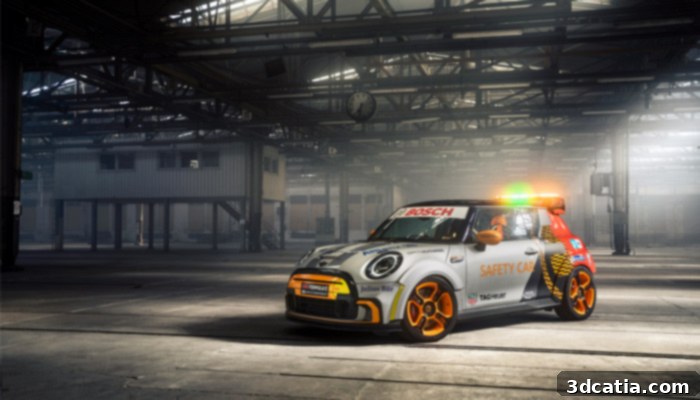
The MINI Electric Pacesetter Safety Car (photo credits: BMW Group)
MINI’s Bold Vision: Electrifying Performance with the JCW Spirit
The John Cooper Works (JCW) division has long been synonymous with MINI’s most exhilarating sports models, delivering a unique blend of go-kart handling and competitive spirit. With the Electric Pacesetter, JCW sought to translate this revered performance heritage into the electric era. This ambition isn’t entirely new for MINI; the brand has been exploring electric powertrains for some time, understanding that electrification can enhance, rather than detract from, the driving experience.
Bernd Körber, Managing Director of MINI, eloquently articulates this philosophy: “With the MINI Electric, we have already shown how well driving fun and electromobility go together. The MINI Electric Pacesetter inspired by JCW goes at least one step further and combines the performance character of the John Cooper Works brand with electric mobility. Of course, this extreme form as a safety car for the ABB FIA Formula E World Championship E racing series is not intended for road use. When you see the vehicle, you can see where we could go in terms of electrification of the JCW brand. For me, it clearly shows: electrification and John Cooper Works go together.” His words highlight the Pacesetter not just as a safety car, but as a bold conceptual blueprint for the future of JCW, demonstrating that electric powertrains can indeed deliver the raw, engaging performance that fans of the brand expect, perhaps even surpassing conventional combustion engines in certain aspects like instant torque delivery.
The Pacesetter serves as a crucial prototype, pushing the boundaries of what an electric MINI JCW model could be. It demonstrates that performance-oriented electric vehicles can retain the iconic MINI charm while embracing sustainable technology. This strategic move aligns with the broader automotive industry trend towards electric vehicles, positioning MINI as a forward-thinking brand ready to lead the charge into a fully electric future. The integration of electric powertrains into the JCW lineage is not just about meeting emissions standards, but about redefining performance, agility, and driving excitement for a new generation of enthusiasts.
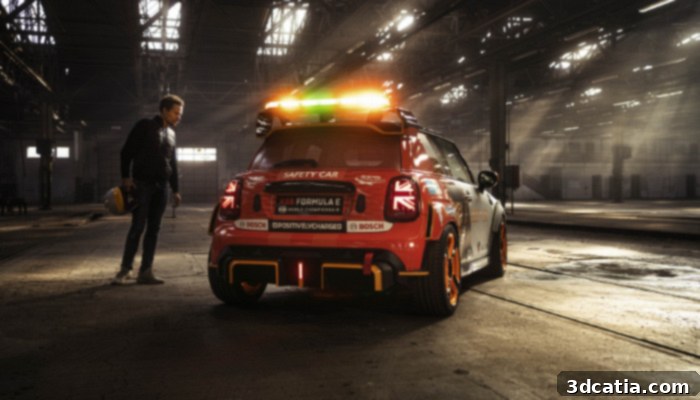
The rear of the MINI Electric Pacesetter (Photo credits: BMW Group)
Revolutionizing Design and Personalization Through 3D Printing
One of the most captivating aspects of the MINI Electric Pacesetter is its pioneering adoption of 3D printing (also known as additive manufacturing) for various critical components. This technology not only allows for innovative design and customization but also contributes significantly to the vehicle’s performance and driver experience. Oliver Heilmer, Head of Design at MINI, emphasizes the symbiotic relationship between form and function in the Pacesetter’s design: “Here, function dictates form, and many design elements have been shaped by technical considerations. For example, we worked closely with our colleagues at BMW Motorsport to develop the form of the wheel arches and front and rear aprons, and the optimization program for them included weight-saving measures. This visually striking, technically precise design language gives the car its pervasive sense of emotional engagement and excitement.” This statement underscores how advanced manufacturing techniques like 3D printing enable designers and engineers to push boundaries, creating components that are both aesthetically pleasing and highly functional.
Custom-Fit Comfort: 3D Printed Seat Pads
The most striking example of 3D printing in the Pacesetter’s interior lies in its sports seats. The pads for these seats are entirely 3D printed, offering an unprecedented level of customization and interchangeability. This means that each driver can have seat pads specifically tailored to their individual physique, weight, and even personal preferences, all without compromising comfort or safety. The ability to precisely tune the ergonomics of the seat for each driver is a significant advantage in competitive motorsport, where every detail can influence performance. 3D printing allows for intricate lattice structures within the pads, which can be engineered for optimal cushioning, support, and ventilation, surpassing the capabilities of traditional manufacturing methods. Furthermore, the customizable aspect extends to aesthetics, allowing for unique designs and color schemes, making each driver’s experience truly personal.
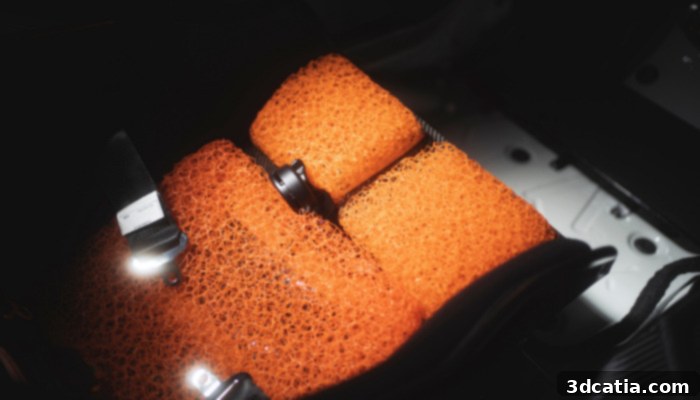
The pads are 3D printed and the color is customizable (photo credits: BMW Group).
Aerodynamic Excellence and Lightweight Construction
Beyond the interior, 3D printing plays a vital role in enhancing the vehicle’s aerodynamics and overall performance. The car’s sleek and aggressive aesthetic is partly due to redesigned fairings and a prominent rear spoiler, both of which were produced using additive manufacturing. These components, like the seat pads, were 3D printed using recycled carbon fiber, highlighting a commitment to both performance and sustainability. The use of 3D printing for aerodynamic parts allows for highly complex geometries that are difficult or impossible to achieve with conventional molding techniques. This design freedom enables engineers to precisely sculpt surfaces to optimize airflow, reduce drag, and generate essential downforce, crucial for a high-speed racing environment. The rear wing, another element produced via additive manufacturing, not only provides aerodynamic stability but also integrates distinctive yellow accent lines and flashing lights on the roof, blending functionality with unique visual identity. All these intricately designed mechanical components were manufactured at MINI’s Oxford factory, underscoring the localized and agile production capabilities offered by 3D printing.
The interior of the MINI Electric Pacesetter is purposefully stripped down, reflecting the spartan efficiency of a true racing car. It features two lightweight bucket seats, carbon fiber door panels, and a robust welded roll bar for enhanced safety and structural rigidity. The emphasis on weight reduction is evident throughout the vehicle’s construction. Thanks to the significantly reduced weight of various components, including the 3D printed parts, and the extensive use of carbon fibers, the Pacesetter is approximately 130 kg lighter than a standard Cooper SE – the model that served as its foundational inspiration. This substantial weight optimization is a direct result of embracing advanced materials and manufacturing processes like 3D printing. The ability to create complex, hollow, or lattice structures that are incredibly strong yet exceptionally light is one of the many compelling reasons why additive manufacturing is gaining widespread adoption across demanding sectors such as automotive and aerospace. The tangible benefits of this approach are clearly demonstrated in the agility and performance capabilities of this revolutionary new MINI safety car.
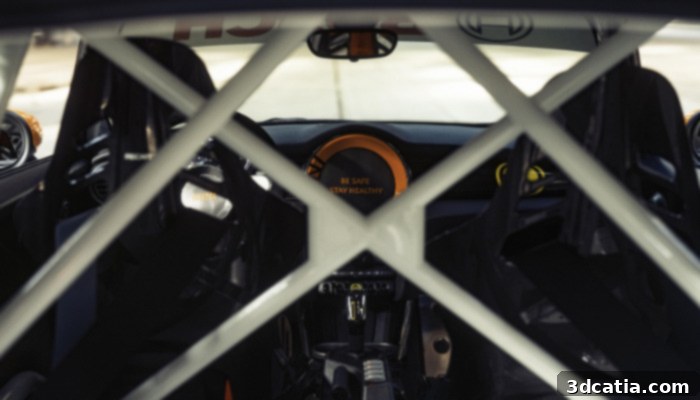
The interior of the MINI Electric Pacesetter (photo credits: BMW Group).
Debuting Innovation on the Global Stage
The JCW-inspired MINI Electric Pacesetter made its highly anticipated debut in Rome on April 10, 2021, during the second round (Race 3) of the exhilarating 2021 Formula E season. This momentous occasion allowed the world to witness MINI’s electric future in action. At the wheel was none other than Bruno Correia, the official championship safety car driver, whose expertise ensured the Pacesetter performed flawlessly under race conditions. Correia’s feedback on the vehicle was overwhelmingly positive: “Agility, performance, and a cool looking car. the MINI Electric Pacesetter […] has it all. Driving is a lot of fun and it feels like going karting.” His comments encapsulate the essence of MINI’s driving philosophy – a dynamic, engaging experience – successfully translated into an electric format. The Pacesetter not only performs its vital safety role but also acts as a thrilling showcase of MINI’s engineering prowess and its vision for sustainable, high-performance mobility. Further details about the Electric Safety Car can be explored HERE.
The Road Ahead: MINI’s Electric Future and Additive Manufacturing
The MINI Electric Pacesetter stands as a powerful symbol of the brand’s strategic direction. It not only fulfills a critical role in one of motorsport’s most forward-thinking championships but also acts as a vibrant blueprint for MINI’s electric future, particularly for its revered JCW performance sub-brand. By showcasing how electrification can be seamlessly integrated with the thrilling, agile driving experience that defines MINI, the Pacesetter dispels any doubts about the compatibility of performance and sustainable mobility. Furthermore, its extensive use of 3D printing highlights the transformative potential of additive manufacturing in automotive design, production, and personalization. From bespoke driver comfort through custom seat pads to enhanced aerodynamic efficiency with lightweight carbon fiber components, 3D printing has enabled an unprecedented level of innovation and performance optimization. This progressive approach positions MINI at the cutting edge of automotive technology, ready to inspire a new generation of drivers with vehicles that are exciting, sustainable, and truly unique.
What are your thoughts on the groundbreaking MINI Electric Pacesetter and its innovative use of 3D printing? We’d love to hear from you! Let us know in a comment below or connect with us on our Linkedin, Facebook and Twitter pages! Don’t miss out on the latest advancements in additive manufacturing – sign up for our free weekly Newsletter here, delivering the freshest 3D printing news straight to your inbox!
* Cover photo credits: BMW Group