
Revolutionizing Construction: MiCoB’s Vision for 3D Concrete Printing in India and Beyond
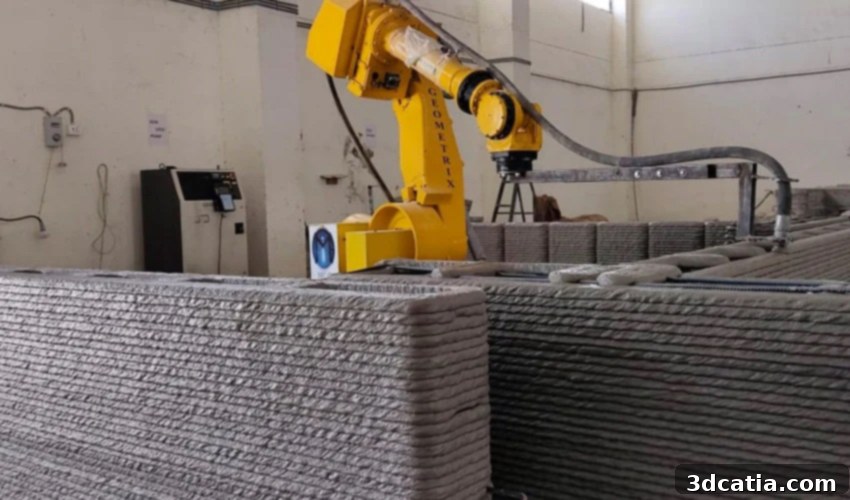
The global construction landscape is experiencing a profound transformation, largely driven by continuous advancements in additive manufacturing, particularly in the realm of concrete. This innovative technology is rapidly gaining traction across various industries, offering unprecedented benefits in terms of speed, cost-efficiency, design freedom, and sustainability. Companies worldwide are strategically adopting these methods to reshape traditional building practices. Among the frontrunners in this exciting evolution is MiCoB, an India-based pioneer that has developed its own cutting-edge 3D concrete printing technology. MiCoB’s primary mission is to democratize this advanced construction method within India, making it accessible and viable for a diverse range of applications. What makes MiCoB particularly compelling is the expansive scope of sectors where their 3D printers are being implemented, spanning critical areas such as civil infrastructure, military installations, and even bespoke decorative elements. To delve deeper into MiCoB’s groundbreaking technology and its versatile applications, we had the privilege of speaking with the company’s insightful co-founder, Shashank Shekhar.
3DN: Can you introduce yourself and tell us about your relationship with 3D technologies, particularly in concrete construction?

Shashank Shekhar
“I am Shashank Shekhar, Co-founder, and CEO of MiCoB Pvt Ltd. My journey into 3D printing began during my Ph.D. studies at IIT Gandhinagar, where I specialized in 3D concrete printing. It was during this period that I truly recognized the immense potential this technology held for commercial construction. The ability to create complex geometries, reduce material waste, and significantly accelerate construction timelines presented a paradigm shift from conventional building techniques. This vision motivated me to establish MiCoB in 2018, alongside two dedicated colleagues. The initial two years of our venture were critically dedicated to extensive research and development. We meticulously addressed various facets of 3D concrete printing technologies, which included developing robust prototypes, designing and manufacturing our in-house 3D printers from scratch, formulating optimal concrete mixes specifically engineered for printability, and integrating novel techniques to enhance the quality and precision of our printed outputs. The successful results and the tangible progress we made during this foundational phase instilled in us the confidence to implement this technology on a broader scale. Our aim was to cater to the diverse construction needs of both the civil and defense markets, sectors that stand to benefit immensely from rapid, durable, and customized construction solutions. Since then, we have been incredibly fortunate to demonstrate the practical applications of 3D concrete printing in full-scale commercial construction projects, successfully completing numerous work orders that have validated our technology and approach.”
3DN: What is MiCoB, and what inspired the creation of the company?
“MiCoB is an innovative entrepreneurial venture rooted in 3D concrete printing, founded on the principle of merging art, automation, and construction. Our core philosophy revolves around transforming the construction industry, challenging its traditional perceptions, and ushering in an era of efficiency and creativity. MiCoB strives to integrate advanced machine technologies into the construction segment, leveraging our state-of-the-art 3D concrete printing solutions. The genesis of MiCoB stems from my observations after completing my degree at IIT Roorkee. I keenly noticed the multitude of challenges and inherent risks prevalent in the conventional construction industry. Issues such as significant material waste, prolonged project timelines, high labor costs, and frequent quality compliance failures due to human error, often leading to costly demolition and reconstruction, were widespread. These inefficiencies sparked a desire within me to contribute to a significant change in the construction paradigm by incorporating novel techniques and methodologies. This realization led me to pursue dedicated research in 3D concrete printing, which, at that time, was an emerging but immensely promising construction technology. My vision was to make substantial developments in this field that could eventually be commercialized, offering practical and scalable solutions to existing problems. I committed myself to thorough research and simultaneously sought to assemble a strong, passionate team to bring this startup to fruition. I was fortunate to connect with Ankita and Rishabh, who not only shared my enthusiasm but also brought complementary skills and dedication. Together, we laid the foundation of MiCoB. Since our inception, we have been ceaselessly working towards perfecting our technology and deploying it in the most effective ways to meet the diverse and evolving construction needs of our clients, always pushing the boundaries of what’s possible with digital construction.”
3DN: Can you explain how your concrete 3D printing technology works and highlight the unique characteristics of your machines?
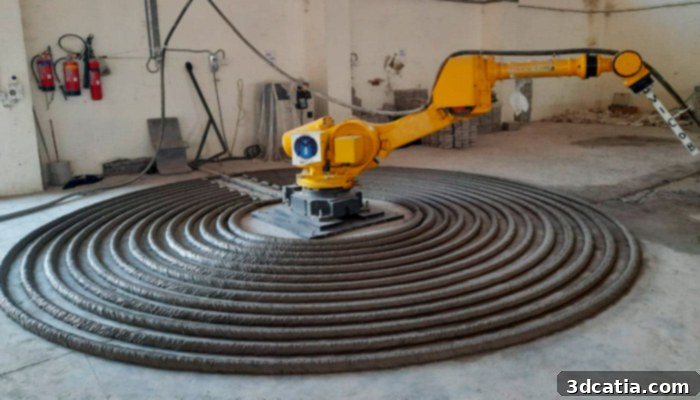
“Our proprietary 3D concrete printer is an intricately designed system comprising four key components that work in seamless synergy: a highly precise motion assembly, an efficient feeding system, a robust pump, and a continuous mixer. The process begins with the continuous mixer, where a finely tuned, customized concrete mix is developed. This isn’t just any concrete; it’s engineered for optimal printability, ensuring the right rheology and setting characteristics. Once prepared, this specialized paste is then transferred to the feeding system by the pump. At the terminal end of the feeding system, a precisely engineered nozzle dispenses the concrete mix in a controlled manner, creating thin, uniform layers. The motion assembly, which serves as the structural backbone and control mechanism, guides the feeding system to move with exceptional accuracy, enabling the deposition of concrete in the desired shape and dimensions. This entire operation is meticulously orchestrated by advanced software. A CAD model of the structure intended for printing is first developed digitally. This model is then fed into our in-house software, which is seamlessly integrated with the printer’s motion assembly. The software intelligently sections the CAD model into numerous thin layers, simultaneously calculating the most efficient and optimum path for the motion assembly during the printing process. This ensures precision, minimizes printing time, and optimizes material usage. All these various parts of the assembly – the mixer, pump, feeding system, motion assembly, and software – communicate with each other through a sophisticated control architecture. This architecture acts as the central nervous system, integrating all system components and functioning as the ‘brain’ of the entire 3D concrete printing operation, ensuring synchronized and flawless execution.”
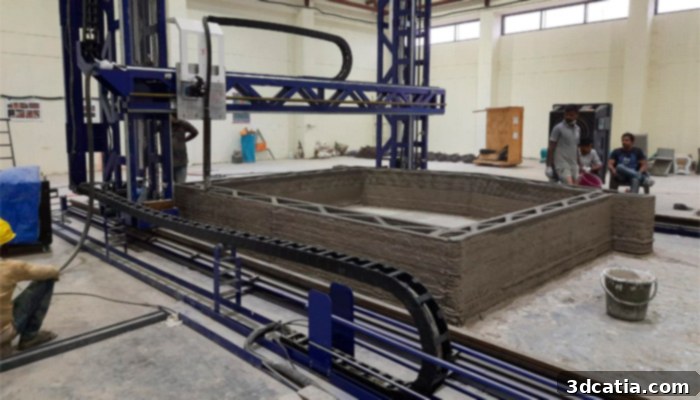
“Regarding our hardware development, MiCoB has successfully engineered and deployed a diverse range of 3D printers. So far, we have developed two gantry-based systems and two advanced robotic system-based 3D printers. The gantry systems are typically excellent for larger, more rectilinear structures, offering stability and precision over wider areas. Our robotic systems, on the other hand, provide greater flexibility, reach, and the ability to print more complex, organic geometries. A significant achievement for MiCoB is the cost-effectiveness of our systems; these developments are approximately three times more economical than comparable European and American 3D Concrete printing systems. This affordability is a key factor in our mission to democratize the technology in India, achieved through smart design, local sourcing, and optimized manufacturing processes. On the material front, we have innovated a wide spectrum of printable concrete mixes, often referred to as ‘printing inks.’ This includes lightweight mixes, ideal for reducing structural load and improving insulation; high-performance mixes, designed for superior strength and durability in demanding applications; and fiber-reinforced mixes, which offer enhanced tensile strength and crack resistance. These material innovations allow us to cater to a broad array of project requirements. Furthermore, we pride ourselves on our in-house proprietary software solution. Our Advanced 3D Concrete Printing software boasts comprehensive capabilities including intuitive 3D slicing, efficient multiple file slicing for complex projects, real-time 3D simulation to preview and optimize prints, precise G-Code generation, detailed project estimation, and thorough post-print analysis. Beyond technology, MiCoB has also cultivated an exceptional in-house team of experts dedicated to assisting clients. This team provides invaluable support in the design and engineering of 3D printed structures, from conceptualization to execution, ensuring that our clients can fully leverage the potential of additive construction.”
3DN: What innovative projects and applications have you developed using your additive manufacturing method?
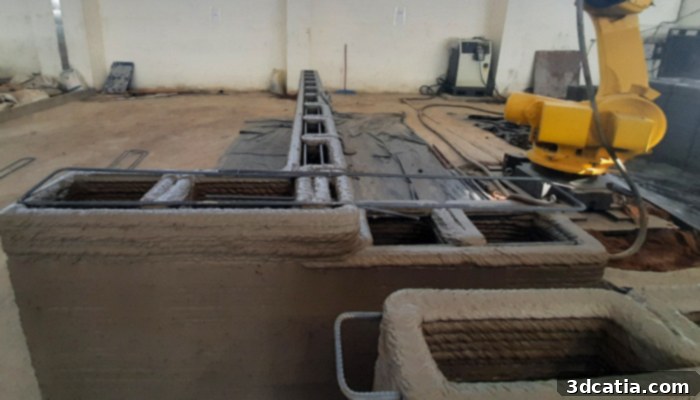
“MiCoB has successfully showcased the transformative potential of 3D concrete printing across several critical domains, particularly in the modular and rapid construction of structures for both military and civil applications. One of our proudest achievements is becoming an official supplier to the Indian Army. In this capacity, we are addressing their crucial needs for permanent defense structures, which require unparalleled durability and resilience, as well as providing rapidly deployable residential spaces in some of the most challenging extreme terrains and climates. The ability to quickly construct robust shelters in remote or harsh environments offers a significant strategic advantage, drastically reducing logistical complexities and construction timelines compared to traditional methods. Beyond defense, MiCoB is also making significant inroads into a more aesthetically driven market segment: concrete furniture. Our 3D printed concrete furniture stands out due to its exceptional features, truly unique designs, and the unparalleled ease of customization it offers. From elegant outdoor pieces to modern interior accents, MiCoB’s concrete furniture provides an excellent, durable, and stylish choice for contemporary décor, allowing architects and designers to realize previously impossible shapes and textures. The design flexibility inherent in 3D printing means that each piece can be tailored precisely to client specifications, ensuring individuality and artistic expression. Looking ahead, we have ambitious plans to address the pressing need for customized, flexible, and rapid construction of large-scale infrastructural elements. This includes vital projects such as bridges and flyovers. The geometric complexities often associated with these structures, combined with the demand for rapid deployment to alleviate urban congestion, make them ideal candidates for 3D concrete printing. This technology can significantly reduce construction time, minimize disruption, and potentially lower overall project costs while enhancing structural integrity and design innovation. We believe 3D concrete printing will play a pivotal role in modernizing India’s infrastructure, making it more resilient and sustainable.”
3DN: How do you envision the future of additive manufacturing within the broader construction sector?
“Over the past few years, 3D printing in construction has indeed captured a tremendous amount of attention, and its immense potential is now being increasingly recognized and embraced across the globe. We at MiCoB are incredibly optimistic about its future trajectory. The inherent advantages of this technology – including unprecedented ease of customization, significantly accelerated construction pace, and the production of consistently high-quality structures – make it a game-changer. When strategically integrated with conventional construction methods, 3D printing has the transformative power to revolutionize the entire construction industry. It addresses critical issues such as labor shortages by automating repetitive tasks, dramatically reduces material waste through precise deposition, and enables the creation of complex, organic architectural designs that were previously impractical or prohibitively expensive to build. Moreover, it holds immense promise for sustainable construction by facilitating the use of local and recycled materials, leading to a smaller carbon footprint. We are incredibly positive about the new avenues and opportunities that this technology is poised to create in the construction industry over the next few years. We foresee a future where bespoke housing can be erected in a matter of days, where disaster relief shelters can be deployed almost instantly, and where infrastructure projects can be completed with unprecedented efficiency and design sophistication. The collaboration between digital design, advanced robotics, and innovative material science will pave the way for a more sustainable, efficient, and creatively boundless construction sector. We believe that 3D concrete printing is not just an alternative method but a fundamental shift that will redefine how we conceive, design, and build our environments. The journey has just begun, and the possibilities are truly endless for additive manufacturing to reshape the built world for generations to come. For those interested in exploring our work further, more information can be found on the MiCoB website.”
What are your thoughts on MiCoB’s pioneering activities in 3D concrete printing? Share your insights and comments below, or connect with us on our LinkedIn, Facebook, and Twitter pages! Don’t miss out on the latest 3D printing news and innovations – subscribe to our free weekly Newsletter here to get updates delivered straight to your inbox. You can also discover more captivating videos and demonstrations on our YouTube channel.
*All Photo Credits: MiCoB