
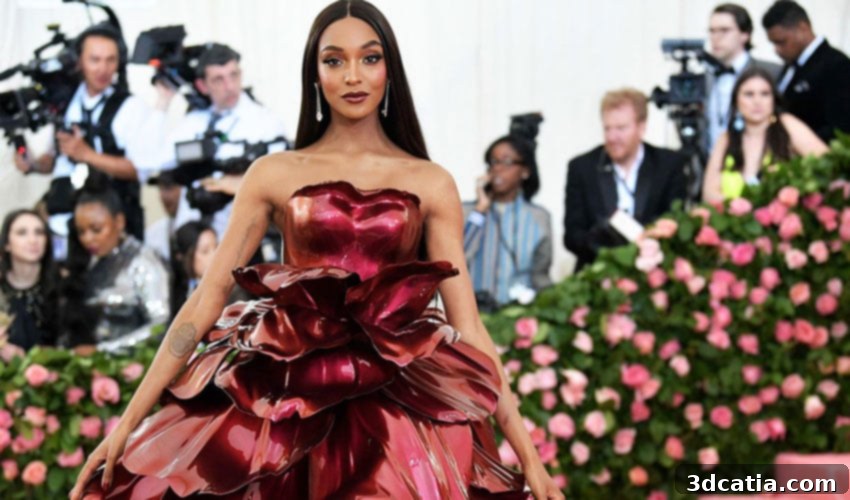
Zac Posen’s Vision: How 3D Printing Revolutionized Met Gala 2019 Fashion with GE Additive and Protolabs
The Met Gala stands as an unparalleled pinnacle in the global fashion calendar, an evening where the realms of haute couture and groundbreaking innovation converge. It’s a spectacular platform that unites celebrated designers, A-list celebrities, and emerging talents, all striving to push the boundaries of artistic expression and technological advancement. The 2019 Met Gala, with its “Camp: Notes on Fashion” theme, provided an especially fertile ground for avant-garde creations, showcasing an extraordinary blend of traditional craftsmanship and state-of-the-art 3D printing technology.
At the heart of this sartorial spectacle was the visionary designer Zac Posen, who embarked on an ambitious collaboration with industrial manufacturing giants GE Additive and rapid prototyping specialists Protolabs. This powerful partnership culminated in a collection of truly unique 3D printed pieces, ranging from a show-stopping full-length gown to intricate accessories. These breathtaking designs, gracing the bodies of supermodels and acclaimed actresses alike, unequivocally demonstrated the harmonious synergy between additive manufacturing and high fashion. The collection served as a powerful testament to how 3D printing is not merely an engineering tool, but a transformative force reshaping the aesthetic and functional possibilities within the fashion industry.
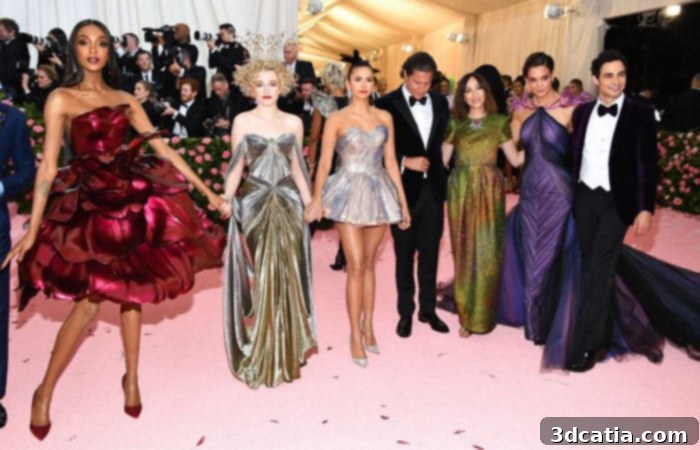
From left to right: Jourdan Dunn, Julia Garner, Nina Dobrev, Vito Schnabel, Gia Coppola, Katie Holmes and Zac Posen | Photo Credits: Dimitrios Kambouris / Getty Images
For several years now, advanced 3D technologies have been steadily making their mark in the exclusive world of haute couture, unlocking an entirely new universe of possibilities in terms of design freedom and geometric complexity. Designers are no longer confined by the limitations of traditional textile construction, able to imagine and realize shapes, textures, and structures that were previously considered impossible. We have witnessed the emergence of original and truly unique dresses, shoes, and an array of accessories, all brought to life through the precision and versatility of 3D printing. The groundbreaking project spearheaded by Zac Posen, alongside GE Additive and Protolabs, stands as a crowning achievement in this ongoing evolution.
This time, the three partners pushed creative boundaries even further, drawing inspiration from the captivating dynamics of moving natural objects. Their collective objective was clear: to unequivocally demonstrate that, in the realm of design and manufacturing, “almost anything is possible with 3D printing,” a sentiment proudly articulated by the celebrated American designer, Zac Posen himself. This ambition translated into garments and accessories that mimicked organic forms, flow, and intricacy, creating a collection that was both technologically advanced and deeply artistic. The Met Gala 2019 collaboration thus transcended mere fashion, offering a vivid glimpse into a future where imagination is the only true constraint.
The “Rose” Dress: A Fully 3D Printed Gown at Met Gala 2019
Undoubtedly the crown jewel of Zac Posen’s Met Gala collection, the “Rose” dress captivated audiences with its innovative design and sheer technological prowess. Worn by the internationally renowned supermodel Jourdan Dunn, this extraordinary gown was not fashioned from traditional fabric but meticulously constructed from 21 individual 3D printed rose petals. Each petal was a marvel of engineering and artistry, measuring an impressive 53 centimeters (approximately 21 inches) in length and weighing a mere 0.4 kilograms (less than a pound), a testament to the lightweight yet robust nature of the chosen materials and additive manufacturing processes.
The creation of these intricate petals involved Stereolithography (SLA) 3D printing, a process renowned for its ability to produce highly detailed and smooth surfaces. The complex printing process for these components was expertly managed by Protolabs’ advanced 3D printing department located in North Carolina, leveraging their cutting-edge facilities and extensive experience in rapid manufacturing. Each petal was then carefully affixed to an invisible, modular net, which itself was a feat of additive manufacturing. This underlying structure was 3D printed in lightweight yet incredibly strong titanium, utilizing electron beam fusion (EBM) technology. EBM, known for its precision in handling reactive metals like titanium, allowed for the creation of a durable and custom-fit framework that provided both support and flexibility.
The statistics behind the “Rose” dress underscore the monumental effort involved in its creation. The final garment, despite its seemingly delicate appearance, weighed approximately 13 kilograms (about 28.7 pounds). Its production demanded an astonishing 700 hours of continuous 3D printing time, followed by an additional 400 hours of meticulous post-processing to achieve the desired aesthetic and finish. This post-processing included applying a base coat of primer to each petal, followed by a specialized chameleon-effect automotive paint, which gave the petals a mesmerizing, shifting hue that caught the light beautifully on the red carpet. Furthermore, to ensure a flawless fit, the entire design process commenced with a precise 3D digitization of Jourdan Dunn’s morphology, creating a bespoke garment perfectly tailored to her form. The “Rose” dress also showcased an ingenious modular design, allowing for the addition of more petals – up to 37 in total – to adjust the dress’s length and volume, demonstrating both artistic vision and practical foresight in additive manufacturing for fashion.
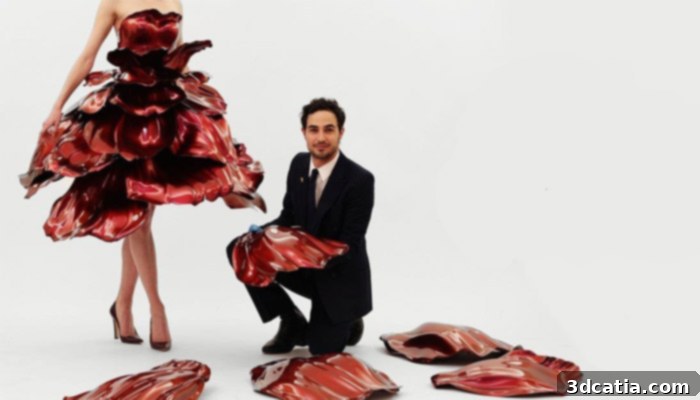
Zac Posen holding the 3D printed petals | Photo credits: GE Additive
A Custom-Made 3D Printed Bustier for Nina Dobrev at the Met Gala 2019
Continuing his exploration of personalized 3D printed fashion, Zac Posen conceived an entirely novel bustier for acclaimed actress Nina Dobrev. This custom piece was a prime example of how additive manufacturing enables unparalleled personalization and intricate design. The process began with a highly detailed 3D scan of Dobrev’s body, providing the designer and his team with the precise anatomical data needed to craft a perfect fit. From this digital blueprint, the partners 3D printed a stunning plastic bustier, meticulously divided into four interlocking parts, using an SLA (Stereolithography) machine. The choice of SLA was crucial for achieving the bustier’s smooth surface and the desired “vitrified” or glass-like appearance, which gave it a futuristic and ethereal quality.
The creation of this unique bustier demanded an intensive 200 hours of dedicated work, showcasing the commitment to perfection in both design and production. Nina Dobrev herself recounted the extraordinary fitting experience that preceded the Met Gala: “About a month and a half before the Met Gala, Zac’s team made me do the most original fitting of my life! They put me in a spandex suit and I had to stand still in front of a 360° camera. It took a minute and a half to take 15 to 20 photos – we did it 6 times. A few days later, I discovered this futuristic bustier.” Her vivid description highlights the seamless integration of advanced 3D scanning technology and additive manufacturing in crafting a garment that was not only visually striking but also perfectly contoured to her individual form, redefining the concept of bespoke fashion.
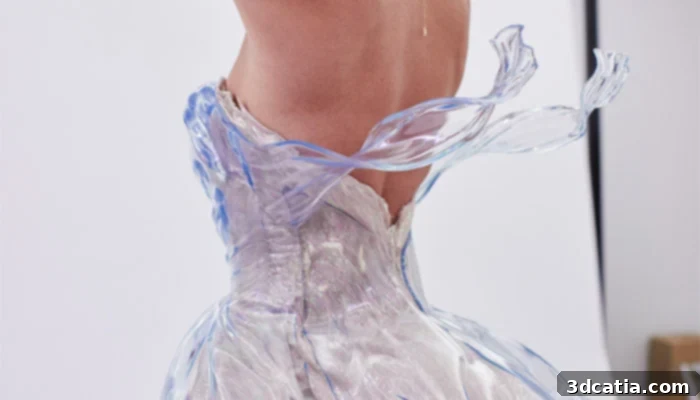
The 3D printed glass-like bustier
Exquisite 3D Printed Accessories Gracing the Red Carpet
Beyond the show-stopping gowns and bustiers, the Met Gala 2019 red carpet was adorned with a variety of intricate 3D printed accessories, further underscoring the versatility and creative potential of additive manufacturing in fashion. Actress Katie Holmes, for instance, wore a remarkable collar-like accessory, elegantly attached to the neckline of her dress. This piece, embodying pearly purple palm leaves, was expertly 3D printed using a resin-based machine, likely another SLA application due to its fine detail capabilities. Its creation required a substantial 56 hours of intensive 3D printing and meticulous finishing work, resulting in a delicate yet impactful statement piece that perfectly complemented her ensemble and showcased the ability of 3D printing to produce organic, flowing forms with exquisite precision.
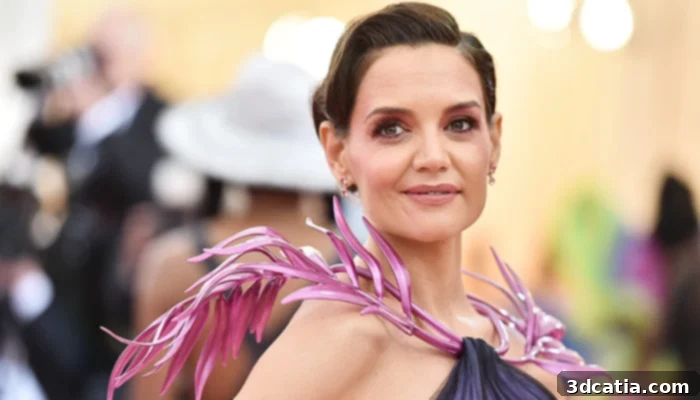
Katie Holmes wearing the 3D printed neck accessory | Photo credits: Theo Wargo / WireImage
Protolabs’ expertise in advanced manufacturing was also instrumental in crafting a stunning 3D printed headdress for actress Julia Garner. This elaborate accessory was produced on a Multi Jet Fusion (MJF) machine, utilizing durable nylon material. The headdress drew its artistic inspiration from the rich symbolism of the wine sector, featuring intricately rendered berry leaves that created a captivating, organic silhouette. The entire process, from design to final production, required 22 hours of dedicated work to perfect this unique ornamental piece. Elsewhere, the acclaimed Indian actress Deepika Padukone’s dress was adorned with an impressive array of 3D printed embroideries, also manufactured using an SLA 3D printer for their fine detail. In total, 408 individual embroideries were painstakingly sewn onto her gown, a task that required more than 160 hours of work, illustrating how additive manufacturing can facilitate the mass production of highly detailed, customized elements for traditional garments.
The influence of 3D printing extended beyond women’s fashion at the Met Gala. Zac Posen himself proudly sported lapel pins in the elegant shape of 3D printed palm leaves, a subtle nod to the technological innovation pervading his collection. Similarly, actors Andrew Garfield and Vito Schnabel both wore cufflinks thoughtfully shaped like rose petals, providing a direct and sophisticated echo to Jourdan Dunn’s iconic 3D printed “Rose” dress. These small yet significant buttons were also precisely 3D printed on a stereolithography machine, highlighting the technology’s capability for intricate, high-fidelity components. One thing was abundantly clear: these revolutionary creations did not merely go unnoticed; they commanded attention and sparked conversation, with 3D technologies undeniably playing a pivotal role in their unforgettable impact on the evening’s fashion narrative. For a deeper dive into this groundbreaking collaboration, more information can be found on GE Additive’s official website HERE.
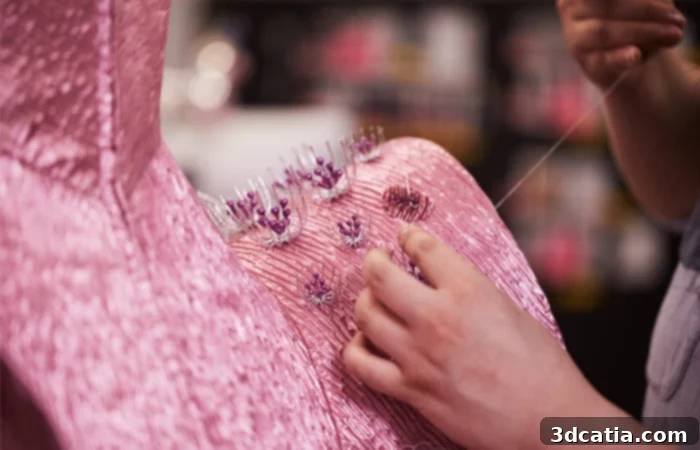
The 3D printed broideries | Photo credits: GE Additive
The Met Gala 2019 served as a landmark event, cementing 3D printing’s place not just as a futuristic concept but as a tangible, transformative force in the contemporary fashion landscape. Zac Posen’s collaboration with GE Additive and Protolabs proved that additive manufacturing can create garments and accessories that are not only visually stunning but also embody unparalleled complexity, customization, and artistic expression. This fusion of high fashion and high technology continues to inspire, promising an exciting future where design possibilities are truly limitless.
What are your thoughts on these innovative 3D printed dresses and accessories? Do you believe additive manufacturing will become a staple in haute couture and everyday fashion? Share your insights and opinions in a comment below or join the conversation on our Facebook and Twitter pages! Don’t miss out on the latest advancements and news in the additive manufacturing world – sign up for our free weekly Newsletter to get all the cutting-edge updates delivered straight to your inbox!
*Cover Photo Credits: The New York Times