
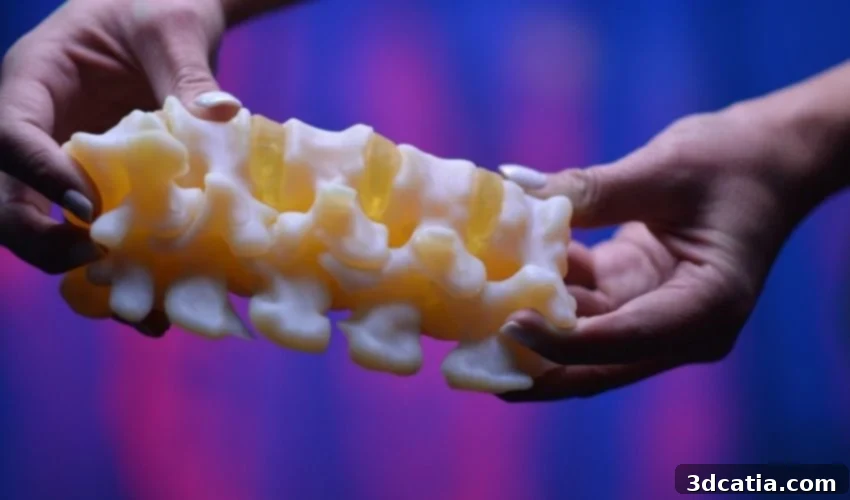
Revolutionizing Healthcare: Stratasys and Ricoh Partner to Expand Access to Patient-Specific 3D Printed Anatomical Models
In a significant stride towards transforming personalized medicine, Stratasys, a global leader in 3D printing solutions, has announced a groundbreaking partnership with Ricoh USA, Inc. This collaboration introduces “RICOH 3D for Healthcare,” an innovative service designed to dramatically expand access to patient-specific anatomical models created using Stratasys’ cutting-edge 3D printing technologies. This initiative solidifies Stratasys’ growing presence in the healthcare sector, leveraging Ricoh’s extensive service capabilities to bring advanced medical visualization and surgical planning tools to a broader spectrum of healthcare providers.
The medical industry’s adoption of 3D printing is rapidly accelerating, driven by its profound ability to enhance diagnostic accuracy, refine treatment strategies, and improve surgical outcomes. Among its many applications, the creation of perfectly replicated anatomical models stands out as an increasingly popular and impactful use case. These highly detailed, patient-specific models empower doctors and other healthcare professionals to develop a deeper understanding of unique patient pathologies, leading to more informed decisions and personalized care plans. The Stratasys-Ricoh partnership aims to make these invaluable tools more readily available to medical providers of all sizes, from large university hospitals to smaller clinics and individual practices, thereby democratizing access to state-of-the-art medical technology.
The utility of 3D printed anatomical models in the medical field cannot be overstated. By converting complex radiology scans—such as CT (Computed Tomography) and MRI (Magnetic Resonance Imaging)—into tangible, physical replicas, healthcare providers gain an unparalleled ability to visualize internal structures. This tactile interaction is especially beneficial for surgeons, enabling them to study a patient’s unique anatomy, identify potential challenges, and develop precise treatment options long before entering the operating room. Surgical rehearsal on these models has been demonstrably linked to reduced operating times, fewer intraoperative complications, and a significant decrease in surgical errors. The ability to “practice” complex procedures in advance builds surgeon confidence and ensures a smoother, safer experience for the patient.
Beyond surgical planning, these models play a crucial role in medical education and training. They serve as exceptional teaching aids for medical students, allowing them to interact with realistic anatomical representations of various conditions. For seasoned professionals, they offer opportunities for continuous skill development and hands-on training for new surgical techniques or medical devices. Indeed, the importance of integrating 3D technology into medical curricula has led some hospitals and academic institutions to establish dedicated training programs focusing on 3D printing, ensuring that current and future healthcare professionals can fully harness the potential of this transformative technology for improved patient care and operational efficiency.
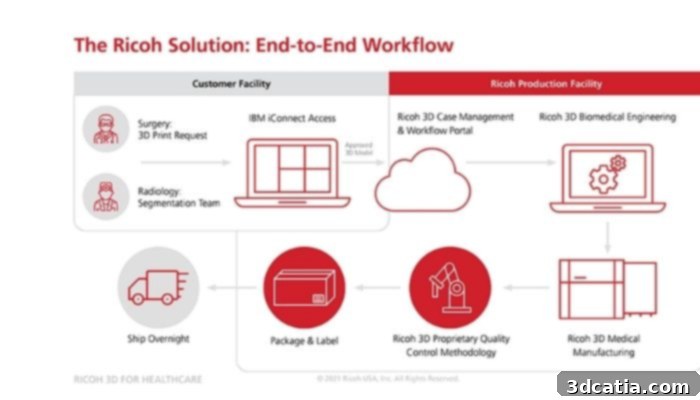
The RICOH 3D for Healthcare service is designed as a comprehensive, end-to-end workflow solution engineered to simplify the intricate process of creating and delivering anatomical models to healthcare providers. This streamlined approach minimizes the logistical and technical hurdles traditionally associated with establishing in-house 3D printing capabilities. The process begins with customers submitting their radiology scans and specific model requests through a user-friendly interface. This data is then securely transferred to Ricoh 3D, where expert technicians utilize advanced software to convert the 2D scan data into printable 3D files. The models are then manufactured using Stratasys’ state-of-the-art 3D printers and subsequently shipped directly to the healthcare provider. This seamless workflow ensures efficiency, accuracy, and timely delivery of critical medical tools.
At the heart of this innovative service are Stratasys’ purpose-built medical 3D printing technologies: the Stratasys J750 Digital Anatomy™ printer and the Stratasys J5 MediJet™ 3D printer. These advanced machines are renowned for their ability to produce incredibly life-like anatomical models that not only replicate the external form but also accurately mimic the internal textures, densities, and mechanical properties of human tissue. The Digital Anatomy printer, in particular, can simulate the bio-mechanical characteristics of bone, soft tissue, and even vascular structures, providing clinicians with models that can be physically manipulated and cut like real human tissue. This level of realism allows for unprecedented pre-surgical planning, personalized education, and the development of truly bespoke patient care strategies. The J5 MediJet offers multi-material capabilities, allowing for the creation of models with varied textures and colors, crucial for differentiating specific anatomical features or pathologies.
Scott Drikakis, Healthcare Segment Leader for Stratasys, emphasized the transformative potential of this partnership, stating, “Through our partnership with Ricoh we are giving healthcare institutions the opportunity to access patient care tools that they may not have previously had access to. With Ricoh 3D for Healthcare, providers can easily generate 3D printed models of patient specific anatomy using state of the art technology through an on-site managed services or on-demand part approach. This will demonstrate the clinical and economic benefits of anatomic models, while streamlining the historical challenges of establishing 3D printing programs in hospitals.”
Drikakis’ comments underscore a critical aspect of this collaboration: addressing the historical barriers to 3D printing adoption in healthcare. Many hospitals and clinics, particularly smaller facilities, lack the capital, infrastructure, and specialized expertise required to establish and maintain an in-house 3D printing lab. RICOH 3D for Healthcare mitigates these challenges by offering both on-site managed services, where Ricoh personnel operate the equipment within a hospital, and an on-demand part production model, allowing institutions to order models as needed without significant upfront investment. This flexibility makes advanced medical modeling accessible to a much wider range of healthcare providers, democratizing a technology that was once largely confined to large academic medical centers.
The benefits of enhanced accessibility are far-reaching. By enabling more medical professionals to utilize patient-specific 3D printed models, the partnership is set to accelerate the adoption of personalized medicine practices. This leads to improved diagnostic confidence, more effective surgical planning, and better patient communication, as models can be used to explain complex conditions and procedures in an easily understandable way. Ultimately, this translates to improved patient outcomes, reduced healthcare costs associated with complications or prolonged surgeries, and a more efficient healthcare system. The strategic alliance between Stratasys’ unparalleled 3D printing technology and Ricoh’s robust service infrastructure creates a powerful synergy capable of driving significant innovation and positive change across the entire healthcare continuum.

Ricoh will be using Stratasys printers that have been specifically designed for the healthcare sector (photo credits: Stratasys)
This collaboration marks a pivotal moment in the integration of additive manufacturing into mainstream medical practice. As technology continues to advance, the demand for highly customized, patient-specific solutions will only grow. The ability of 3D printing to create models that perfectly replicate individual pathologies is invaluable for conditions ranging from complex congenital heart defects to intricate tumor resections. Moreover, these models also hold immense potential for the development and testing of new medical devices and prosthetics, further solidifying 3D printing’s role as an indispensable tool in medical innovation. The partnership between Stratasys and Ricoh positions both companies at the forefront of this evolution, ready to meet the evolving needs of the global healthcare landscape.
What are your thoughts on RICOH’s new service offering 3D printed anatomical models in partnership with Stratasys? Do you believe this will significantly impact access to advanced medical visualization tools? Share your insights and join the conversation in a comment below, or connect with us on our Linkedin, Facebook, and Twitter pages! Don’t miss out on the latest 3D printing news; sign up for our free weekly Newsletter here, delivered straight to your inbox. You can also find all our videos and more engaging content on our YouTube channel.
*Cover Photo Credits: Business Wire