
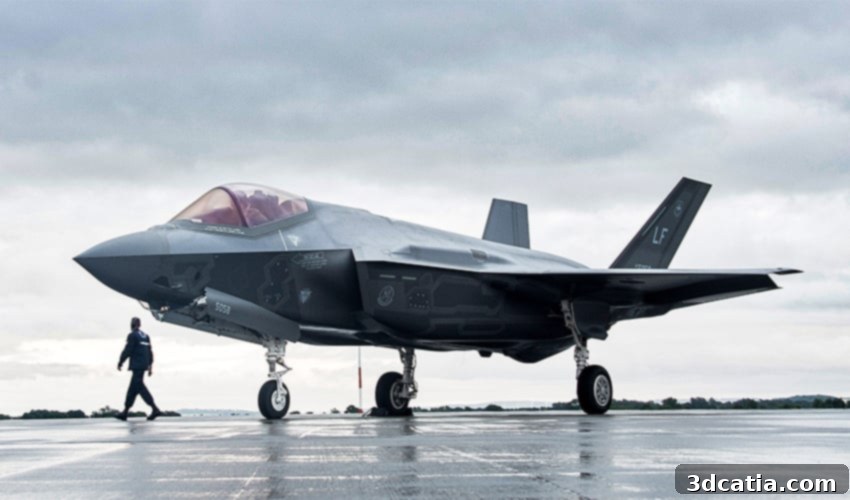
Revolutionizing Defense: How 3D Printing on the Front Lines Saved $70,000 on an F-35 Stealth Fighter
In a testament to the transformative power of modern technology, a team of resourceful Marines recently leveraged the capabilities of 3D printing to achieve a remarkable $70,000 in cost savings. This significant financial gain stemmed from their ingenious decision to utilize additive manufacturing for a critical, albeit small, component of an F-35 Stealth Fighter. By producing this specific part through 3D printing, they ingeniously circumvented the need to procure an entirely new landing gear door for the high-tech aircraft, a purchase that would have incurred the substantial $70,000 expense. This incident underscores the growing potential of 3D printing to revolutionize military logistics, maintenance, and operational readiness, proving its value far beyond experimental phases and into practical, impactful applications on the ground.
The integration of additive manufacturing into military operations is not a new concept, but its application is continuously evolving. Currently, the US Army has meticulously established comprehensive guidelines and detailed instructions specifically for 3D printing new parts intended for on-ground vehicles. Each newly 3D-printed component for these vehicles undergoes a rigorous approval process, meticulously reviewed and sanctioned by the Marine Systems Command (MSC) to ensure functionality, safety, and adherence to military standards. However, the scenario changes dramatically when considering aircraft components. Due to the inherent complexities, extreme operational environments, and paramount safety requirements associated with aviation, the regulations and restrictions governing aircraft parts are considerably more stringent. Any 3D-printed part destined for an aircraft must meet exceptionally high standards, ensuring it poses absolutely no risk to crew members, pilots, or the structural integrity of the aircraft, thereby mitigating any potential for operational failure or catastrophic incidents. The US Marines have, in fact, been at the forefront of exploring diverse applications for 3D printing, ranging from the creation of specialized submarine hulls to the crucial ability to 3D print essential equipment directly on-site in remote or challenging environments. This proactive adoption signifies the military’s strategic move to bring 3D technology directly to the front line, embedding it within the core of their tactical and logistical frameworks.
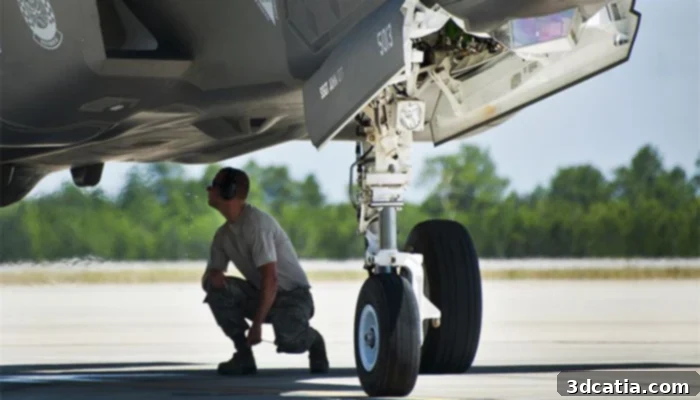
The specific component in question was a small, yet vital, piece designed to be mounted onto the F-35’s landing gear door, functioning as a crucial part of the latching mechanism. Its proper operation is essential for the secure closure and deployment of the landing gear. This particular 3D-printed part was meticulously designed and produced by a dedicated team of Marines from the Combat Logistics Battalion 31 (CLB-31), stationed in Carderock, Maryland. Their innovative efforts were significantly bolstered by the expert support of Sam Pratt, a highly experienced mechanical engineer affiliated with Carderock’s Additive Manufacturing Project Office. Pratt played a pivotal role by providing invaluable technical assistance, guiding the team through the intricacies of design, material selection, and printing optimization, ensuring the final product met the rigorous demands of military aviation applications. This collaborative effort between active-duty personnel and specialized engineers highlights a new paradigm in defense logistics, where rapid, localized innovation can directly impact operational readiness and cost efficiency.
The sheer economic impact of this single endeavor is truly staggering. As the team members themselves articulated, “You can’t buy the piece separate from the landing gear door which is a cost of $70,000. By having the capabilities to print in the field, we were able to replicate the part for a cost of roughly 9 cents.” This direct comparison vividly illustrates the immense value proposition of additive manufacturing in a defense context. Beyond just the dollar figures, this ability to produce parts on-demand, virtually anywhere, drastically reduces reliance on cumbersome supply chains, minimizes aircraft downtime, and significantly enhances operational flexibility. The traditional procurement process for a part like this could involve lengthy lead times, complex logistics, and an exorbitant price tag for an entire assembly when only a small component is faulty. The Marines’ initiative effectively bypassed these obstacles, transforming a potentially expensive and time-consuming repair into a swift, cost-effective solution, embodying the strategic advantages that 3D printing brings to military readiness and resource management.
3D Printed Part for F-35 Stealth Fighter: The Technical Journey
Sam Pratt’s primary role often involves a proactive approach to developing the next generation of military innovators. He is regularly tasked with training CLB-31 Marines in the intricate art of designing and effectively applying 3D-printed parts for various applications. This foundational expertise made Pratt the ideal choice when officers from CLB-31 urgently requested his assistance to help restore a grounded F-35, rendering it fully functional once again. However, upon his arrival at the laboratory, Pratt discovered that the resourceful team had already taken the initiative to print the part. While their ingenuity was commendable, they were facing significant challenges, primarily related to sizing inaccuracies. The group had initially utilized Blender, a popular design software predominantly known for its applications in creating immersive games and sophisticated movie effects, to design and shape the 3D-printed component. While Blender offers powerful modeling capabilities, Pratt quickly identified a crucial limitation: it is not typically optimized for the precise measurements and rigorous engineering specifications demanded by aerospace components. This disparity in software suitability necessitated further meticulous modifications to ensure the part could be installed flawlessly and function perfectly within the F-35’s complex systems, highlighting the importance of specialized tools and expertise in critical military applications.
Following Pratt’s guidance and technical intervention, the team embarked on a precise calibration process. They meticulously corrected the initial measurements, adjusting the design to achieve an exact fit for the intricate landing gear mechanism of the F-35 Stealth Fighter. This crucial step ensured not only mechanical compatibility but also the structural integrity and operational reliability required for such a high-performance aircraft. Once the design was perfected, the component was printed using what could be described as a hobbyist-oriented 3D printer. The choice of material was critical: a robust PETG filament was selected. PETG (Polyethylene terephthalate glycol) is renowned for its excellent balance of strength, durability, and resistance to impact and chemicals, making it a suitable material for non-load-bearing, functional components that require resilience in demanding environments. This deliberate material selection ensured that the 3D-printed part possessed the necessary properties to perform its intended function reliably, seamlessly integrating into the F-35’s systems and contributing to the aircraft’s rapid return to operational status. The successful implementation of this part underscored the potential for accessible additive manufacturing technology to address complex, high-stakes maintenance challenges within the military, proving that even a “hobbyist” printer, when coupled with expertise and appropriate materials, can deliver professional-grade solutions.
The utilization of 3D technology within the US military, particularly in the Army and Marine Corps, is experiencing a period of rapid and exponential growth. This F-35 incident is not an isolated case but rather a vivid illustration of a broader strategic shift. As Sam Pratt further elaborates, “We will see additive manufacturing used more often to make replacement parts across various platforms and branches of service. Currently, there are already about 85-90 parts officially approved to print for ground vehicles alone. This process is becoming as streamlined as going online, downloading the validated design file, and printing the part right where it’s needed.” This statement highlights the burgeoning maturity of additive manufacturing for ground-based assets, transforming supply chain logistics into a more agile, digital-driven operation. The ability to access a digital inventory of certified parts and produce them on-demand significantly reduces the need for extensive physical stockpiles, minimizes lead times, and enhances the overall responsiveness of military maintenance operations. While ground vehicle applications are becoming increasingly commonplace, the development and integration of 3D-printed components for airborne machines, subject to much stricter certification processes, are also steadily progressing. This trajectory indicates a future where 3D printing will play an even more pervasive and critical role in ensuring the continuous operational readiness of all military assets, from infantry vehicles to advanced stealth fighters, thereby bolstering national security and tactical superiority.
The implications of this successful 3D printing application for the F-35 Stealth Fighter extend far beyond a single cost-saving event. It represents a significant leap forward in military logistics and maintenance paradigms. This incident showcases the immense potential for on-site, rapid manufacturing to not only drastically cut costs but also to enhance operational readiness by minimizing downtime for critical assets. As additive manufacturing technologies continue to evolve, we can anticipate a future where digital inventories replace vast warehouses, and customized parts can be produced anywhere, from forward operating bases to naval vessels at sea. This level of adaptability and responsiveness is invaluable in modern warfare and defense. The successful application on an F-35, despite the stringent aerospace regulations, paves the way for further research and development into certifying more complex, and potentially flight-critical, components. This innovation fosters a culture of ingenuity within the military, empowering personnel to solve complex problems with cutting-edge tools. It’s an exciting time for defense technology, marking a clear path towards a more efficient, resilient, and technologically advanced military force.
What are your thoughts on the revolutionary potential of 3D printing parts for high-value military assets like the F-35 Stealth Fighter? Do you believe this technology will fundamentally alter military supply chains and maintenance protocols? We eagerly await your insights and perspectives. Please feel free to share your thoughts in a comment below, or engage with our community on our vibrant Facebook and Twitter pages! For those who wish to stay at the forefront of additive manufacturing news and developments, don’t miss out on signing up for our free weekly Newsletter, which delivers all the latest updates in 3D printing directly to your inbox!