
University of Maine Shatters Records with World’s Largest 3D Printed Boat, Ushering in a New Era of Additive Manufacturing
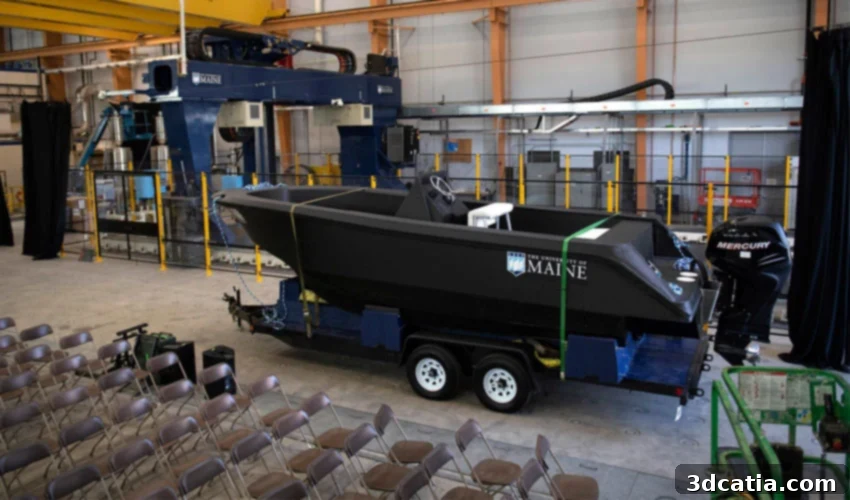
In a monumental leap forward for additive manufacturing and marine engineering, a dedicated team of researchers at the University of Maine (UMaine) has unveiled the largest solid 3D printed part ever created: a boat named the 3Dirigo. This groundbreaking achievement not only earned UMaine three prestigious Guinness World Records but also showcased the immense potential of large-format 3D printing in transforming traditional industries. Designed and manufactured on a colossal, custom-built polymer 3D printer at the UMaine Advanced Structures and Composites Center, the 3Dirigo measures an impressive 7.62 meters (25 feet) in length and weighs a substantial 2.2 tons (5,000 pounds). This initiative marks a significant milestone, particularly for the maritime sector, demonstrating how advanced manufacturing can revolutionize the design, prototyping, and production of large-scale structures.
The revelation of the 3Dirigo highlights a growing trend within the additive manufacturing landscape. A rising number of innovators and manufacturers are gravitating towards large-format 3D printing solutions. The primary motivation behind this shift is the ambition to fabricate extensive structures as single, monolithic pieces, thereby circumventing the time-consuming and often costly stages of assembly and post-processing. The University of Maine stands at the forefront of this movement, distinguished by its particular emphasis on the integration and utilization of advanced composite materials. This focus is further underscored by a significant $20 million investment received last May by UMaine’s esteemed partner, the Oak Ridge National Laboratory (ORNL), dedicated to developing a large-format additive manufacturing program centered on 3D printing materials enhanced with wood fiber. The successful 3D printing of the 3Dirigo boat, therefore, represents a pivotal and tangible advancement within this broader, government-supported research and development endeavor.
Setting New Benchmarks: The 3Dirigo’s World Records
The University of Maine’s ambitious project culminated in not one, but three remarkable Guinness World Records, solidifying its place in the annals of manufacturing history. The 3Dirigo was officially recognized as:
- The Largest 3D Printed Solid Part: Demonstrating an unprecedented scale in additive manufacturing.
- The Largest 3D Printed Boat: A testament to the feasibility of rapidly producing substantial marine vessels.
- The Largest 3D Printer: The colossal machine that brought the 3Dirigo to life, a marvel of engineering in its own right.
These records are more than mere accolades; they are powerful indicators of what is achievable when innovation, cutting-edge technology, and collaborative research converge. The ability to print such a large and functional object in a relatively short timeframe opens up a myriad of possibilities for various industries that have traditionally relied on slower, more labor-intensive manufacturing processes. The implications for rapid prototyping, on-demand manufacturing, and the use of sustainable, bio-based materials are profound.

The large-format 3D printer, next to the 3D printed boat | Image via UMaine
Innovating Production: The Manufacturing Process of the 3Dirigo
The successful creation of the 3Dirigo boat was made possible by the development of an extraordinary 3D printer, a result of a strategic collaboration between UMaine’s expert teams and Ingersoll Machine Tools. This partnership yielded a machine with a truly colossal printing volume, measuring an astounding 30 meters (100 feet) in length, 6.70 meters (22 feet) in width, and 3 meters (10 feet) in height. Such dimensions enable the production of exceptionally large components, setting new industry standards. Beyond its sheer size, the printer boasts an impressive material deposition rate of 227 kilograms (500 pounds) per hour, significantly accelerating the manufacturing process for large-scale parts.
A key feature of this advanced printer is its print head, which is ingeniously fixed on a gantry system mounted on rails. This design facilitates smooth and efficient movement along the entire length of the print bed, ensuring precise and consistent material application across vast surfaces. While the manufacturer continues to expand the range of compatible materials, the machine was purposefully engineered with a strong emphasis on utilizing raw materials of biological origin. This includes, most notably, cellulose derived from wood, aligning with sustainable manufacturing practices and leveraging Maine’s rich forest resources. The versatility and rapid prototyping capabilities of this 3D printer make it an ideal tool for diverse applications, including critical infrastructure development, civil engineering projects, and demanding defense sector requirements.
To comprehensively demonstrate the formidable capabilities of their newly developed large-format 3D printer, the UMaine teams embarked on the ambitious task of creating the 3Dirigo. This remarkable vessel was manufactured in an astonishingly short period of just 72 hours, showcasing the unparalleled speed and efficiency of the additive manufacturing process at this scale. The material chosen for the 3Dirigo was an innovative blend of plastic and wood cellulose, a composite that contributes to both the structural integrity and the sustainability of the boat. With its final dimensions of 7.62 meters in length and a weight of 2.2 tons, the 3Dirigo undeniably stands as the largest solid structure ever produced through 3D printing, a testament to UMaine’s pioneering spirit and engineering prowess.
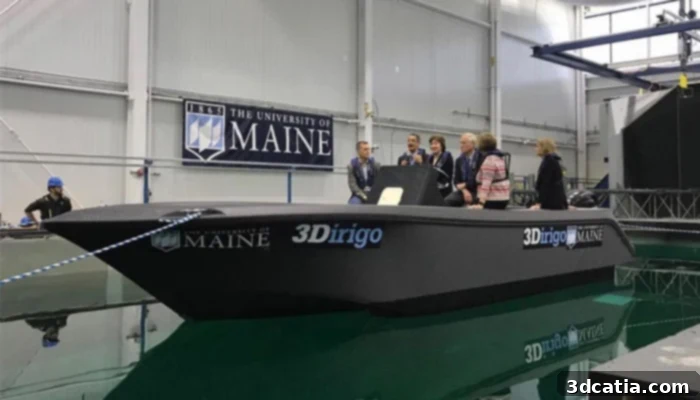
The boat has been tested by the Alfond W2 Ocean Engineering Laboratory test site
Beyond the Boat: Diverse Applications and Strategic Projects
The groundbreaking work at the University of Maine extends far beyond the 3Dirigo boat, with several other high-impact projects demonstrating the versatility and potential of their large-format additive manufacturing capabilities. During the same unveiling event, UMaine also showcased a second significant project: a 3.6-meter (12-foot) long 3D printed communication shelter meticulously designed for the U.S. military. This endeavor was a collaborative effort with the Combat Capabilities Development Command (CCDC), a crucial branch of the army focused on the rapid deployment of shelter systems for soldiers in dynamic operational environments. Colonel Frank Moore, the Military Assistant at the CCDC Soldier Center, underscored the transformative nature of these innovations, stating, “The innovation that we have witnessed here at the University of Maine will revolutionize how the Army prototypes and manufactures shelters, vehicles and other large systems. The lighter yet stronger 3D printed systems will advance the state of the art in additive manufacturing, forging the future of expeditionary equipment IAW with the Army’s new policy on advanced manufacturing.” This quote highlights the strategic importance of UMaine’s work for national defense, promising more agile and resilient military assets.
Further illustrating the printer’s broad utility, UMaine’s machine is also being leveraged to address the pressing needs for rapidly deployable and logistically efficient infrastructure systems. In a testament to this capability, the teams successfully printed a 2.2-ton, 6.4-meter (21-foot) long 3D mold. This massive mold is intended for the fabrication of a much larger, 23-meter (76-foot) long bridge girder. The completed bridge is slated for construction in Hampden, Maine, in the summer of 2020, representing a concrete application of additive manufacturing to civil engineering challenges. This project demonstrates how 3D printing can accelerate the construction of vital infrastructure, especially in areas where traditional methods are logistically challenging or time-consuming.
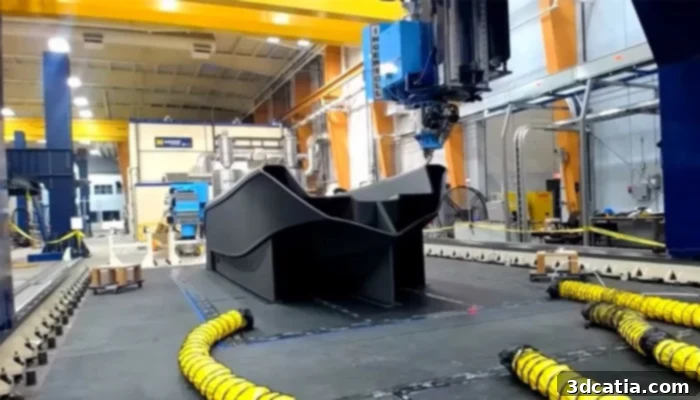
The boat took 72 hours to be 3D printed
A Collaborative Vision for the Future of Manufacturing
The pioneering work at the UMaine Advanced Structures and Composites Center is a testament to the power of collaboration across various sectors. Habib Dagher, the Executive Director of the Center, eloquently summarized the breadth of their partnerships and the vision for the future: “We are truly honored to be working with leaders from the Maine boatbuilding industry, Maine Forest Products Industry, the national construction industry, Maine Technology Institute, Oak Ridge National Laboratory, the U.S. Dept of Energy Advanced Manufacturing Office, the U.S. Office of Naval Research, the U.S. Army, and the U.S. Army Corps of Engineers. With this large printer, we will be able to accelerate innovation and prototype development in both the civilian and military sectors.” This comprehensive list of collaborators underscores the interdisciplinary and strategic importance of UMaine’s initiatives, aiming to drive innovation, foster economic development, and enhance national capabilities.
The integration of wood cellulose into the printing materials, supported by partners like the Maine Forest Products Industry, also highlights a commitment to sustainability and leveraging local resources. This approach not only provides a renewable material source but also contributes to the circular economy by utilizing byproducts from traditional industries. The ability to rapidly prototype and manufacture large-scale components using sustainable materials positions UMaine as a global leader in environmentally conscious advanced manufacturing.
The University of Maine’s achievements with the 3Dirigo boat and other large-scale 3D printed structures mark a pivotal moment in the evolution of additive manufacturing. By pushing the boundaries of size, speed, and material innovation, UMaine is not just breaking world records; it is actively shaping the future of how industries like maritime, defense, and infrastructure will design, build, and innovate. The rapid prototyping capabilities and the potential for on-demand, localized manufacturing of substantial parts promise to reduce lead times, cut costs, and foster unprecedented design flexibility. The ongoing research and future projects from the UMaine Advanced Structures and Composites Center are poised to continue revolutionizing manufacturing processes and creating sustainable solutions for complex engineering challenges globally. For more information, please visit the official UMaine news blog HERE.
What are your thoughts on these monumental achievements coming from the University of Maine and the future prospects of large-format 3D printing? Share your insights and join the discussion in a comment below or connect with us on our Facebook and Twitter pages! Don’t miss out on the latest advancements in the world of additive manufacturing; sign up for our free weekly Newsletter to receive all the breaking news directly in your inbox!