
The Digital Revolution: How 3D Printing is Reshaping Modern Dental Practices
The landscape of modern dentistry is continually evolving, driven by technological advancements that promise greater precision, efficiency, and improved patient outcomes. Among these innovations, 3D printing, also known as additive manufacturing, stands out as a transformative force. However, despite its widespread potential and the significant buzz surrounding it, a recent study by the American Dental Association (ADA) revealed a relatively modest current adoption rate. According to their findings, only 17% of dentists have integrated 3D printers into their dental practice. Furthermore, this adoption has been quite recent for most, with a substantial 67% of these early adopters having incorporated the technology for fewer than two years. Interestingly, while current usage is low, the future looks promising, as the study also indicated that 21% of non-users are actively considering acquiring or renting a 3D printer in the near future.
This dynamic presents an intriguing paradox. Market research conducted by Markets and Markets in 2022 projected that the global dental 3D printing market is poised for explosive growth, expecting to generate a staggering $7.9 billion by 2027. Such a colossal market valuation suggests immense potential and widespread application, yet current adoption rates among individual practitioners remain in the minority. This disparity raises critical questions: Why haven’t more dental professionals fully embraced this cutting-edge technology? What specific benefits and practical applications does 3D printing offer to justify such a robust market projection? And, perhaps most importantly, could it be universally beneficial for all dental practitioners to integrate 3D printing into their daily workflow to enhance patient care and practice efficiency?
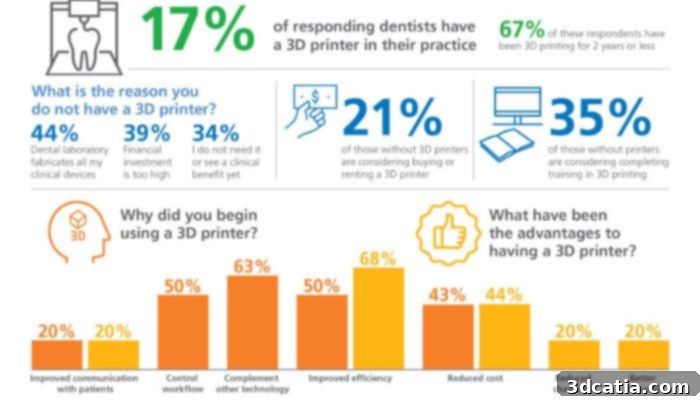
Only 17% of surveyed dentists currently utilize a 3D printer in their practice, according to the American Dental Association study.
Driving Factors: How 3D Printing Enhances Dental Practice Efficiency and Reduces Costs
Out of the 277 dentists surveyed by the ADA, the 17% who have adopted additive manufacturing reveal compelling reasons for their integration of this technology into their dental care practices. The primary drivers highlight a clear focus on operational improvement and enhanced control. According to the survey, 63% of adopters utilize 3D printing to complement other existing technologies, indicating its role in creating a more comprehensive digital workflow. A significant 50% of dentists incorporating 3D printing aim to improve overall control over their workflow, allowing for greater autonomy and less reliance on external laboratories. An equal percentage, 50%, anticipates that additive manufacturing will significantly enhance their practice’s efficiency, streamlining processes and reducing turnaround times. Furthermore, 43% of adopters are motivated by the potential for substantial cost reduction, a crucial factor in managing practice overheads and maximizing profitability.
The crucial question then becomes: does 3D printing truly live up to these high expectations? The empirical data from the survey overwhelmingly suggests that it does. Among the dentists who have adopted the technology, a significant 68% reported a tangible improvement in efficiency, validating the initial expectation of many users. Cost reduction, another key motivator, was realized by 44% of surveyed practitioners, demonstrating the financial benefits of in-house manufacturing. Beyond these primary metrics, 3D printing also positively impacted the patient experience and clinical outcomes. A notable 20% of users observed a decrease in consultation time, indicating faster and more streamlined appointments. Moreover, another 20% reported achieving better and more predictable results in their treatments, leading to enhanced patient satisfaction and clinical excellence. These statistics underscore the tangible and multifaceted advantages that 3D printing brings to a dental practice.
Versatile Applications of 3D Printing in Modern Dentistry
The versatility of additive manufacturing allows it to serve a wide array of applications within dentistry, from diagnostic stages to restorative procedures. The survey meticulously documented these specific uses:
- Diagnostic Models: Leading the pack, 62% of adopters utilize 3D printing for manufacturing highly accurate diagnostic models. These models are invaluable for treatment planning, patient education, and simulating complex procedures, providing a precise physical representation derived from intraoral scans or impressions. They allow for virtual articulation and detailed analysis of occlusal relationships, enhancing the quality of diagnosis and treatment strategy.
- Dental Splints and Occlusal Devices: Produced using 3D printing by 50% of dentists, these custom-fitted devices are crucial for managing bruxism, temporomandibular joint disorders (TMD), and for post-orthodontic retention. The ability to rapidly produce perfectly fitting splints in-house offers significant advantages in terms of patient comfort and quick turnaround.
- Surgical Guides: Nearly half (48%) of dentists use 3D printing for fabricating surgical guides. These precision guides are essential in implant dentistry, ensuring accurate placement of implants, reducing surgical invasiveness, and improving patient safety and predictability of outcomes. They are planned digitally based on CBCT scans and intraoral data.
- Temporary Crowns and Bridges: Used by 36% of practitioners, 3D printed temporary restorations allow for quick, chairside production of aesthetic and functional provisional crowns and bridges. This speeds up treatment, improves patient comfort during the interim period, and allows for immediate adjustments, optimizing the final restoration’s fit and appearance.
- Transparent Aligner Models: With the increasing demand for aesthetic orthodontics, 29% of dentists leverage 3D printing to create models for transparent aligners. This process is fundamental to the fabrication of clear aligners, enabling highly personalized and precise orthodontic treatment planning and delivery.
- Crown and Bridge Models: While related to diagnostic models, 26% of dentists specifically use 3D printing for creating models for permanent crowns and bridges. These models serve as highly accurate templates for fabricating or verifying indirect restorations, ensuring optimal fit and function before final cementation.
Despite this diverse range of applications, it is noteworthy that the majority of dental users (more than 50%) currently employ additive manufacturing for less than a quarter of the total devices they manufacture. This suggests that while the technology is being utilized, its full potential is yet to be unlocked in many practices, possibly due to a learning curve, specific case requirements, or evolving material science.
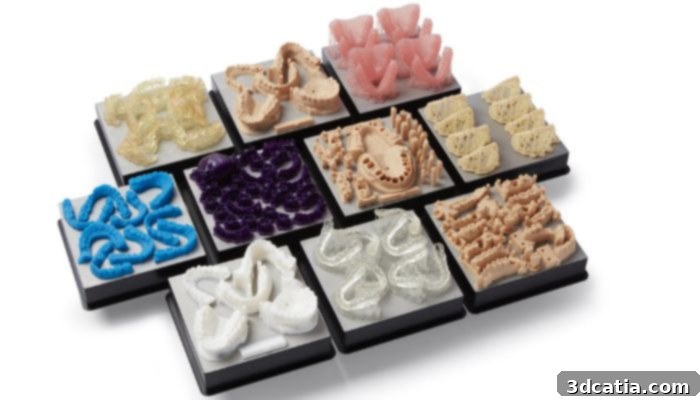
Custom dental splints and occlusal devices are produced using 3D printing by half of the surveyed dentists (Photo credits: Formlabs).
Overcoming Obstacles: Addressing Barriers to Widespread 3D Printing Adoption
Despite the myriad of benefits and diverse applications reported by dentists who have embraced 3D printing, several significant factors currently impede its widespread adoption within the dental sector. Understanding these barriers is crucial for developing strategies to accelerate the digital transformation of dentistry.
Firstly, a substantial number of dentists (44%) continue to rely on traditional dental laboratories for the manufacturing of their dental devices. This long-standing paradigm has its own efficiencies and established workflows, limiting dentists’ direct engagement with in-house additive manufacturing. The symbiotic relationship between practices and labs means that many practitioners simply outsource production, perceiving little need to invest in an in-house manufacturing setup. This reliance on external labs often stems from comfort with existing processes, a lack of familiarity with new technologies, or a belief that lab-based production is more cost-effective or less demanding in terms of expertise and maintenance.
Secondly, the initial cost associated with implementing 3D printing technology serves as a major deterrent for 39% of non-users. This includes not only the price of the 3D printer itself but also associated expenses such as specialized resins, post-processing equipment (like washing and curing units), software licenses, maintenance, and the necessary training for staff. While the long-term return on investment (ROI) through reduced lab fees and increased efficiency can be significant, the upfront capital expenditure can be prohibitive for smaller practices or those operating on tight budgets. Demonstrating a clear and compelling ROI model is essential to overcome this financial hurdle.
Furthermore, a notable 34% of dentists perceive additive manufacturing as irrelevant to their current profession or specific practice needs. This perception often arises from a lack of comprehensive understanding regarding the technology’s capabilities, its practical applications beyond a few well-known uses, or a misconception that it is only for highly specialized practices. Without proper education and exposure to the tangible benefits and diverse applications, many practitioners may fail to see how 3D printing could genuinely enhance their day-to-day operations and patient care. This knowledge gap highlights the need for more targeted educational initiatives, workshops, and accessible case studies to illustrate the value proposition of digital dentistry.
The Future is Now: Accelerating the Digital Dental Transformation
Despite the current hurdles, the potential for significant growth in the adoption of 3D printing within the dental sector is undeniably strong. Among dentists who do not currently use this technology, a promising 21% explicitly express intentions to incorporate it in the future, either by purchasing or renting a 3D printer. This “intent to adopt” group represents a critical segment ready to transition into the digital workflow. Additionally, an even larger percentage, 35% of non-users, are considering acquiring training in 3D printing. This indicates a growing curiosity, a recognition of the technology’s emerging importance, and a proactive openness to exploring its potential applications within their practices. This desire for education is a vital precursor to wider adoption, suggesting that as knowledge and confidence grow, so too will the integration of 3D printing.
Considering these factors – the reported benefits, the existing barriers, and the clear intent for future adoption – it raises the pivotal question of whether the dental sector will experience a rapid increase in the integration of 3D printing in the coming years, and if so, at what pace. The compelling benefits of improved efficiency, substantial cost reduction, enhanced workflow control, and consistently better clinical outcomes are powerful drivers that will undoubtedly encourage more dentists to embrace this technology. As the costs of 3D printers and materials continue to decrease, and as the technology becomes more user-friendly, the financial barrier will diminish. Simultaneously, addressing concerns related to perceived irrelevance through comprehensive education and practical demonstrations will be crucial for wider acceptance within the profession. Educational institutions, professional associations, and equipment manufacturers will play a vital role in showcasing the simplicity and efficacy of modern dental 3D printing solutions.
The trajectory of dental innovation points towards an increasingly digital future. 3D printing is not merely a niche tool but a foundational component of this digital shift, enabling personalized patient care, faster treatment times, and a more streamlined practice operation. As the dental community continues to recognize the tangible advantages and overcome initial hesitations, the transition towards a digitally-driven practice, with 3D printing at its core, appears not just probable, but inevitable. This will ultimately lead to a more efficient, precise, and patient-centric approach to dentistry.
What are your thoughts on this comprehensive study regarding the evolving role of 3D printing in dentistry? We invite you to share your insights in a comment below or join the conversation on ourLinkedIn,Facebook, andTwitter pages! Don’t forget to sign up for our free weeklyNewsletter here to receive the latest 3D printing news directly to your inbox. You can also explore all our informative videos on ourYouTube channel.