
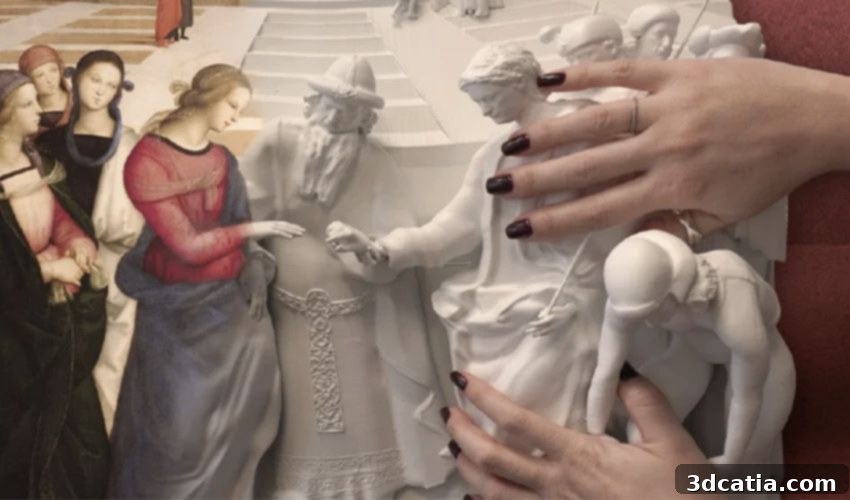
Touching Masterpieces: How 3D Printing Transforms Art Accessibility for the Visually Impaired with Valentin Haüy’s Tactile Tour
The world of art, with its myriad forms and expressions, has historically been perceived as a predominantly visual experience. However, a profound shift is underway, driven by innovative technologies and the unwavering dedication of organizations committed to universal accessibility. At the forefront of this movement in France is the Valentin Haüy association, a venerable voluntary organization established in 1889. For over a century, Valentin Haüy has been a beacon of support for visually impaired individuals across the nation, tirelessly working to break down barriers and foster inclusion in all facets of life – from education and employment to the enriching world of culture. Their mission is expansive, encompassing a vast array of initiatives designed to empower the blind and partially sighted, ensuring they have equitable opportunities and access to the cultural heritage that enriches human existence.
In 2022, the Valentin Haüy association unveiled one of its most innovative and celebrated projects to date: the “Tactile Tour.” This new, interactive temporary exhibition represents a groundbreaking approach to art appreciation, fundamentally redefining how masterpieces can be experienced. The exhibition features a meticulously curated collection of 12 relief reproductions of some of the world’s most iconic artworks. Imagine feeling the intricate details of Leonardo da Vinci’s enigmatic “Self-portrait,” tracing the harmonious proportions of his “Vitruvian Man,” or exploring the delicate narrative of Raphael’s “The Marriage of the Virgin” not with your eyes, but with your fingertips. The core objective of the Tactile Tour is elegantly simple yet powerfully transformative: to facilitate the discovery and appreciation of art through the sense of touch. For blind and visually impaired individuals, this offers an unparalleled opportunity to engage intimately with these revered works, allowing them to form a personal, tangible connection with art history. Crucially, the exhibition is designed to be universally accessible, welcoming everyone. Sighted visitors are encouraged to deepen their understanding and empathy by participating in the visit blindfolded, an experience that offers a profound insight into the world of tactile perception. To enhance the experience further, state-of-the-art headsets are provided, offering richly detailed audio descriptions that complement the tactile exploration of each artwork, bringing its history, context, and artistic nuances to life.
The innovative spirit behind the Tactile Tour lies in its ingenious integration of modern technology to breathe new life into classic art. The term “technological innovation” is not merely an embellishment but a precise descriptor, particularly given the pivotal role played by 3D printing in the creation of these extraordinary art reproductions. Additive manufacturing, commonly known as 3D printing, has emerged as a game-changer in the realm of accessibility, offering unprecedented capabilities to translate visual information into tactile forms. This application of 3D printing for making cultural heritage accessible to the blind and visually impaired is not an isolated phenomenon but part of a growing global trend. Indeed, the precedent for using this transformative technology in museum settings is already being established. A notable example comes from the city of Lancaster, England, where two visionary students successfully 3D printed relief versions of paintings housed in the city’s museum art collection. These pioneering efforts underscore the immense potential of 3D printing to democratize art, ensuring that its beauty and narratives are accessible to every individual, regardless of their visual abilities.
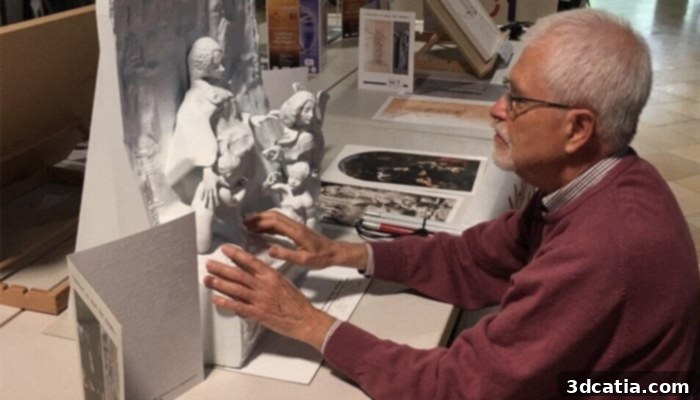
Rémy Closset is at the origin of the reproduction of the 12 works (photo credit: Valentin Haüy Association)
3D Printing for the Blind and Visually Impaired: A Gateway to Multisensory Art
The implementation of 3D printing in projects like the Tactile Tour represents a significant leap forward in cultural accessibility. Traditionally, experiencing visual art has been a challenge for the visually impaired, often limited to verbal descriptions or highly simplified models. However, 3D printing offers a nuanced and detailed solution. By converting two-dimensional images into three-dimensional relief models, it allows individuals to “see” with their hands, perceiving textures, depths, and compositions that were previously inaccessible. This tactile exploration fosters a much deeper understanding and appreciation of the artwork, transforming a passive auditory experience into an active, engaging, and personal journey of discovery. The technology allows for the precise reproduction of brushstrokes, contours, and spatial relationships, bringing out the essence of the original piece in a format perceivable by touch.
Crafting Tactile Art: The Role of Rémy Closset and Advanced Manufacturing
The meticulous and technically demanding task of creating these tactile reproductions for the Valentin Haüy association’s Tactile Tour fell to Rémy Closset. A former architect with a keen eye for detail and a deep understanding of spatial relationships, Closset is also a dedicated administrator of the association, bringing both artistic sensibility and practical expertise to the project. His process for developing the 12 relief artworks was a fascinating blend of digital artistry and advanced manufacturing techniques. Initially, Closset embarked on a comprehensive digital modeling phase, meticulously transforming high-resolution images of the original masterpieces into three-dimensional digital files. This required a profound understanding of how to interpret and translate visual cues into tactile information, emphasizing elements like depth, texture, and contour that would be meaningful to touch. Once the digital models were perfected, the physical creation process commenced. A portion of the works was brought to life using 3D printing, a method praised for its ability to produce complex geometries and fine details layer by layer. For other parts of the reproductions, an alternative method was employed: milling a polyurethane plate. This technique involves using a high-precision machine to carve out the relief from a solid block of material, offering a different approach to achieving desired textures and forms, particularly useful for larger, more robust sections. While specific details regarding the exact 3D printing technology or milling processes used have not been disclosed, the combination of these advanced manufacturing techniques highlights a pragmatic and sophisticated approach to achieving optimal tactile quality for each piece.
The impact of these tactile devices, as articulated by the Valentin Haüy association itself, is profound and far-reaching. They enable visually impaired individuals to truly “feel a work” – to engage with the art on a physical level that transcends mere description. This tactile engagement opens up a new avenue for experiencing the joy and wonder that sighted individuals derive from observing paintings, drawings, photographs, sculptures, or architectural monuments. It’s about shared cultural experiences, breaking down the invisible walls that have long separated the visually impaired from the rich tapestry of human artistic expression. By providing a tangible representation, these reproductions foster an emotional connection and a deeper appreciation for the artist’s intent and the piece’s historical significance, creating memories and understandings that are as vivid and personal as any visual encounter. This initiative truly embodies the spirit of universal design, ensuring that art is not an exclusive domain but a shared heritage for all.
The Tactile Tour: A Journey of Discovery Across Europe
Following its successful debut, the Tactile Tour embarked on an exciting journey, extending its reach to diverse audiences. The 2023 edition of the exhibition commenced its highly anticipated tour in Lyon in early January, met with enthusiastic reception from both the visually impaired community and the general public. From Lyon, this unique and inspiring exhibition is set to traverse the length and breadth of France, bringing its multisensory art experience to numerous cities and cultural centers. Beyond national borders, the Tactile Tour’s mission of cultural inclusivity extends internationally, with scheduled stops in Belgium, allowing a wider European audience to engage with these remarkable relief reproductions. The tour’s itinerary is carefully planned to ensure maximum accessibility, offering free admission wherever possible to remove financial barriers to cultural participation. Currently, the exhibition is delighting visitors in the historic city of Orleans, where the 12 captivating relief reproductions are presented to the public from March 6 to 11, 2023. These scheduled stops are more than just exhibition dates; they are opportunities for communities to come together, to learn, and to share in the universal language of art through a revolutionary new medium. The public’s response has been overwhelmingly positive, highlighting a genuine demand for more inclusive cultural experiences and underscoring the success of Valentin Haüy’s vision.
The Future of Inclusive Art and Cultural Accessibility
The success of initiatives like the Tactile Tour, powered by the capabilities of 3D printing, signals a promising future for cultural accessibility worldwide. Museums and galleries are increasingly recognizing the imperative of catering to diverse audiences, and technologies like additive manufacturing provide powerful tools to achieve this. Imagine a future where every museum actively offers tactile reproductions, where audio descriptions are standard, and where art truly welcomes all senses. This shift not only benefits the visually impaired but enriches the experience for everyone, fostering a deeper understanding of perception and empathy. The development of more sophisticated 3D printing materials and techniques promises even greater accuracy and fidelity in reproductions, potentially allowing for the capture of color variations through texture or temperature-sensitive materials, further broadening the scope of tactile exploration. The collaboration between art institutions, accessibility organizations, and technological innovators like Rémy Closset is crucial in driving this evolution. The Valentin Haüy association has set a commendable example, demonstrating that with vision and innovation, the barriers to art can be dismantled, opening up worlds of beauty and meaning to every individual.
We invite you to join the conversation: What are your thoughts on the transformative use of 3D printing to enhance the accessibility of art for the visually impaired? How do you envision this technology further shaping our cultural landscapes? Share your insights and comments below, or connect with us on our vibrant social media platforms: LinkedIn, Facebook, and Twitter! Don’t miss out on the latest advancements and news in the world of additive manufacturing. Be sure to sign up for our complimentary weekly Newsletter here to receive the freshest 3D printing news directly in your inbox! For visual learners and enthusiasts, you can also explore all our engaging videos and exclusive content on our dedicated YouTube channel. Your participation helps us foster a community passionate about innovation and accessibility.
*Cover photo credits : Valentin Haüy Association