
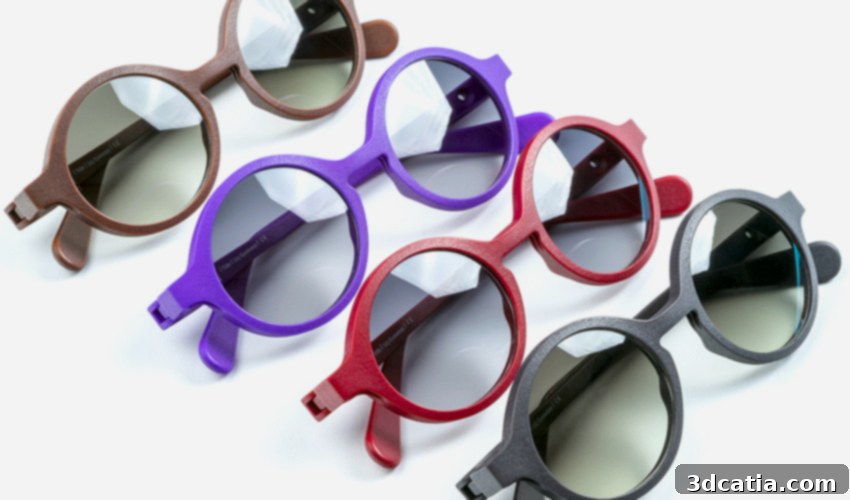
Revolutionizing Eyewear: Liq Eyewear Pioneers Personalized and Sustainable 3D Printed Sunglasses
In today’s rapidly evolving consumer landscape, personalization has become a paramount expectation. A revealing study by McKinsey & Company highlights that a remarkable 71 percent of consumers now anticipate highly personalized interactions from companies. This demand for tailored products is profoundly impacting various sectors, with consumer goods emerging as a prime area where advanced manufacturing technologies, particularly 3D printing, are gaining considerable traction and significance. Additive manufacturing, often simply referred to as 3D printing, brings a host of transformative advantages to this domain. It offers the unprecedented ability to customize products precisely according to individual customer preferences, drastically reducing both production time and associated costs. Among the innovators leading this charge is Liq Eyewear, a dynamic and forward-thinking company based in the vibrant city of Barcelona, Spain. Liq Eyewear has distinguished itself as a specialist in crafting stylish and functional sunglasses using cutting-edge additive manufacturing techniques. To better understand their vision, innovations, and the profound impact of 3D printing, we recently had the privilege of interviewing Josep Mateo Muñoz, the creative force behind this inspiring startup.
3DN: Can you please briefly introduce yourself and tell us how you got into 3D printing?

Josep Mateo Muñoz
My name is Josep Mateo Muñoz, and I wear a couple of hats: I am an industrial designer by profession and also serve as the creative director of Creax Design, an industrial design studio nestled in Terrassa, a bustling hub just outside Barcelona. Our studio prides itself on its expertise in designing and developing a diverse array of products, with a significant focus on eyewear for various esteemed brands. Historically, much of this work involved traditional manufacturing methods, which provided a solid foundation in understanding the intricacies of product development.
However, my journey into 3D printing began as we increasingly engaged in innovative projects that specifically incorporated 3D printed eyewear. This exposure quickly transformed my perspective on additive manufacturing. What started as a technology primarily used for creating prototypes soon evolved into a realization that 3D printing is exceptionally well-suited for producing final, consumer-ready products. I now consider 3D printing an indispensable and highly valuable manufacturing resource, extending far beyond its conventional prototyping role. Consequently, at Creax Design, we are proactive in identifying and integrating 3D printing solutions into our projects whenever this technology can offer substantial value and unique advantages to our clients, pushing the boundaries of what’s possible in product design and manufacturing.
3DN: Who is behind Liq Eyewear and how did the company come about?
Liq Eyewear was born from a deep understanding of design and a passion for embracing new technologies to solve existing challenges in the eyewear industry. At its core, 3D printing plays a fundamental and central role in our frame production process. We primarily leverage this technology for crafting critical components like the front frames and temples of our sunglasses, and sometimes exclusively for the entire front part, allowing for intricate designs and precise fits. However, the application of 3D printing at Liq Eyewear extends well beyond the glasses themselves. We ingeniously utilize it for advertising purposes, producing eye-catching display stands and small, customized accessories that enhance our brand presence and customer experience. Furthermore, 3D printing serves as an invaluable tool for rapidly crafting prototypes of new glasses designs, significantly streamlining and accelerating our design and iteration process.
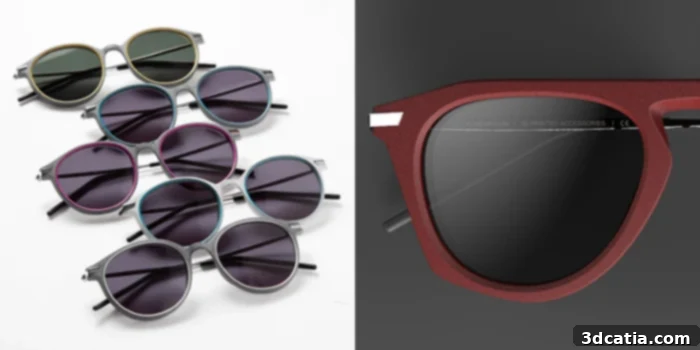
In our manufacturing philosophy, we firmly believe in a hybrid approach, embracing a thoughtful combination of different materials and manufacturing techniques. We hold the conviction that 3D printing and conventional manufacturing methods are not mutually exclusive but rather highly complementary. By synergizing these approaches, we can achieve the utmost perfection and quality in our products, leveraging the unique strengths of each technology. Consequently, we work with a diverse palette of materials, including advanced polymers for 3D printed components, often complemented by traditional materials like high-quality acetate and various metals for specific elements. This careful selection and combination of materials enable us to harness the individual strengths and aesthetic qualities of each, ultimately allowing us to create superior, durable, and uniquely designed eyewear that stands out in the market.
3DN: What advantages does this manufacturing method offer over conventional methods?
The benefits that 3D printing brings to the eyewear industry, especially when compared to conventional manufacturing methods, are incredibly diverse and impactful, driving innovation and efficiency across multiple fronts:
- Inventory-Free and Moldless Production: One of the most significant advantages is the elimination of the need for extensive capital investment in molds and tooling. Traditional eyewear manufacturing often requires costly molds for each design, making small batch production economically unfeasible. By avoiding these upfront investments, projects can proceed with unparalleled swiftness and flexibility. This ability to create small batches, customized runs, or even one-off pieces without the constraints of molds empowers small businesses like Liq Eyewear to experiment freely with new products and design ideas, rapidly adapting to dynamic market demands and consumer trends without incurring massive risks. It transforms the supply chain, moving away from large stock piles to agile, on-demand production.
- Agile Development and Improvement: 3D printing inherently supports an agile development cycle. When an issue arises in a design or a change is required, 3D models can be swiftly revised and updated in digital form. This allows for quick, seamless updates to the glasses during the printing phase, much like applying a software update to an application. Designers can iterate rapidly, testing new geometries, fits, and aesthetic elements with minimal delay and cost. In stark contrast, conventional manufacturing methods face immense challenges and expenses in making such adjustments, often requiring new molds or significant retooling, which prolongs development cycles and stifles innovation.
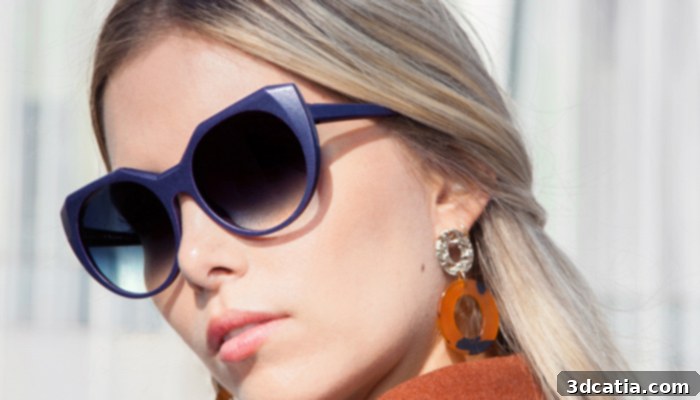
- Lightweight Design: Comfort is paramount for eyewear. 3D printing excels in creating complex, lightweight structures that are simply not achievable with traditional methods. As a direct result, 3D printed glasses are approximately 50% lighter than traditional acetate glasses, providing a dramatic improvement in comfort and overall wearability for the end-user. This reduction in weight minimizes pressure points and allows for extended use without discomfort, enhancing the overall user experience and making Liq Eyewear products particularly appealing for daily wear.
- Environmentally Friendly and Sustainable Practices: In an era of increasing environmental consciousness, 3D printing stands out for its ecological and sustainable advantages. By enabling on-demand production, items are only produced upon sale or specific order, which drastically reduces excess inventory and minimizes material waste. Furthermore, the nature of additive manufacturing means that replacement parts can be easily printed, even for discontinued models, significantly prolonging the product’s life cycle and minimizing waste generation. This approach aligns perfectly with circular economy principles, making 3D printing a far more environmentally favorable and responsible method than traditional mass manufacturing, which often leads to overproduction and disposal.
- Limitless Customization Opportunities: The inherent flexibility of 3D printing unlocks unprecedented possibilities for customization. The technology allows for the precise production of various sizes, limited editions, and even completely unique models made to order. From subtle fit adjustments to bespoke aesthetic elements, customers can have products tailored to their exact specifications. This level of personalization extends beyond simple color changes to truly custom geometries and ergonomic solutions, offering an unparalleled individualized experience that builds strong customer loyalty and meets the growing demand for unique products.
- Unrestrained Creativity for Designers: For industrial designers, 3D printing is a liberating technology. It allows them to fully unleash their creativity, as the only true limit becomes the designer’s imagination and their ability to translate concepts into a 3D model. Any design that can be accurately modeled digitally can be transformed into a physical product. This opens up a vast world of creative possibilities, enabling designers to explore complex geometries, organic forms, intricate textures, and innovative structural designs that would be impossible or prohibitively expensive to produce with conventional injection molding or machining processes.
3DN: What do you think the future holds for additive manufacturing in your line of work?
As technology continues its rapid progression, particularly concerning surface finishes, available colors, and the introduction of advanced materials, it is not just probable but highly certain that an increasing number of brands across the eyewear industry will adopt 3D printing as a primary method for manufacturing their products. The advancements in materials will allow for even greater durability, flexibility, and aesthetic appeal, making 3D printed eyewear indistinguishable, if not superior, to traditionally manufactured frames.
Looking ahead, the coming years are also expected to witness a significant surge in the popularity and development of “smart glasses.” This innovative category will further blur the lines between traditional eyewear and sophisticated technology, integrating augmented reality, biometric sensors, and connectivity directly into frames. This increasing convergence of fashion, function, and technology will undeniably highlight the critical significance of 3D printing. Additive manufacturing’s ability to create complex internal structures, integrate electronics seamlessly, and offer bespoke fitting will be indispensable for the successful development and mass adoption of smart glasses, opening up a boundless world of possibilities in this exciting new frontier for eyewear.
3DN: Do you have any final words for our readers?
In the dynamic realm of eyewear, particularly within the fast-paced fashion segment, it has become customary to introduce countless new models and colors at an accelerated pace, a trend often characterized as “fast fashion.” This approach, while commercially driven, often leads to overproduction and increased waste. However, I am firmly convinced that 3D printing offers a transformative solution for establishing a more sustainable and responsible approach not only to fashion eyewear but for the entire fashion industry as a whole. By wholeheartedly embracing 3D printing, we can facilitate a pivotal transition towards a “slow fashion” model. This paradigm shift means production is strictly limited to only what is genuinely in demand, eliminating speculative manufacturing and the resulting accumulation of unsold inventory.
This conscious consumption concept extends far beyond eyewear and is applicable across a multitude of sectors. 3D printing inherently enables us to be significantly more environmentally conscious by meticulously producing only what is truly necessary, reducing waste, conserving resources, and minimizing our carbon footprint. It’s about creating value, quality, and individuality without compromising the planet. For readers eager to explore our innovative designs and sustainable approach, we invite you to learn more about Liq Eyewear by clicking HERE.
What are your thoughts on Liq Eyewear’s groundbreaking 3D printed sunglasses and the broader implications of additive manufacturing for sustainability and personalization? We would love to hear your opinions! Please share your insights in a comment below or connect with us on ourLinkedIn,Facebook, andTwitter pages! Don’t forget to sign up for our free weeklyNewsletter here to get the latest 3D printing news delivered straight to your inbox! You can also find all our compelling videos on ourYouTube channel.
*All photo credits: Liq Eyewear