
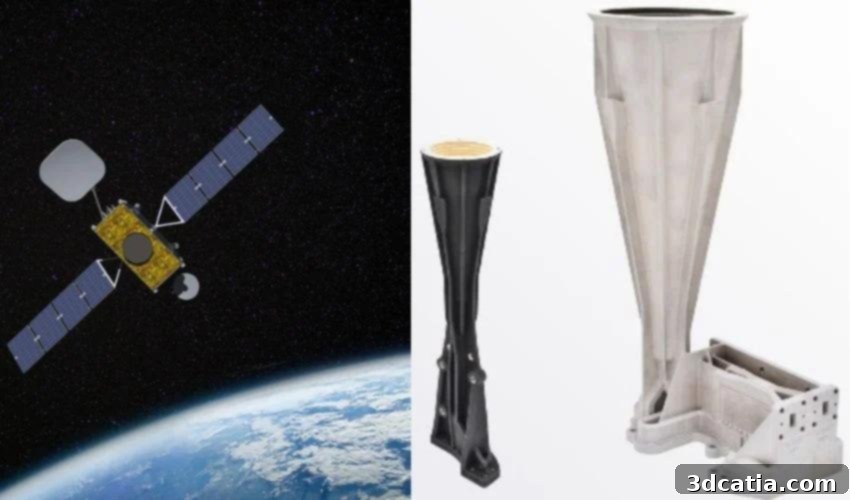
Northrop Grumman Integrates SWISSto12’s Advanced 3D Printed RF Antennas for GEOStar-3 Commercial Satellites
In an era defined by rapid technological advancement, high-frequency systems and sophisticated satellites stand as pillars of global connectivity, scientific discovery, and national security. These vital assets are instrumental in the intensive observation and exploration of space, the intricate analysis of complex weather phenomena, and the seamless enablement of worldwide communication networks. As humanity’s ambitions in space grow, so do the demands placed upon these systems, requiring them to provide ever more comprehensive, precise, and reliable data. This escalating need for superior performance exerts significant pressure on companies operating within this specialized field, driving them to innovate continuously and develop increasingly powerful and efficient systems.
Leading this charge in innovation is Northrop Grumman Corporation, a globally recognized American powerhouse in the aerospace and defense sectors. The company is currently spearheading the development of its groundbreaking GEOStar-3 communications satellite system, a testament to its commitment to advancing space technology. Designed to meet the evolving needs of commercial satellite operators, the GEOStar-3 system boasts an impressive capacity, capable of carrying payloads weighing up to 800 kilograms and delivering a robust 8000 watts of power. To ensure the successful and timely implementation of this ambitious project, Northrop Grumman is strategically leveraging a blend of cutting-edge technologies and specialized expertise, prominently including Swiss innovation.
SWISSto12: A Pioneer in RF Additive Manufacturing for Space
For the critical GEOStar-3 commercial satellite program, Northrop Grumman has forged a key partnership with St12 RF Solutions, the U.S. subsidiary of SWISSto12. This collaboration is centered around the supply of three fully integrated Radio Frequency (RF) antenna chains, components that are absolutely vital for the satellite’s communication capabilities. SWISSto12, headquartered in Lausanne, Switzerland, has rapidly emerged as a leading manufacturer of advanced satellite RF products, payloads, and entire systems since its founding in 2011. The company’s impressive growth trajectory has seen it expand significantly across Europe, notably through its collaborative efforts with the European Space Agency (ESA) on the innovative HummingSat geostationary telecommunications satellite program.
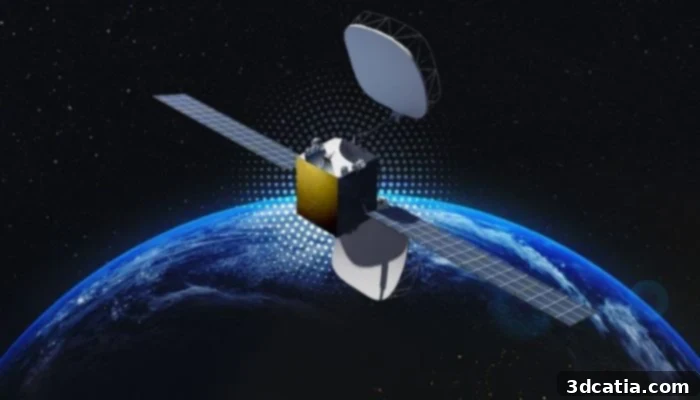
SWISSto12 worked with ESA on the HummingSat satellite, demonstrating their expertise in space-grade RF components.
A significant enabler of SWISSto12’s rapid success and industry leadership is its pioneering additive manufacturing technology, specifically tailored for high-frequency RF applications. This innovative approach is precisely what is being utilized to produce the highly complex and critical RF antenna chains for the GEOStar-3 satellite program. By harnessing the power of 3D printing, SWISSto12 is redefining what is possible in the design and production of space-grade RF components, offering unparalleled performance and efficiency.
The Unrivaled Advantages of Radio Frequency Additive Manufacturing (RFAM)
The feed chains developed for the GEOStar-3 satellite exemplify the transformative potential of SWISSto12’s proprietary Radio Frequency Additive Manufacturing (RFAM) process. Unlike traditional manufacturing methods that often involve assembling multiple discrete components, these feed chains are designed and produced as single, monolithic assemblies. This groundbreaking approach integrates several critical elements—including diplexers, filters, polarizers, apertures, and various mechanical interfaces—into a cohesive, single-piece structure. This level of integration is a significant departure from conventional fabrication, which typically relies on intricate machining, brazing, or bolting together numerous individual parts, each with its own manufacturing tolerances and potential points of failure.
RFAM technology transcends previous production limitations, enabling the creation of extraordinarily complex and unconventional designs that were once considered unattainable. Historically, engineers faced severe constraints dictated by performance targets, strict weight limitations, spatial requirements, and exorbitant manufacturing costs. RFAM effectively overcomes these barriers, allowing for designs that are optimized not only for RF performance but also for structural integrity and thermal management, all within a compact and lightweight form factor. The ability to realize such intricate geometries in a single manufacturing step significantly reduces the complexity of assembly, minimizes the risk of human error, and improves overall system reliability—a paramount concern for missions in the harsh environment of space.
Furthermore, this advanced additive manufacturing technique allows for superior optimization of design parameters, tighter manufacturing tolerances, and exceptional surface finishes. The precision afforded by RFAM directly translates into enhanced RF performance, reduced signal loss, and improved operational efficiency. By minimizing the number of interfaces and connections inherent in multi-part assemblies, RFAM inherently reduces potential sources of signal degradation and structural weakness. The result is a substantial reduction in both the size and weight of the components, while simultaneously meeting or even exceeding the incredibly stringent performance and reliability requirements mandated by the GEOStar-3 program and indeed, by the entire aerospace industry. This paradigm shift in manufacturing capability is crucial for next-generation satellites, which demand lighter, more powerful, and more resilient components to deliver advanced services and explore new frontiers.
Successful Qualification and Delivery: A New Benchmark
The rigorous qualification program for these advanced RF antenna chains was successfully completed earlier this year, marking a significant milestone for both SWISSto12 and Northrop Grumman. Following this triumphant validation, St12 RF Solutions proudly announced the development and delivery of three fully integrated RF antenna chains. These highly sophisticated feed chains are now poised for incorporation into the GEOStar-3 payload, ensuring that the ambitious launch schedule for the GEOStar-3 satellite can proceed as planned for 2024. This achievement underscores the maturity and reliability of SWISSto12’s additive manufacturing processes and its capability to deliver space-qualified hardware.
The successful fulfillment of this order from Northrop Grumman, encompassing the challenging space qualification process and the subsequent delivery of the feed chains, represents an extraordinary leap forward for SWISSto12. It solidifies their position as a trusted and innovative supplier to the global space industry. Scott Wolf, the astute Managing Director of the U.S. subsidiary St12 RF Solutions, articulated the significance of this accomplishment:
SWISSto12 is delighted to announce this first delivery to Northrop Grumman of cutting-edge Radio Frequency Antenna Feed Chains for one of its commercial GEOStar-3 programs. Our novel Radio Frequency Additive Manufacturing capabilities coupled with advanced monolithic designs enabled by 3D printing have created a new benchmark in Antenna Feed Chain size, weight and performance. Our Radio Frequency Additive Manufacturing and HummingSat geostationary SmallSat businesses have delivered over $200 million in customer orders to date, validating our mission to push the limits of existing payload capabilities to better protect and connect every corner of the world.”
Wolf’s statement highlights several crucial aspects of this milestone. The phrase “cutting-edge Radio Frequency Antenna Feed Chains” emphasizes the advanced nature of the technology, while the “new benchmark in Antenna Feed Chain size, weight and performance” speaks to the tangible benefits derived from their additive manufacturing approach. By integrating multiple components into a single, monolithic design, SWISSto12 has not only optimized the physical characteristics of these critical satellite components but has also enhanced their functional performance in unprecedented ways. The impressive figure of “over $200 million in customer orders” to date serves as a robust validation of SWISSto12’s business model and its overarching mission: to continually “push the limits of existing payload capabilities” to foster a more connected and secure global environment. This reflects a broader trend in the aerospace industry, where innovative manufacturing techniques like 3D printing are enabling smaller, more cost-effective, and more capable satellite platforms, fundamentally transforming access to space and its applications.
The Future of Satellite Technology Powered by 3D Printing
The collaboration between Northrop Grumman and SWISSto12 on the GEOStar-3 program is more than just a successful partnership; it’s a clear indicator of the transformative power of additive manufacturing in the aerospace and defense sectors. As the demand for satellite-based services continues to surge, from high-speed internet to advanced Earth observation and secure communications, the need for lighter, more efficient, and more robust components becomes increasingly critical. 3D printing, and specifically RFAM, offers a compelling solution by enabling the creation of complex geometries that are impossible with traditional methods, leading to significant reductions in weight, improved performance, and shorter development cycles. This directly contributes to lower launch costs and extended satellite lifespans, maximizing the return on investment for satellite operators.
The successful deployment of SWISSto12’s 3D-printed RF components on a major commercial satellite like GEOStar-3 serves as a powerful validation of additive manufacturing’s readiness for mainstream space applications. It paves the way for wider adoption of these technologies across the industry, fostering an ecosystem where innovation can thrive and new possibilities in space exploration and utilization can be unlocked. From geostationary communication satellites to constellations of Low Earth Orbit (LEO) smallsats, the ability to rapidly produce highly customized, high-performance RF components will be a cornerstone of future space architectures. This signifies a bright future for companies like SWISSto12, who are at the forefront of leveraging advanced manufacturing to connect and protect our world from orbit.
What are your thoughts on SWISSto12 and its innovative additive manufacturing technology for high-frequency products in space? We invite you to share your insights and comments below or engage with us on our LinkedIn, Facebook, and Twitter pages! Don’t miss out on the latest advancements in 3D printing and space technology; sign up for our free weekly newsletter here to receive breaking news directly in your inbox! You can also explore all our informative videos and exclusive content on our YouTube channel.
*All Photo Credits: SWISSto12