
Laminated Object Manufacturing (LOM): A Comprehensive Guide to This Unique Additive & Subtractive 3D Printing Technology
Within the vast and rapidly evolving landscape of additive manufacturing, often referred to as 3D printing, a diverse array of technologies exists, each with its own unique methodology and applications. While widely recognized methods such as Fused Deposition Modeling (FDM) and Stereolithography (SLA) dominate much of the industry’s discourse, there are other, more specialized processes that offer distinct advantages for particular needs. One such intriguing process is Laminated Object Manufacturing (LOM). LOM stands out as a unique rapid prototyping technique that ingeniously combines both additive and subtractive manufacturing elements. This hybrid approach makes LOM a distinctive and valuable player in the ever-expanding 3D printing landscape, capable of producing robust and detailed prototypes with specific material characteristics.
The origins of Laminated Object Manufacturing can be traced back to 1991 when Helisys Inc., an American company, first introduced the technology. Their innovative process involved layering sheets of material, typically paper coated with adhesive on one side, which were then fused together. A digitally controlled laser was subsequently used to cut the outline of the desired object from each layer. This pioneering method laid the groundwork for future advancements in layered manufacturing. Decades later, in 2003, two brothers, Conor and Fintan MacCormack, significantly evolved the LOM process through their company, Mcor Technologies. Their approach was particularly noteworthy for its accessibility and cost-effectiveness: they utilized standard office paper and an inkjet printer to print designs onto each sheet. These printed sheets were then stacked and gradually built up, layer by layer, to form the object. A tungsten blade was then employed to precisely cut away the excess paper around the printed design, revealing the final three-dimensional object with remarkable detail and often, vibrant color.
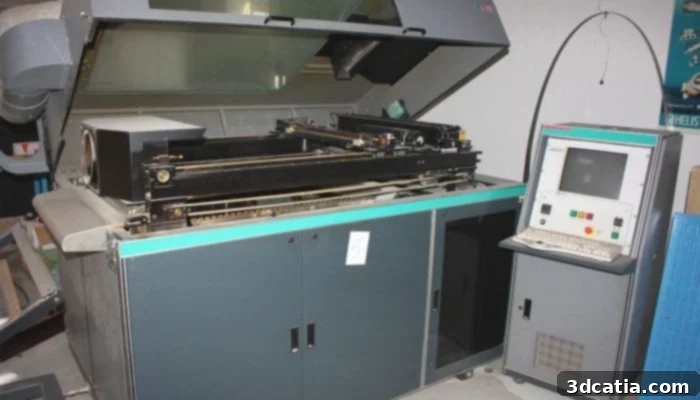
The discontinued Helisys LOM-2030 Rapid Prototype Modeling Machine, built in 1997 (Photo credits: KJ Auktion)
Mcor Technologies continued to refine their innovation, successfully transitioning it into the commercial market. A significant advancement came with the introduction of CMYK (Cyan, Magenta, Yellow, Key/Black) color printing directly onto the paper sheets. This capability allowed for the creation of incredibly vibrant and realistic objects, making their technology highly suitable for promotional materials, visual prototyping, and architectural models where aesthetic appeal is paramount. This enhanced method was termed Selective Deposition Lamination (SDL). With SDL, color designs were printed onto the paper sheets before a heat-activated adhesive was selectively applied to the areas corresponding to the object’s geometry. This selective adhesion, followed by cutting, meant that the unglued waste material could be more easily removed from the final object, simplifying post-processing and improving the overall efficiency of the LOM process. This evolution cemented LOM’s place as a viable and unique 3D printing technology. But how exactly does this fascinating combination of additive and subtractive processes work today, and for what applications is it best suited? To comprehensively understand Laminated Object Manufacturing, let’s delve deeper into its operational mechanics and primary uses.
How Does Laminated Object Manufacturing Work?
Unlike many conventional 3D printing technologies that exclusively build objects layer by layer from molten plastic or cured resin, Laminated Object Manufacturing (LOM) employs a distinct and sophisticated methodology. As previously highlighted, LOM uniquely integrates both additive and subtractive manufacturing techniques, offering a hybrid approach to part creation. This combination allows for a broader range of material use and specific structural properties that set it apart.
The process initiates with the additive phase, where layers of sheet material are bonded together. Typically, these sheets come pre-coated with a heat-activated adhesive on one side. The machine feeds these sheets, one at a time, onto a build platform. Heat and pressure are then applied to each new layer, ensuring a strong and consistent bond with the previously laid sheet. This step is crucial for creating a solid, cohesive block of material, gradually building up the overall height of the object. Once a new layer is securely bonded, the subtractive component of LOM takes over. A high-precision laser cutter, guided by a digital design file (usually a CAD model), meticulously traces and cuts the outline of the object’s cross-section on the newly added layer. The laser cuts through the top layer and potentially a few underlying layers, but not entirely through the whole stack. The areas identified as waste material are cut into a grid pattern or small cross-hatched sections, which simplifies their removal during post-processing. This meticulous laser cutting ensures that each layer is intricately shaped to fit perfectly with the layers above and below it, resulting in a three-dimensional object characterized by tightly fused layers. The seamless fusion of these additive bonding and subtractive cutting steps in LOM enables the production of robust, complex, and accurately shaped objects, making it a promising and versatile technique for various applications across numerous industries. The hybrid nature of LOM not only facilitates efficient material utilization but also contributes to the creation of parts with excellent mechanical strength.
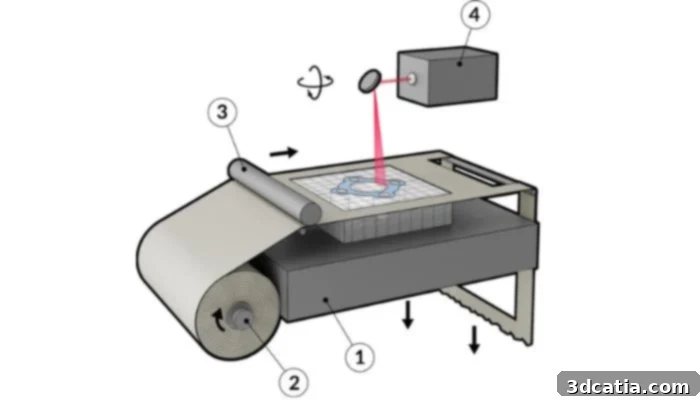
The LOM process involves gluing and cutting into sheets of material layer-by-layer using laser cutting (Photo credit: Manufacturing Guide Sweden AB)
LOM’s versatility is further highlighted by its ability to process a diverse range of materials, although specific machine capabilities may vary. Paper remains the most popular and cost-effective feedstock for LOM. When laminated, paper objects exhibit properties akin to wood, making them ideal for prototypes that require a certain level of rigidity and a natural feel. Furthermore, paper LOM parts can often be infiltrated with hard-setting resins or epoxies post-printing to significantly enhance their rigidity, durability, and moisture resistance, broadening their potential uses. Beyond paper, LOM technology can also utilize sheets of plastic, metal, and various composite materials. However, working with these alternative materials can present different challenges. For instance, metal sheets might require higher-power lasers and different bonding agents, and plastic sheets may need specific temperature controls to prevent warping during lamination. Despite these considerations, the ability to work with a range of materials offers significant flexibility for engineers and designers seeking specific mechanical or aesthetic properties for their prototypes.
The applications of LOM are incredibly diverse and impactful across various sectors. Its primary strength lies in rapid prototyping, where it excels at creating physical representations of designs ranging from small components to large, intricate models. For visual communication, LOM is unparalleled in producing full-color marketing props, product mock-ups, and highly detailed architectural models. These models are invaluable for client presentations, urban planning, and design validation, offering a tangible representation that digital renderings cannot fully replicate. The technology is particularly well-suited for companies seeking in-house prototyping solutions, especially in office environments, due to its relatively clean operation and the use of readily available materials like paper. Moreover, LOM plays a crucial role in traditional manufacturing processes by enabling the creation of sacrificial patterns for sand casting or investment casting. These patterns, often made from paper or composite LOM parts, are burned out during the casting process, leaving behind a cavity for molten metal. This allows for the production of highly complex and intricate metal shapes and designs that would be difficult or impossible to achieve with traditional pattern-making methods. The combination of speed, material flexibility, and the ability to produce large, robust models makes LOM a valuable asset for product development and specialized manufacturing.
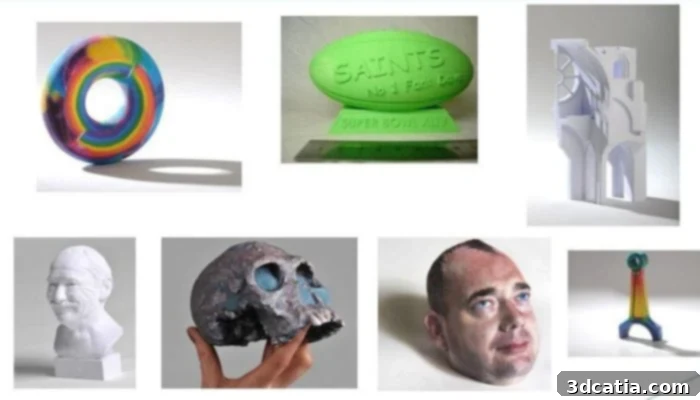
Objects made with Laminated Object Manufacturing (Photo credit: MKS Technologies Pvt Ltd)
Advantages and Disadvantages of LOM
Like any advanced manufacturing technology, Laminated Object Manufacturing presents a unique set of advantages and disadvantages that influence its suitability for specific projects and industries. Understanding these trade-offs is crucial for making informed decisions when considering LOM for a particular application.
On the positive side, LOM offers several compelling benefits. Firstly, it is a highly **cost-effective method**, especially when utilizing paper as the primary material. Standard office paper is significantly less expensive than specialized resins, powders, or filaments used in other 3D printing techniques, making LOM an attractive option for budget-conscious prototyping. Secondly, LOM stands out for its **ability to produce larger objects** compared to many other additive manufacturing processes. The sheet-based approach allows for the creation of substantial prototypes and models, as the build volume is often determined by the size of the material sheets rather than a restrictive enclosed chamber. Thirdly, the resulting LOM objects exhibit **good structural integrity** due to the dense lamination and strong bonding of layers under heat and pressure. This makes them surprisingly robust and well-suited for functional testing and design validation in early stages of product development. Fourthly, LOM’s construction process inherently **minimizes the need for intricate or separate support structures**. The uncured or unglued surrounding material from each layer effectively acts as its own support, eliminating the tedious and material-intensive process of printing and removing dedicated supports, thereby reducing material usage and post-processing efforts. Finally, LOM typically achieves a **smoother surface finish on the exposed vertical sides** of the objects compared to some FDM prints, lessening the necessity for extensive finishing work in these areas. While horizontal surfaces will still show layer lines, the vertical surfaces can be quite presentable directly off the machine.
Conversely, Laminated Object Manufacturing comes with its fair share of drawbacks that must be carefully considered. One significant limitation is the **restricted range of materials** available. While paper is versatile and cost-effective, it may not possess the mechanical properties (e.g., strength, temperature resistance, chemical resistance) required for high-performance engineering applications. While plastics and composites can be used, their availability and processing requirements are more specialized. Secondly, the **production speed can be relatively slow**, especially for highly intricate designs or when producing many small parts on a single build. The process involves laying, bonding, and precisely cutting each individual layer, which can be time-consuming and may hamper time-sensitive projects requiring rapid iteration. Thirdly, the nature of the LOM process often leads to **visible seams or layer lines on the surface of the object**, particularly on horizontal or sloped surfaces. While post-processing like sanding, filling, and painting can mitigate this, it can affect the overall aesthetics and may not be suitable for applications demanding exceptionally smooth, seamless finishes directly from the printer. Fourthly, LOM may not achieve the same level of **fine detail and precision** as some other 3D printing methods, such as SLA or DLP, due to the inherent kerf of the laser or blade used for cutting. This could be a limitation for projects that require extremely intricate features or very tight tolerances. Lastly, a notable concern is the **generation of waste material** during the cutting process. The excess material from each layer, though often neatly cross-hatched, is typically bonded with adhesive, which can complicate recycling efforts and raises environmental considerations regarding waste disposal. Furthermore, paper-based LOM parts are generally sensitive to moisture, requiring careful storage and potentially post-processing for protection in humid environments.
While LOM might not serve as a universal replacement for other established 3D printing techniques, it undoubtedly remains a compelling and highly valuable option for certain specialized applications. Its distinct combination of cost-effectiveness, particularly with paper-based systems, and its ability to produce substantial, full-color visual prototypes make it an extremely attractive choice for rapid prototyping purposes in design, architecture, and marketing. However, companies looking to invest in their first 3D printer should meticulously assess their specific operational needs, considering factors such as required material properties, desired part accuracy, and throughput. They should also evaluate the availability of hardware, material suppliers, and user support within the relatively niche LOM community to ensure a sustainable and productive investment.
In conclusion, Laminated Object Manufacturing holds a unique and important niche within the broader additive manufacturing landscape. With its ingenious combination of additive and subtractive processes, its affordability—especially when leveraging paper as a primary feedstock—and its capacity for producing large, detailed models, LOM continues to be an intriguing and practical option for rapid prototyping, visual mock-ups, and specific modeling needs. As additive manufacturing technologies continue their rapid advancement, LOM-adjacent techniques, such as ultrasonic consolidation (a low-temperature 3D printing method for metals that also uses sheet lamination), could potentially become even more powerful and widespread tools in modern manufacturing, further solidifying the relevance of layered material processes. The fundamental principles of LOM, focusing on layered material deposition and precision cutting, highlight a resourceful and efficient pathway to creating three-dimensional objects.
What are your thoughts on Laminated Object Manufacturing and its potential applications? We invite you to share your insights in a comment below or join the conversation on our LinkedIn, Facebook, and Twitter pages! Don’t forget to sign up for our free weekly Newsletter here to receive the latest 3D printing news directly to your inbox. You can also explore all our informative videos on our YouTube channel for more content on additive manufacturing innovations.
*Cover photo credits: Wevolver