Guides
#Working3D: Six Questions for a 3D Printing Biomedical Engineer
Today we bring you a new installment of #Working3D, the series of articles in which we give insight into the different jobs available in the additive manufacturing industry. Specifically, we will go into detail on a position in one of…
- 3 min read
- Guides
- Six more stories
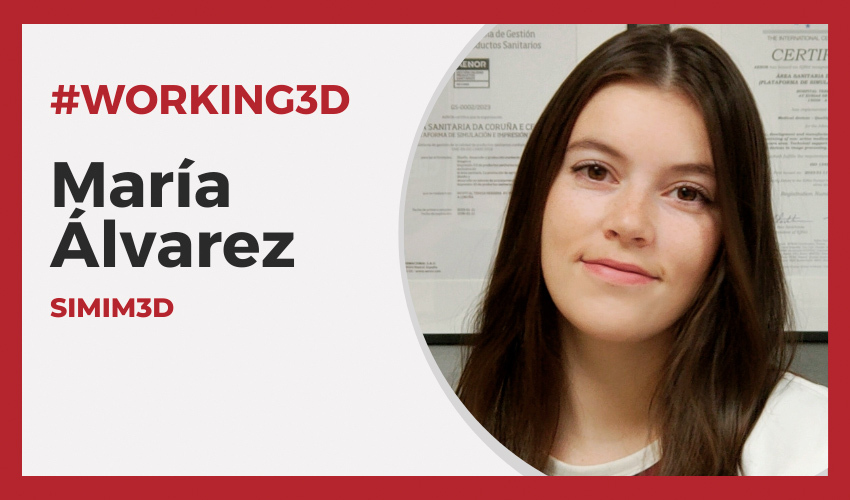
Today we bring you a new installment of #Working3D, the series of articles in which we give insight into the different jobs available in the additive manufacturing industry. Specifically, we will go into detail on a position in one of the sectors in which 3D printing plays a key role: the medical sector. According to a report by Global Market Insights, the 3D printing market in the healthcare sector is expected to reach a value of $19.5 billion by 2032. This growth is due, in part, to increased private and public investments in research and development (R&D) activities. And in this new installment we will understand the day-to-day life of an expert in additive manufacturing working in the industry. We interviewed María Álvarez, a biomedical engineer and quality manager at SIMIM3D, to learn a little more about her professional work and her relationship with 3D technologies.
3DN: Could you introduce yourself?

María Álvarez Caballero, biomedical engineer.
My name is María Álvarez Caballero. I graduated with a degree in Biomedical Engineering, with specialization in medical devices, biomaterials and biomechanics, from the Polytechnic University of Madrid (UPM) in 2016. Then, I completed a Master’s Degree in Biomedical Engineering, with specialization in advanced implant design techniques and tissue engineering, from the Polytechnic University of Valencia (UPV) in 2017. Currently, I am a biomedical engineer and quality manager at the Simulation and 3D Printing Platform (SIMIM3D) of the Health Area of La Coruña.
3DN: How did you discover additive manufacturing?
My experience in the working world began at the Hospital Universitario y Politécnico La Fe in Valencia, where I started working as a biomedical engineer in the Clinical Simulation and Patient Safety Area. Basically, I was dedicated to facilitating, technologically and logistically, the recreation of certain situations and environments so that healthcare professionals could experience the representation of real clinical care events, for different purposes: practicing, learning, evaluating, experimenting, etc.
More from the desk
Six other notes from the rest of the bench.
 NewsThe ‘World’s Best Tiramisu’ Was Recreated With 3D PrintingYes, you read that right. The world’s best tiramisu can now be made using 3D printing. This incredible dessert was recreated as an exact replica of the winner the latest edition of the Tiramisù World Cup (TWC). This time, the…
 News3DExpress: Trumpf Sells off LPBF BusinessThis week’s 3DExpress brings us some business updates: Trumpf is divesting from its laser powder bed fusion business, Autodesk is debating a takeover bid for software provider PTC Inc. and voxeljet is addressing its insolvency issues. Find out what these…
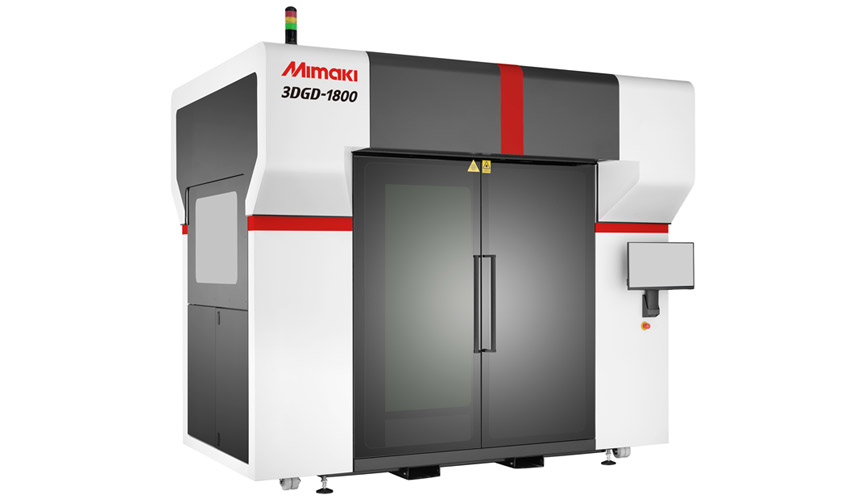 PrintersNew Mimaki 3D printer combines color and large format 3D printingIn September 2017, the Japanese manufacturer Mimaki, a specialist in 2D printing, revealed a 3D machine capable of creating parts with 10 million colours. The 3DUJ-553 met many professional requirements, especially in the design industry. Three years later, Mimaki has…
 NewsSouth Africa Opts for 3D printing to Combat Housing ShortageTo combat the shortage of housing, or simply buildings, additive manufacturing seems to be one of the increasingly popular options available today. And the South African government seems to have understood this. In order to fight against the low level…
 PrintersEpson Officially Enters the 3D Printing MarketIt’s hard not to have heard of the Japanese group Epson, especially when it comes to 2D printers. And today, it particularly interested us because the electronics giant is taking an unexpected turn in the additive manufacturing market. The company…
 ApplicationsUK Aerospace Center With Leonardo and Markforged Will Use Additive ManufacturingAerospace is a field which constantly strives for innovation and pushes the boundaries in order to produce quality results. It is also a field in which the quality, durability and appropriateness of parts is very important because of the high…