News
The ‘World’s Best Tiramisu’ Was Recreated With 3D Printing
Yes, you read that right. The world’s best tiramisu can now be made using 3D printing. This incredible dessert was recreated as an exact replica of the winner the latest edition of the Tiramisù World Cup (TWC). This time, the…
- 3 min read
- News
- Six more stories

Yes, you read that right. The world’s best tiramisu can now be made using 3D printing. This incredible dessert was recreated as an exact replica of the winner the latest edition of the Tiramisù World Cup (TWC). This time, the popular dessert was made with Natural Machines’ 3D food printer, in the city of Treviso, in northern Italy. The project is supported by the European Union, and emerged last year when the Spanish company presented its initiative to the organizers of the culinary competition.
As we know, 3D food printing is a technology that is still making its way into the gastronomic field. There are currently many solutions on the market to create 3D dishes, and some restaurants are already adopting it as a complementary method in the kitchen. Even so, there is still controversy surrounding the future of this method of food manufacturing, especially when we talk about 3D printed vegan meat. On this occasion, additive manufacturing has been used to recreate the popular Italian dessert, resulting in what could be considered to be the best tiramisu in the world.
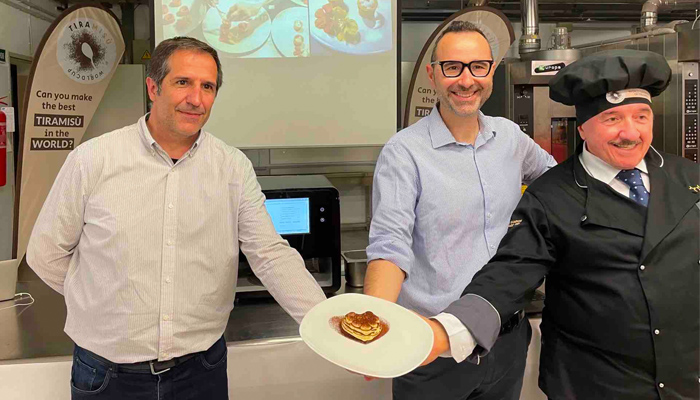
The organizers of the TWC competition with the 3D printed tiramisu
The 3D Printed Tiramisu
Devised by Italian pastry chef Stefano Serafini, this 3D printed tiramisu was made possible after several experiments in which different recipes were tested. The idea is to use the 3D technology of the Foodini machine developed by Natural Machines. Thus, layer by layer, the different mixtures and characteristic textures would be applied until the Italian dessert was achieved. Regarding the use of technology in the TWC, Emilio Sepulveda, CEO and co-founder at Natural Machines, says: “The main objective is the promotion of tiramisu within the competition environment and Italian gastronomy, as well as giving it a greater reach via 3D printing.”
More from the desk
Six other notes from the rest of the bench.
 PrintersNew Report Shows Struggling Industrial 3D Printer Sales With Hope for Better 20252024 was not the best year for the 3D printing industry. When we looked back at the trends that had marked it, turbulence was dominant throughout, with failed mergers, layoffs, leadership changes and more. This struggle has been further shown…
 NewsAMUG 2019: recap of all the reveals at the event!AMUG 2019, also called Additive Manufacturing Users Group, took place this week from March 31st to April 4th in Chicago, Illinois. The conference has its roots in the early 1990s when the founders of the Users Group were still called…
 NewsPrague Receives its First 3D Printed Tram ShelterThe infrastructure of the Czech capital Prague covers a length of 142 kilometers, on which about 991 vehicles are on the road every day, transporting both residents and tourists. Accordingly, the transport company of Prague, which operates the tramway and…
 NewsYou Can Now 3D Print The Moon and View Launch Sites in ARThe Earth has only one moon, so it has a special place in our hearts. Since landing on it (and not going back for 45 years), The Moon has remained a mysterious place. It follows us almost 400,000km away as…
 SoftwareHow to Benefit from AM Workflow Management Software: Experts Give Their Advice!As 3D printing solutions are increasingly adopted in a variety of industries, there has been a clear need for streamlined solutions to ensure that every step of the process of creating parts is optimized. Enter additive manufacturing workflow management software…
 NewsIsotropy in 3D Printing: What Is It and How Does It Affect the Final Parts?If you are part of the 3D printing industry or at least somewhat familiar with the technology, you will have heard of the concept of isotropy, which is defined as uniformity in all orientations. Thus, if we apply it to…